Una and the Wondrous Star
This is not a science-fiction adventure, though it begins among sunken stars.
It is a fairy tale — a quiet journey about hope, memory, friendship, and the people we meet along the road.
Read it slowly, as if listening to a story told by a fire on a long night.
— and stay for the afterword, where the author tells a true story of their own —
Contents
- Prologue
- 1. Where the Rocket Went
- 2. A Strange Star
- 3. The Letter
- 4. The Ice Country (I)
- 5. The Ice Country (II)
- 6. The Veiled Elder
- 7. The Witness
- 8. The Country of Fragrance
- 9. The Land of Kidnappers
- 10. The Yeti
- 11. The Forest Country
- 12. cuna
- 13. The God of Sound
- 14. The Cliff of Illusions
- 15. The Sea of Fire
- 16. The Ark
- 17. Back to the Old Star
- 18. Epilogue
- Afterword
Cast of characters
- una (U-na) — at first the name of a species; later it becomes the protagonist's own name as well. A small traveler from a star sinking beneath the water, in search of the rocket and the companions left behind.
- huna (Hyu-na) — once the Queen of the Ice Country; she travels at una's side.
- uma (U-ma) — the brown horse, swift beyond reason; it once raced under the name "Eclipse."
- the Nose — the master perfumer of the Country of Fragrance, who can smell out anyone alive.
- the yeti — the gentle, faceless snow-giant of the mountain.
- cuna (Kyu-na) — a curly-haired girl who walks on air, raised on a book of riddles; illusions do not work on her.
- suna (Su-na) — the God of Sound, a black-haired girl on the mountain who understands the speech of all living things.
- the Veiled Elder — the veiled old man who stands above all the priests of every land.
- DUNA (Dyu-na) — two sisters, one orange-haired and one white-haired, who keep the border between heaven and hell at the world's end.
Prologue
This is a story from far away. From very, very far away.
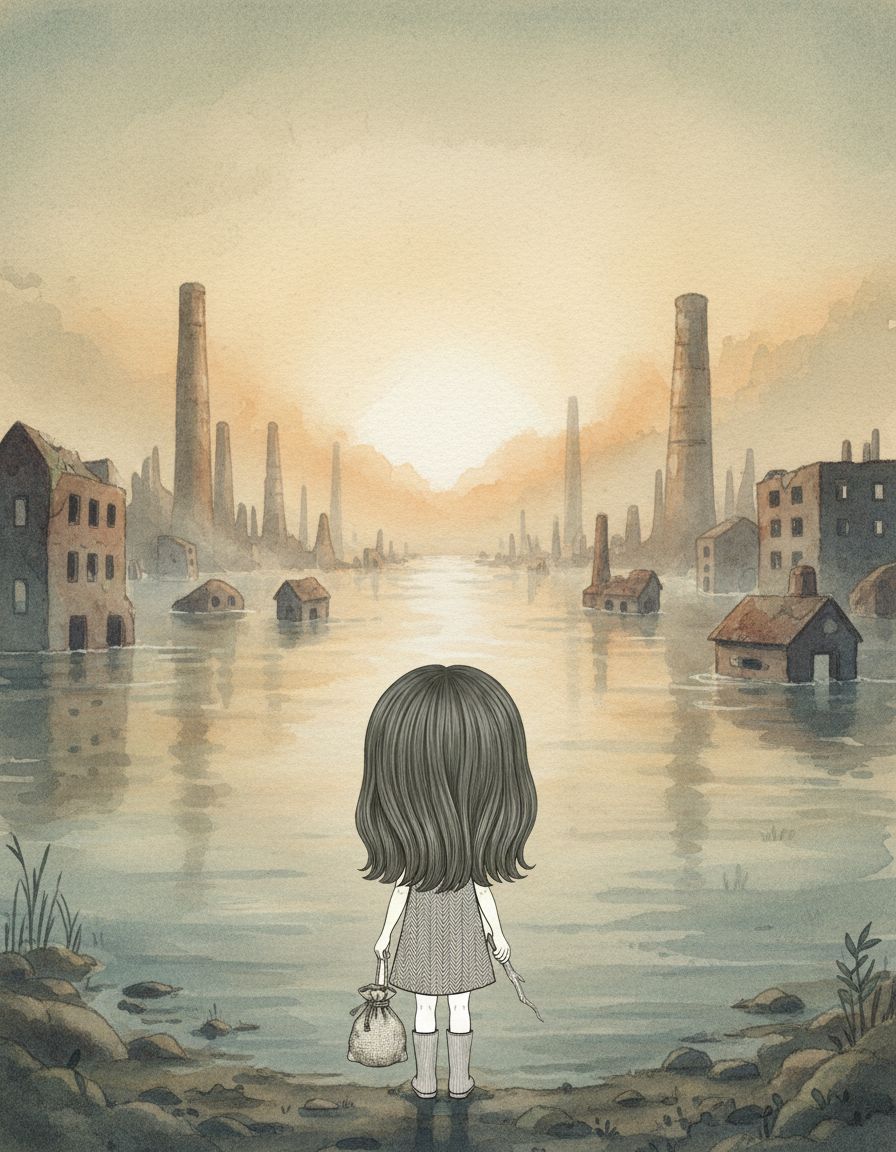
On that star, the people of the civilization that had once flourished there were gone. The factories no one used anymore, the ruined towers — nearly all of them had sunk beneath the water. The living things, who must once have been many, had quietly vanished too.
And yet, on that star, small creatures — the Unas — had lived for generations. But the place where the Unas lived was slowly sinking under the water as well.
So the Unas decided to build a rocket, to set out for a different star. A great rocket, one that could carry as many Unas as possible.
Without anyone giving the order, the Unas began carrying the parts the ancients had left behind out to the little dry land that remained. The parts lay scattered all through the sunken factories. The amount was beyond reckoning. Still the Unas carried them, without a word of complaint, every day, every day. Through rain, through wind that blew them off their feet, every day, every day. It seemed it would never end.
— Then one day, after a great many years had passed, the Unas at last stacked the parts into the shape of a rocket. It had taken so long that water had pooled even on the dry land, and the ground beneath their feet was soft with mud.
The Unas threw up their arms and cheered, and climbed aboard. They had all built it together, yet only fifty or so could fit inside. The Unas who could not get on looked up from below, waiting for it to fly.
They pressed the button with all their might, but the rocket did not stir. — It had only been stacked up; of course it would not move.
The muddy ground beneath bubbled and frothed. One Una noticed and cried out. As everyone watched, the ground could not bear the weight of the rocket, and tilted, with a lurch —
Boom. With a tremendous sound, the rocket toppled over. The Unas gathered below, and the Unas inside, were all crushed beneath it.
The Unas who had escaped being pinned stood stunned at the sound for a while, but before long they began to carry the parts again. To stack them up, once more. There was no dry land left nearby now, so they carried them far, far away. Again it took many years.
It collapsed, and they stacked it; they climbed aboard, and it would not move. Each time they rejoiced, and each time they built it anew. The long rains came, and the dry land all but disappeared. How much time had passed, no one could say anymore.
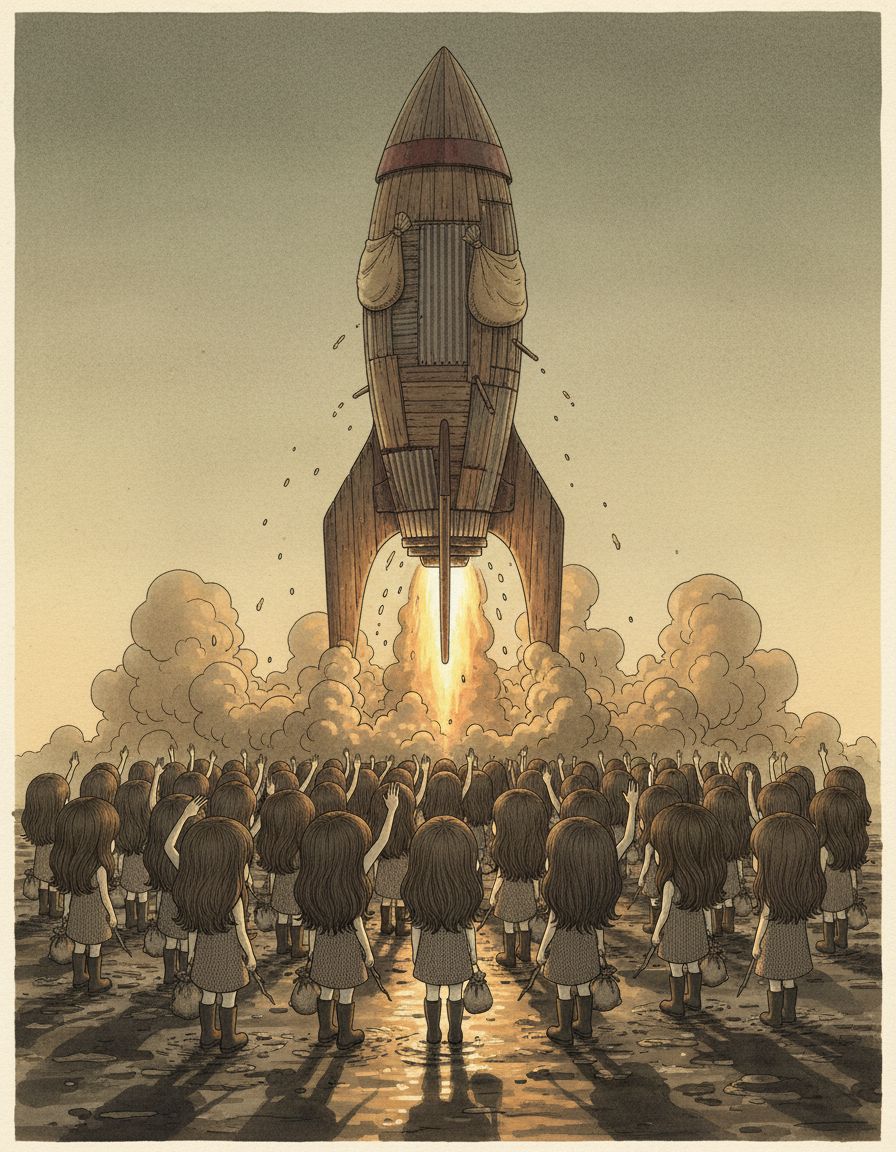
Even so, the Unas stacked it up again. From the ground sunk beneath the water, as everyone watched from afar (— they would not come close now), one Una pressed a switch, and it hummed; the next Una started the engine; the next pulled a lever, and smoke billowed up — and when the red switch was pressed, the rocket at last rose into the sky.
The Unas below let out a great cheer in the smoke. Where it was headed, no one knew. The Unas left behind were simply, simply glad, and they went on calling out to the emptied sky, on and on.
1. Where the Rocket Went
Boom — and the rocket vanished into the sky.
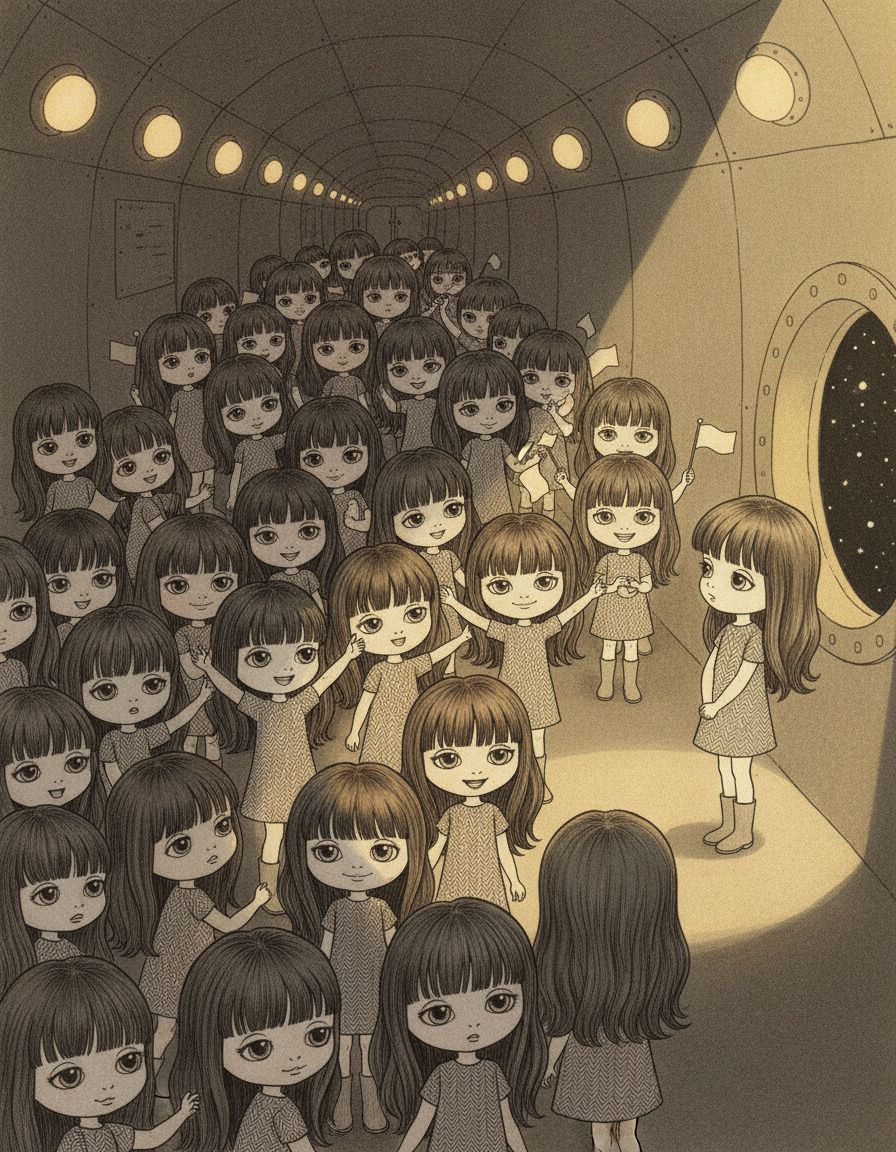
Inside it, rattling and shaking, the Unas began a feast.
(A feast, though there was nothing to eat and nothing to drink.)
One Una proudly beat a drum; one kicked their legs and danced; one kept giggling without end. Every one of them was glad beyond bearing.
Now and then the rocket gave a lurch, but even that shudder seemed to be swallowed up by their hope and excitement.
Only one Una, though, was somehow different.
They made a racket like all the rest — but they were singing, all the while.
The Unas love sound. They are fond of singing, of beating drums. So there was nothing unusual about one of them singing.
What made this Una different from the others was — they would not stop.
The other Unas, after making merry to their hearts' content, grew tired and fell asleep; but this one Una alone went on singing, without rest.
— Now, this rocket had a troubling thing about it.
There was nothing to eat. Nothing to drink. All it carried were drums, scraps of cloth, fishing gear that looked of no use, and small empty jars. Nowhere had its course been set. And there was not much fuel, either.
In other words, the rocket, as it was, would arrive nowhere.
But the Unas aboard had noticed none of this. They made merry and slept, woke and made merry again. One Una grew so excited they slid off their seat again and again, rolling with laughter.
The passages and walls all held lights within them, so everywhere inside the rocket was bright, and the Unas were wrapped in a feeling of perfect happiness.
Boom, boom went the drum — a tiny uproar in the middle of the silent universe.
The Una that kept singing grew hoarser and hoarser.
This Una had convinced themselves of something:
(If I stop singing, I will die.)
Where they had picked up such a mistaken notion, who can say. To anyone watching, it was rather the not stopping that looked likely to kill them.
Even as the other Unas woke and gazed happily out at the windows where nothing could be seen, that Una wrung out their faint voice and sang.
And the rocket carried such Unas as these, on and on.
— And in that time, how were the Unas left behind on the ground?
The Unas who had cheered, hurrah, hurrah, gazing up at the sky and never tiring of it. The rocket of hope had already flown away.
There was just a little food and drink. They shared it among themselves. At night they all climbed into the hollow where the rocket had stood, and slept. When morning came, they looked up at the sky again. Before long one would begin, hurrah, and finding it fun, the others would begin too, hurrah.
— Anyone who has ever kept a small creature may understand. A small creature is loath to show when it is weak. Show weakness, and another creature is upon it at once. So it keeps up a brave front, to the very last.
And so it was with the Una.
Now, back inside the rocket.
Most of the Unas simply passed the time merrily. Very rarely, boom, a drum would sound.
And that Una, the one that kept singing — why, they had risen from their seat and were walking as they sang. They tottered. Hardly any voice was left to them now.
They had thought: (Since no voice will come, I must sing where there is no sound.)
Slipping between the seats, they came to the very front, and with unsteady steps began to climb a ladder. The same ladder they had climbed when first they came aboard. With great effort, they reached the room one floor above. But the sound from below still reached them, so they tried to go higher still — only, that strength was no longer left in them.
To make even a slightly bigger sound, the Una climbed onto a white stand in the room — and, with no strength in their limbs, they fell. Even as they rolled, still they did not stop singing.
Just then, beep beep beep beep, an electronic tone rang out.
In falling, they had struck against something.
The Una thought a bird was singing.
Hearing it, the Una at last stopped singing.
— Now, even if I do not sing, the bird sings in my place, so it is all right.
And thinking so, they closed their eyes, and never opened them again.
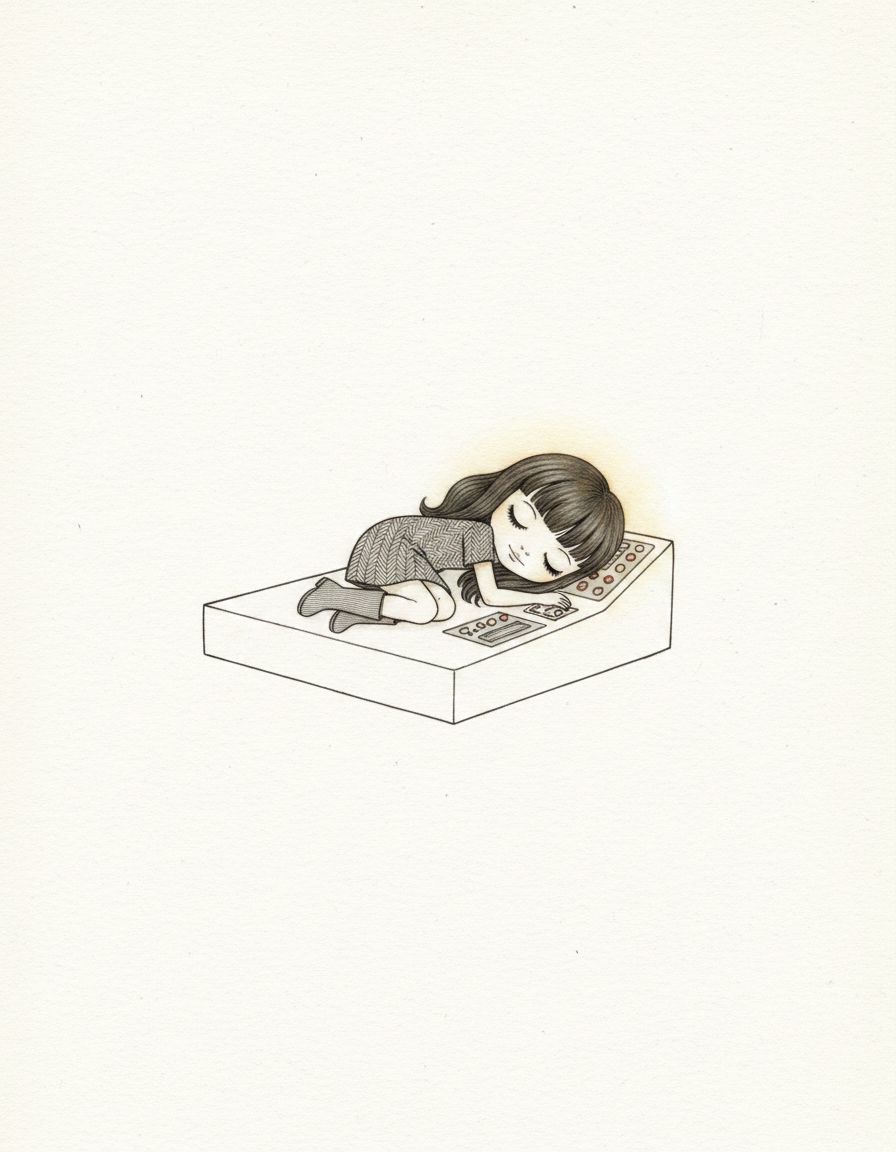
It was the switch that, of itself, changed the rocket's course.
The rocket swung hard and turned.
— Perhaps that Una's mistaken notion had been right, after all. For if everyone had stopped singing then, they would all have died inside a rocket bound for nowhere.
Of course, that Una surely had no such thing in mind. They simply could not help but sing. That was all.
But "being like an Una" — that, surely, is just this kind of thing.
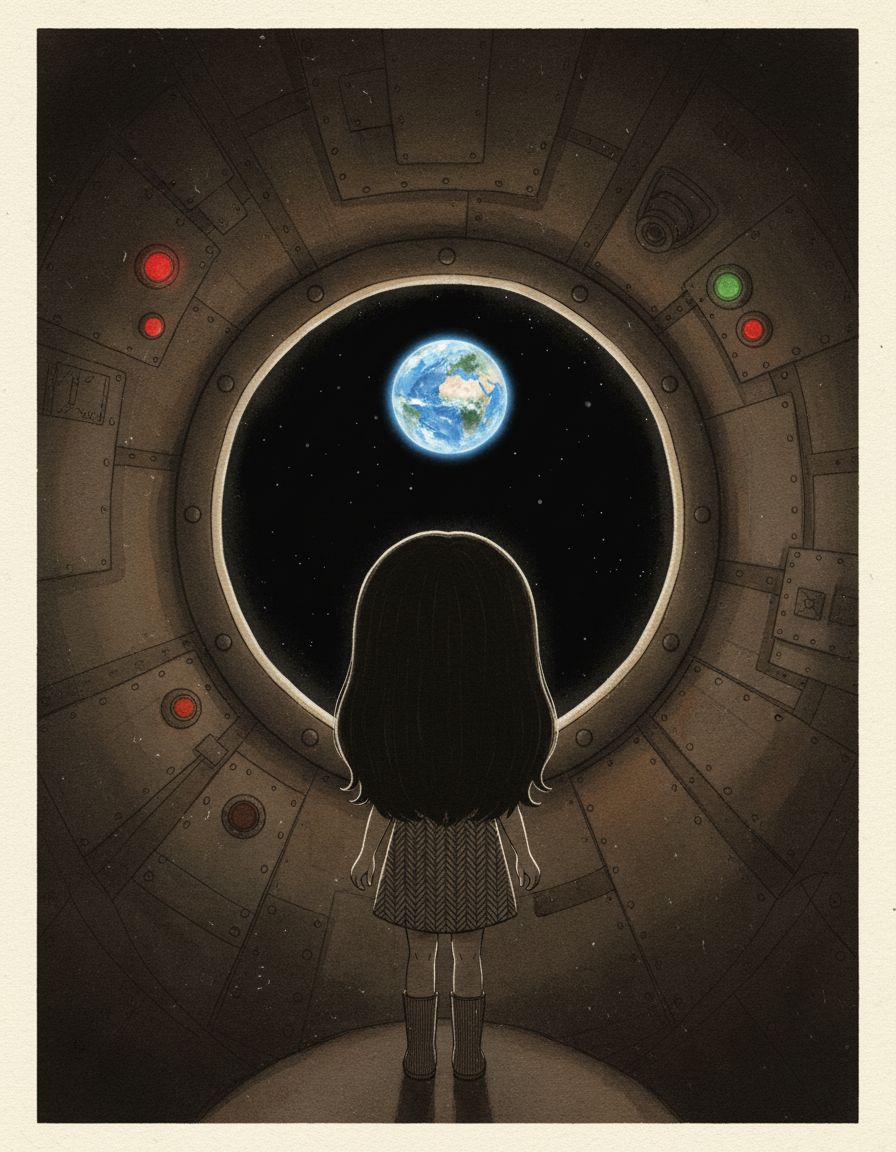
Ahead, a star came into view.
A blue, beautiful star.
The Una below who spotted it gave the drum one small boom.
2. A Strange Star
The rocket groaned, swinging this way and that as though shaken by a great hand. Then, with a tremendous crash, everything inside went dark — and all the Unas lost consciousness.

One Una finally woke. They had struck themselves somewhere, and their nose was bleeding. Feeling about, they found they were inside a luggage rack. They crawled out unsteadily, and were astonished. — There was not a single Una left in the rocket.
"Hello!" they called out loud, thinking the surprise might bring someone out. But there was only the lukewarm air and the dark. Their belly growled, and their throat was parched.
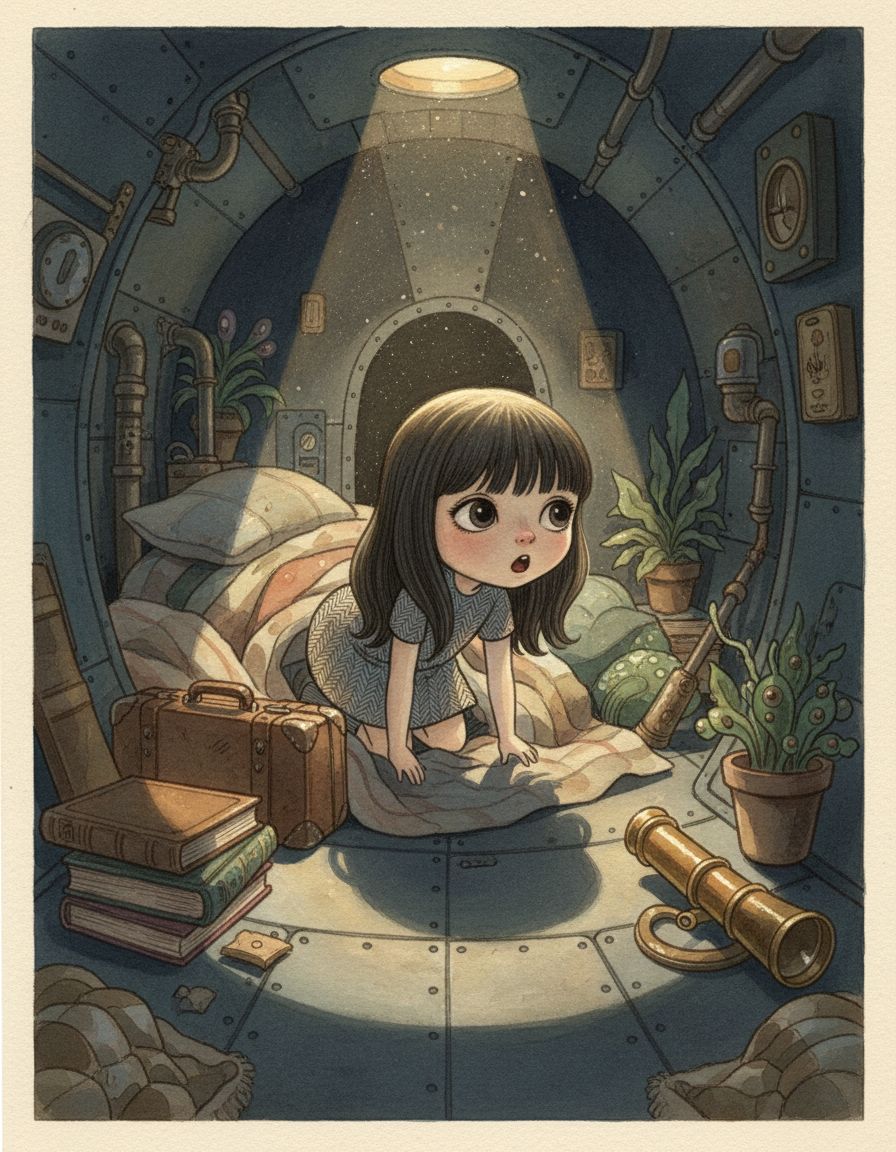
Even so, the Una held just two thoughts, dimly, in their mind. One was to find a place where everyone could live. The other was to bring the companions left behind on their homeworld there. Where everyone from the rocket had vanished to, they did not know. There was nothing but things they did not know. But this much the Una knew: — if you do not move, nothing moves forward.
The Una climbed to the very top and opened the hatch.
Beyond it was a world of trees. Trees tangled in layer upon layer, and the ground was nowhere to be seen. Peering down, there was only bottomless dark. Up in the sky, through the small hole the rocket had punched, a star was just barely visible. It seemed to be night. Even the place where the rocket stood was part of a colossal tree.
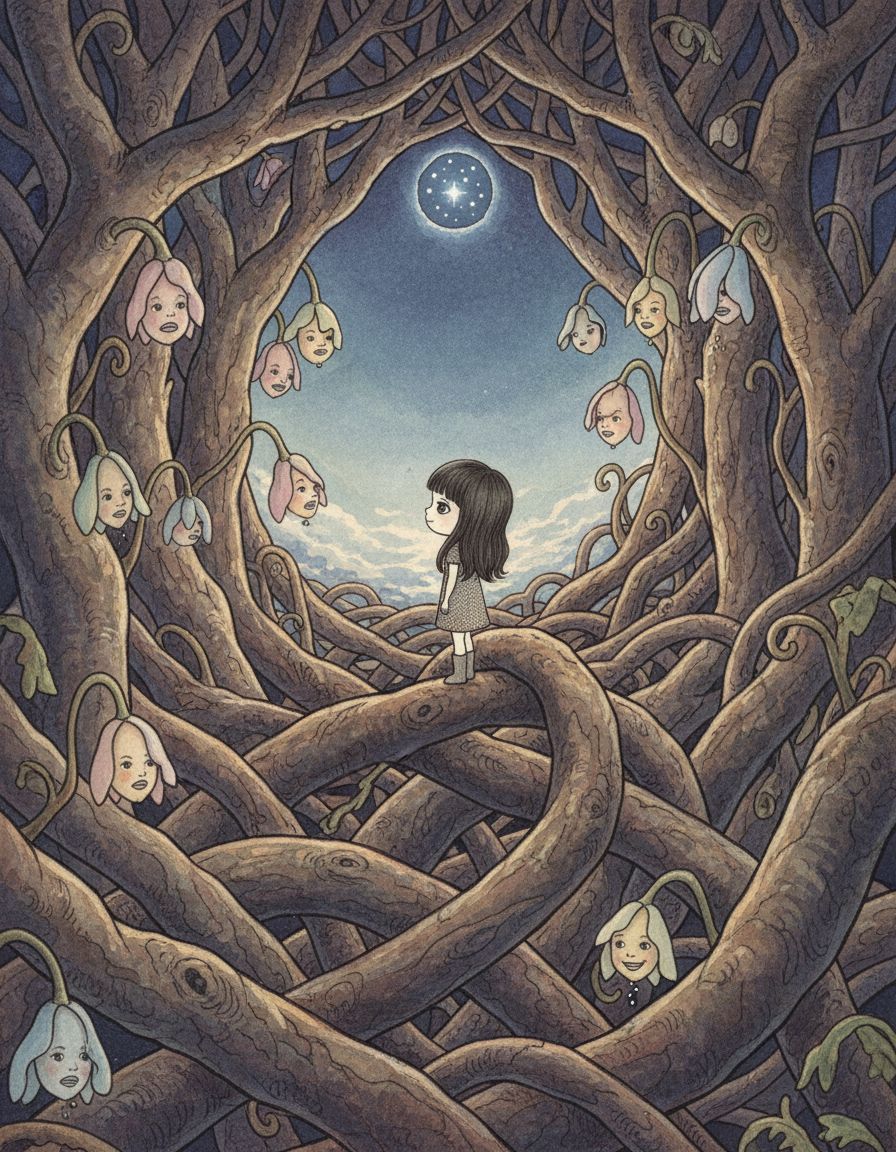
As they padded along, flowers with faces hung down before them.
"Oh my?" said one flower. "There they go again," said another. "And they don't even know," said yet another.
The Una walked on, paying them no mind. When they looked back, the rocket was already out of sight.
"H-hey, you there!" came a shrill voice. But no one was about. Down at their feet, a very small, fat man was raging, his face bright red.
"You there — barging into someone's home as you please! Everything on this side of that door is my house — it says so right here!" he cried, brandishing a little scrap of paper.
Paying him no mind, the Una looked around: from a black crack in a tree, syrup was flowing, and a great many creatures were swarming over it.
"…Don't drink that," the man said suddenly. "Drink that, and you forget everything that matters."
Sure enough, the creatures that drank the syrup tottered and, one after another, fell from the tree.
"Get past that tree, and there's everything — to eat, to drink, whatever you like."
The Una slipped between the entranced creatures. Not one of them so much as glanced at them.
All at once, the forest opened up. It was full of great mushroom houses and shops. There was a smell of food, but not a soul in sight.
The Una entered the tallest mushroom, the one that smelled best. Inside it was empty, with a thin silver pillar rising to the ceiling. When they climbed onto a knob of the pillar — whoosh, they shot up and up. When they were about to fall, a belt caught hold of them. Ding.
On the table before them sat a fragrant soup. "Welcome to our restaurant. A soup of lily bulb and leek," said a voice from a small hole. The Una lapped it right up.
Whoosh again. "A fresh salad." "Lime sorbet." "Salmon mousse." "Roast beef." "Bread." "Wedding gâteau." — They cleared each dish as it came, rising higher and higher.
"Today's main course: braised beef short rib in tomato." This too, clean to the plate.
"And now, at last," said the hole. "To which would you prefer to be fed? The tiger, or the lion?"
The Una was startled. — All they had eaten, they now understood, had been to fatten them for the tiger or the lion.
"If you have no preference, let us say the tiger." Whoosh. Up to the final floor.
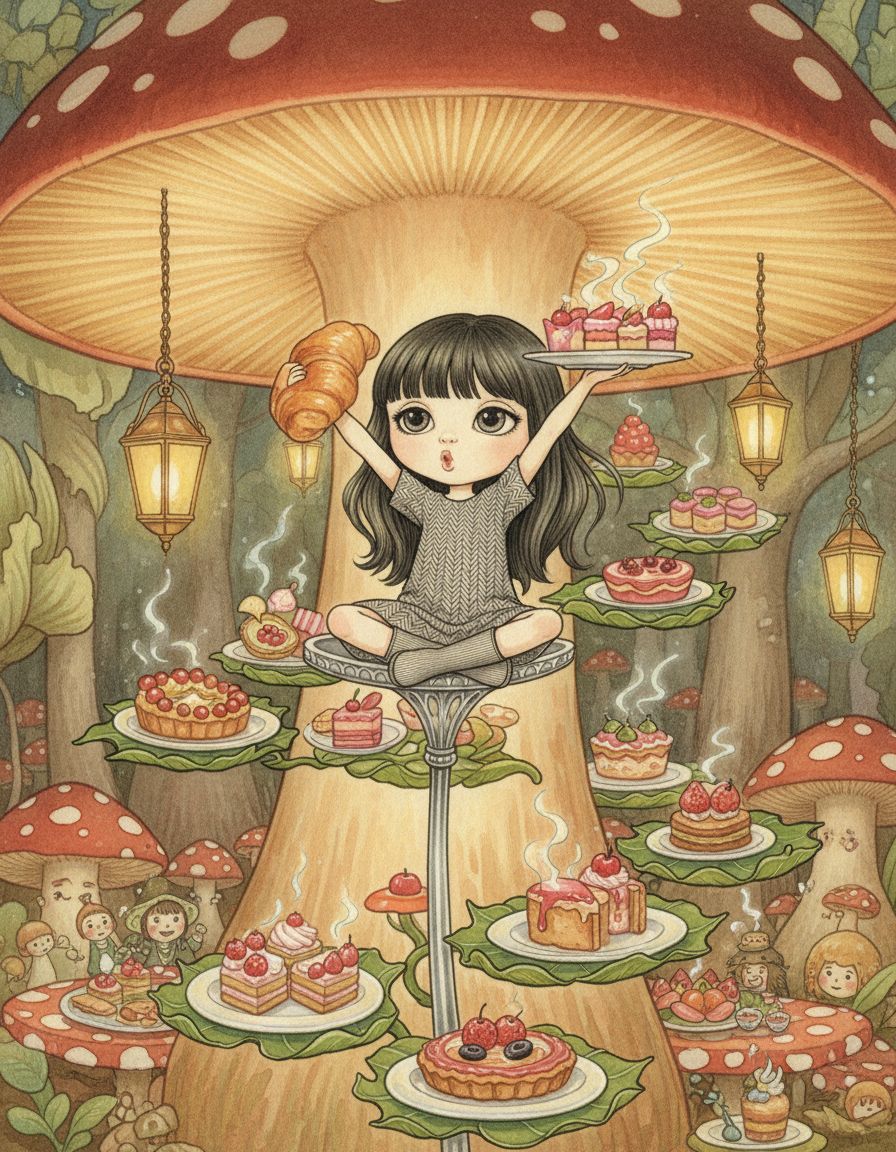
It was a jungle. Bound to their chair, the Una braced themselves. A low growl — and another, and another. There must be many tigers, they thought.
But the tiger that appeared was only one. Only, that tiger had a great many heads. Each of them growled, roared, and glared, all at once and without rest.
The Una glared at the fiercest-looking face and puffed out their cheeks. The tiger, unconcerned, swiped at them with a forepaw. A great deal of blood ran from the Una's body. The nearest head opened its jaws to crush them — when, just then, "RAAAAGH," the topmost head roared, and the nearest head drew its mouth back.
The Una's awareness slipped quietly away.
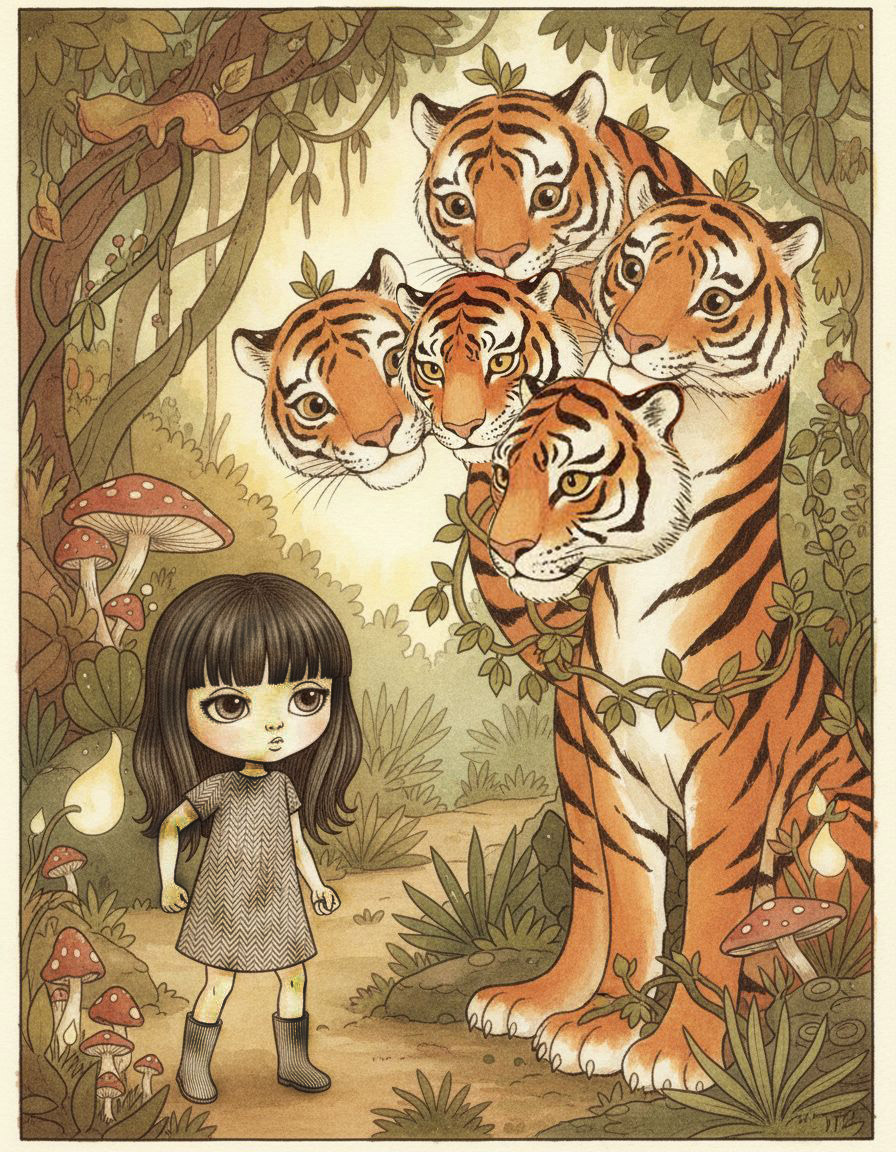
When they woke, the Una was atop a great dandelion. Their clothes were in tatters, but their wounds had closed.
"Don't get the wrong idea." "Don't get the wrong idea, now," said the tiger. What the topmost head said, a sly-looking face at the lower right repeated after it.
"I mean someone who looks just like you!" "Just like you!" "That one tricked me!" "Tricked me!"
— Long ago, someone resembling the Una had promised to cut the tiger's heads apart. But it had gone into a capsule and never come out. Tricked me, said the tiger.
"I'll devour that one alive!"
A dim place, ringed by rocks. Held by the scruff of the neck, the Una was slammed against the stone.
"Get that one out, and I'll spare you! Get that one out!"
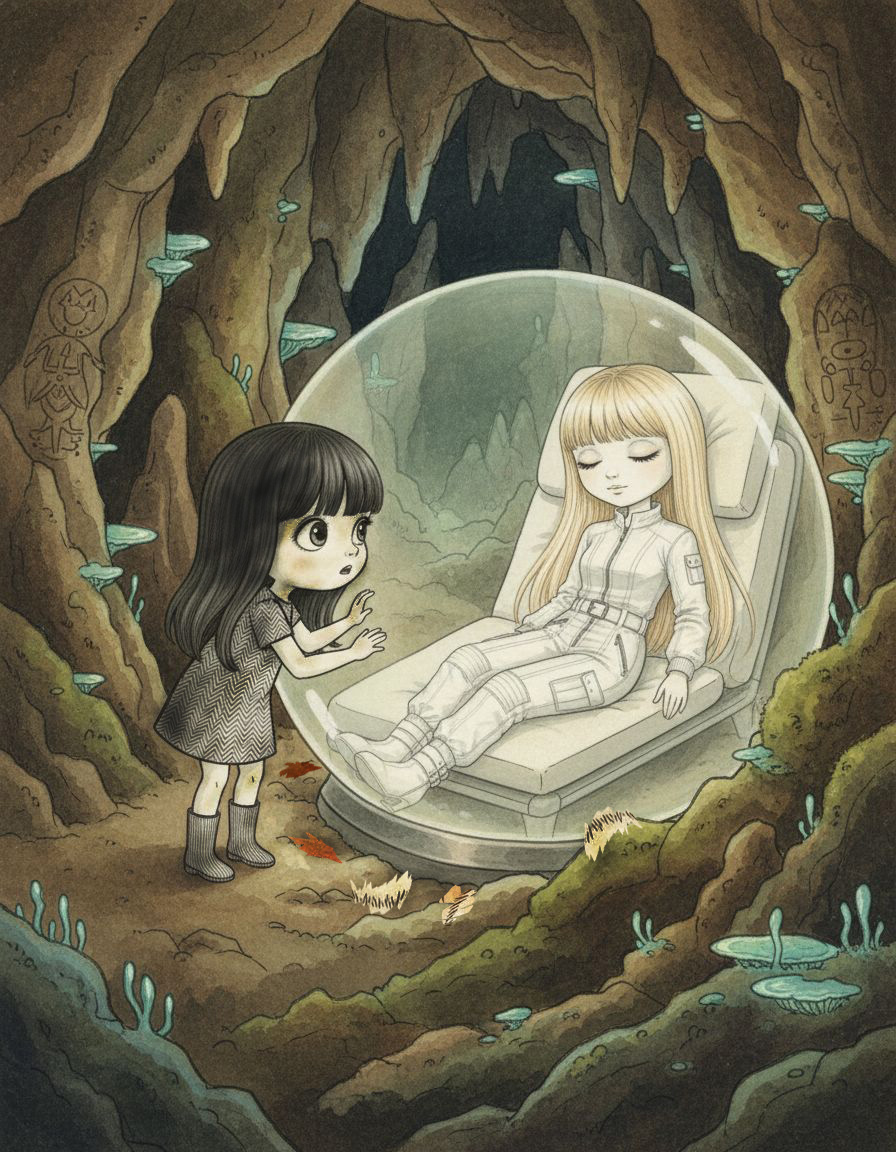
When the Una looked at "that one" — a transparent capsule. Looking inside, they were so astonished their legs nearly gave way. A creature exactly like themselves, with platinum-colored hair, lay sleeping in a white pilot's suit.
All around lay chips of tiger fang and great clumps of fur. The tiger must have tried, over and over, to break it open.
"Lay your hand on it and open it!"
The Una was cornered. If they did not open the capsule, they would be torn apart. If they did, this creature would be killed.
At such a time, what does an Una think? — Most likely, nothing at all. They simply move as they feel. And that, not seldom, is what opens a way through.
All at once, the Una began to giggle. The laughter grew and grew, until they were laughing so hard they could not stand.
One of the glaring tiger-heads was drawn in despite itself: "Pfft." "Who laughed?!" the top head bellowed, and a hush fell — which only made it stranger, the rule that one must not laugh.
The Una abruptly put on a solemn face and, for no reason, gave a little bow. Everyone looked away. But then another head went, "Hff."
And now the Una came into their own. Bowing deeply, they began to sing — horribly, dreadfully off-key. (Happily, this Una was tone-deaf to a fault.) The other heads could no longer hold it in, and laughed.
"Don't laugh!" "I'll bite you to death!" they screamed, but it was no use. It must have been a long, long time since they had laughed at all. And with the laughter, the fear that had ruled the tiger-heads began to thin.
"Let's eat them now." "This one is mine." "It's an order." "Not yet." — The heads began to quarrel and bite at one another. Different heads, but one body. Twitching and convulsing, the tiger at last collapsed.
Seeing it, the Una sang — off-key still — a song of grief.
The Una laid their hand on the capsule's handprint.
The capsule opened without a sound —
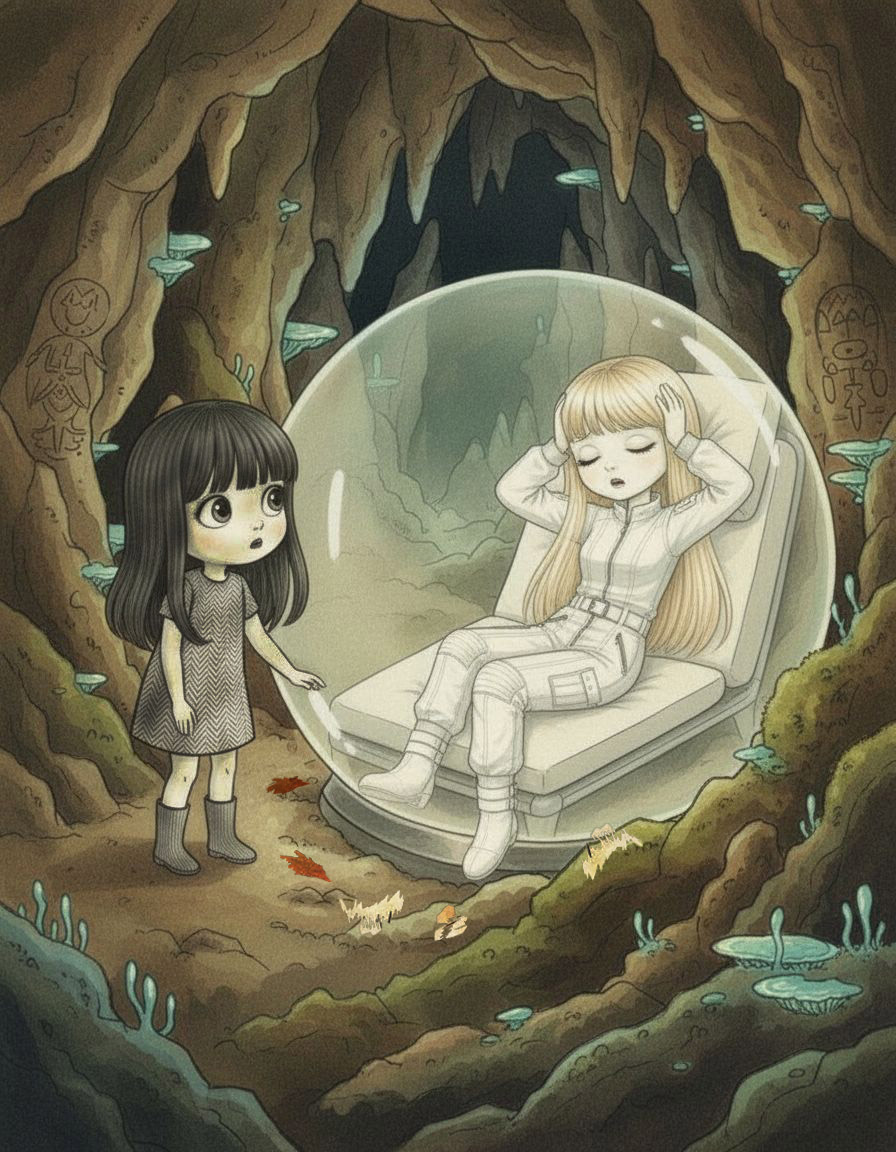
and the creature with platinum-colored hair, exactly like them, dimly, opened its eyes.
3. The Letter
The creature blinked slowly, several times, as though it could not bring its eyes into focus.
The Una drew their face close, sniffed at it, and then asked, "Are you all right?"
The creature spoke in a hoarse voice.
"I am… huna. Of the Ice Country…"
She closed her eyes, thought for a while, and then, as if giving up, murmured, "…I can't remember," and fell silent.
The long years spent in the capsule had robbed her of her memory.
"I know a place to rest," said the Una. When the tiger had wounded them, lying on a dandelion had eased the pain — that was what they remembered.
Lending a shoulder to the limp huna, the Una set off walking.
Suddenly the smell of blood grew strong. Turning, they saw — the tiger, that should have been dead, creeping slowly closer. Most of its heads did not move, but the topmost head alone, with a terrible look, glared especially at huna.
The brave Una snatched up a stick and charged with a cry — and at once fell, vanishing into the grass. The tiger paid the tumbled Una no mind, and bore down on huna.
When the fallen Una lifted their face, a wild-tempered brown horse was looking their way. Without hesitation the Una leapt onto its back. As though it had been waiting, the horse vaulted the grass, snatched huna up and set her upon its back — then, in a single bound, cleared the tiger and galloped away. The tiger collapsed, and never woke again.
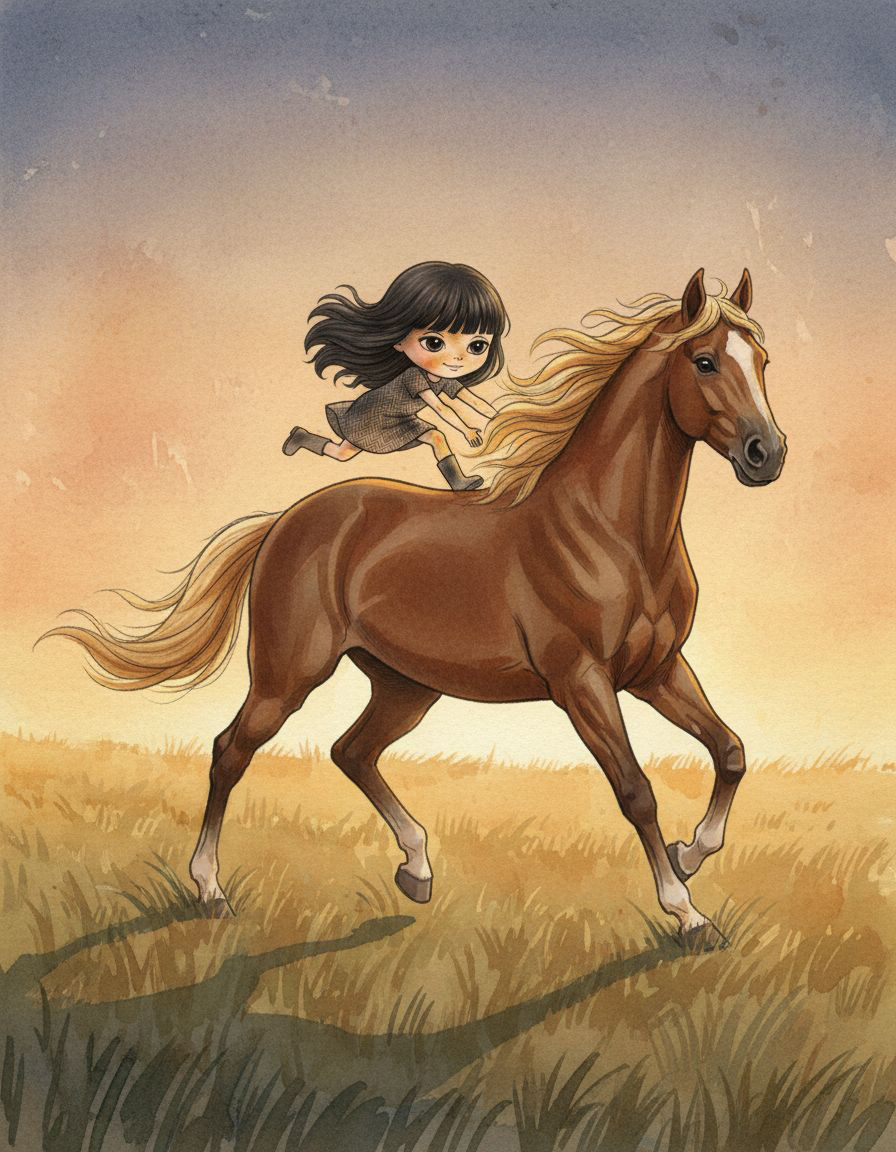
The horse set the Una and huna on a dandelion and sat down at its root. It had not only saved them — it had carried them all the way to a dandelion. (It's almost as if it knows what I'm thinking,) the Una thought.
There is a strange power in a dandelion. As the two slept upon the flower, their wounds healed, more and more. The horse seemed to keep watch.
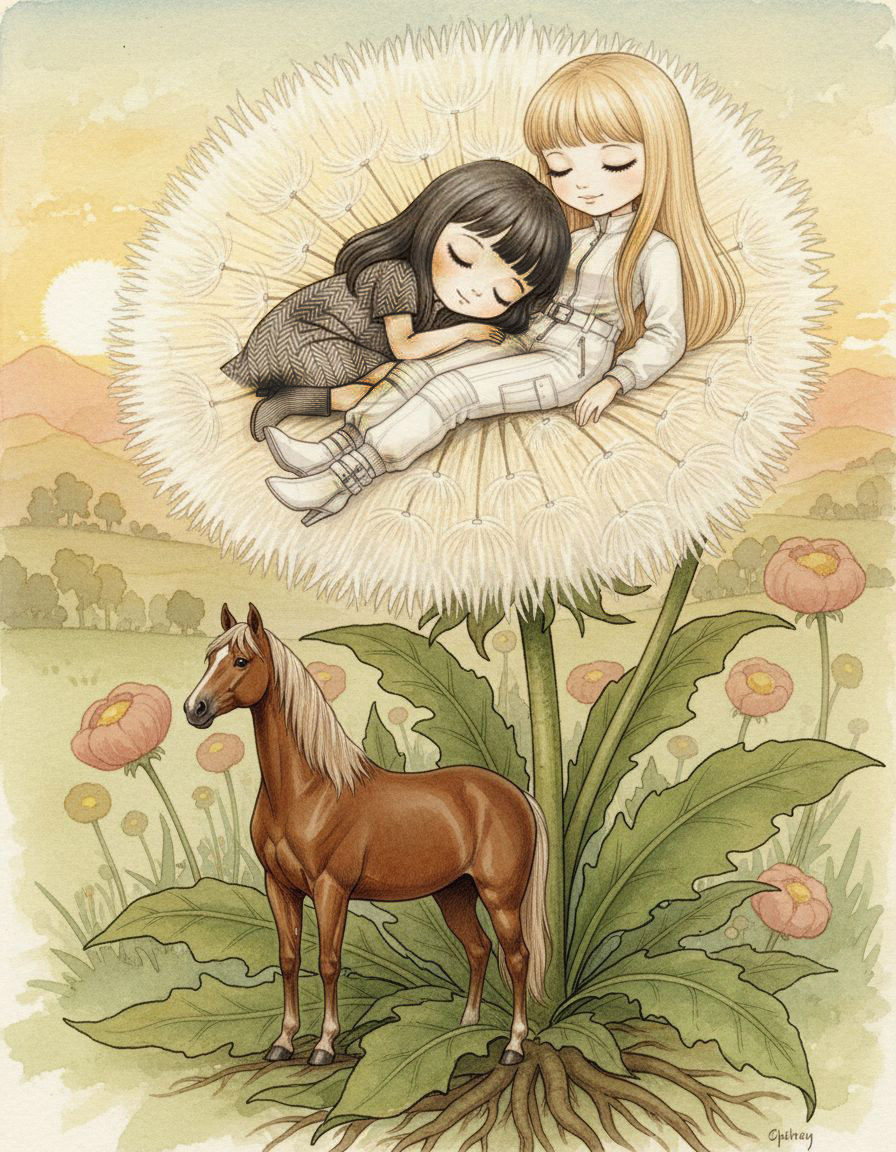
When huna woke and noticed her ragged clothes, the very first thing she did was frown.
"I am not one to let myself be seen in such a state."
The Una did not understand what the words meant. But seeing huna well again, they smiled and smiled.
"We must return to my castle quickly. The Ice Country. You know of it, surely?"
"Don't know."
huna let out a small sigh.
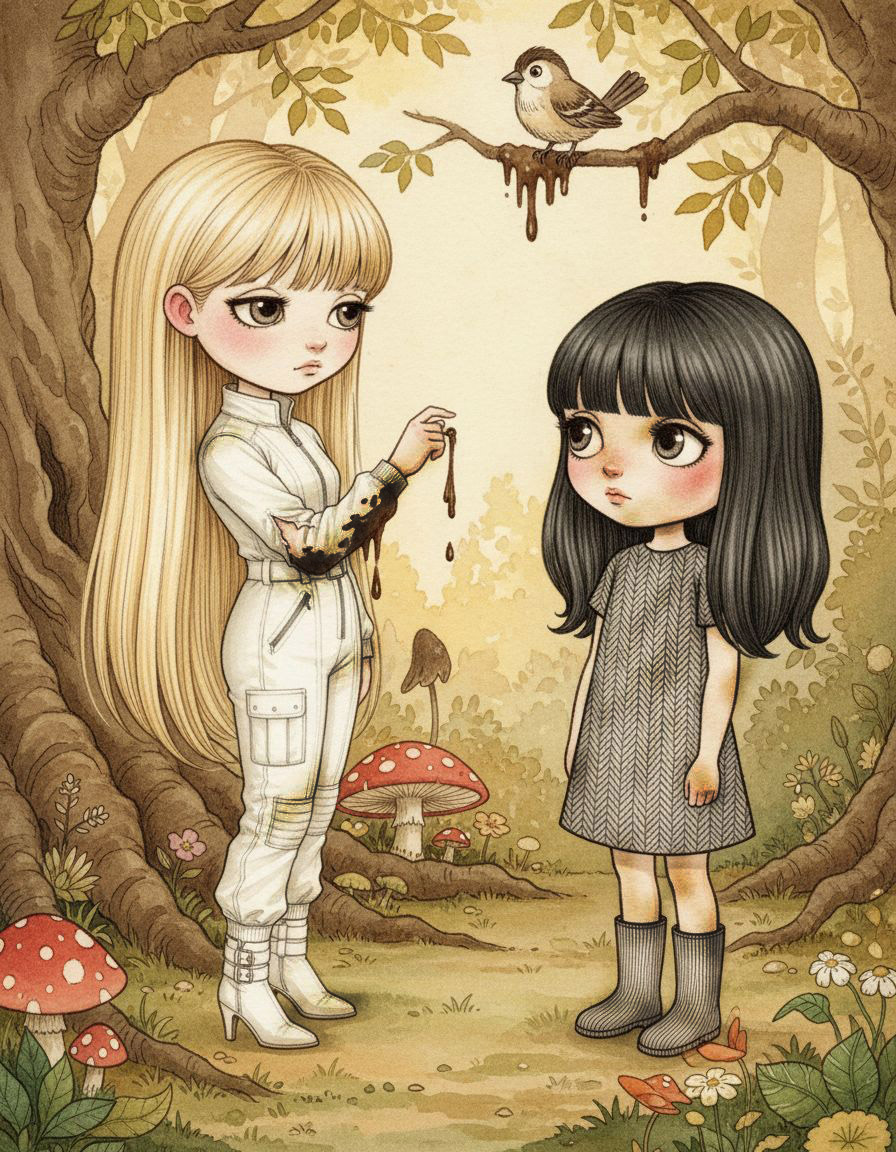
"By the way — what is your name?" asked huna.
"Una!"
"That is the name of your kind, surely," said huna, a little exasperated. "Tell me your own name."
The Una was at a loss. The Una was an Una, and had always thought of themselves as an Una. If that was not an Una, then what were they?
Seeing the Una look anxious, huna changed the question. "…Well, never mind. What is it you are doing?"
And so the Una told her, with all their might. How their star was going under the water, how their companions had disappeared, how they had to save everyone — by the time huna had heard the Una's rambling tale to its end, it was deep in the night.
Now and then huna grumbled, "This is long," but she listened, patiently, to the very end. And then she said:
"To repair a rocket, you'll need money."
The Una was troubled. They knew what money was, but had none.
"If I return to my castle, we'll manage somehow. — There's no reason that one such as I could not help you."
She tipped up her chin — yet there was, in her voice, the true ring of responsibility.
The Una came to like huna entirely. Not because she would help them. — She was the first who had ever listened to their story to the end. They felt as though they had gained an older sister, the Una thought.
"First, let us escape this place," said huna. "When night falls, two holes open in the mushroom tower that lead outside. Slide down one of them, and you can get out."
huna was startled by the words she had spoken without quite meaning to. — How was it that she knew such a thing?
The company slid down the mushroom's holes, spiraling round and round. Their heads spun. Even dizzy, huna would not stop explaining. "Below these trees a sea spreads out… and at its bottom is the Ice Country."
At the exit they gathered nuts for the long journey ahead, and entered the crack of the thickest tree. Inside, it had been carved into steps that wound down and down, without end.
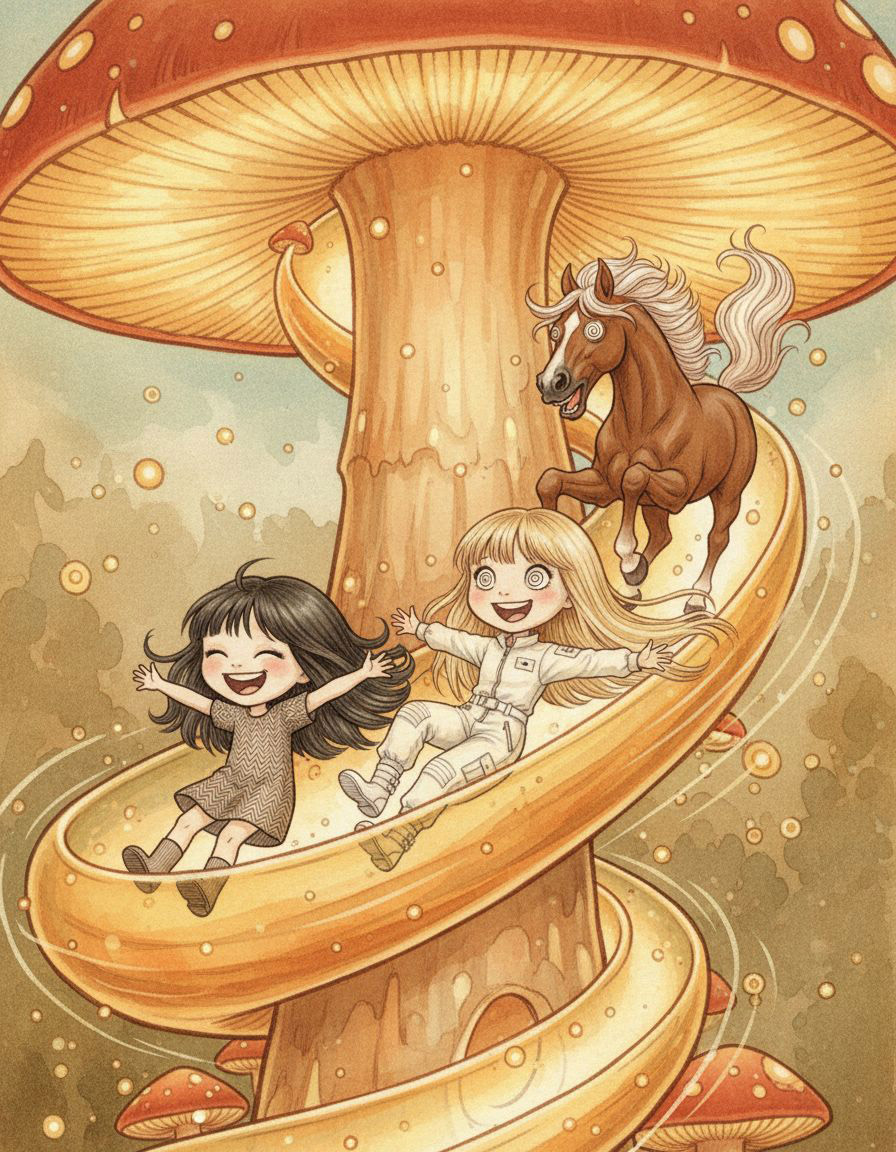
Down through the dim trunk they went, in silence. Look up or look down, it was the same spiral stair. It even seemed they might be circling the very same spot. Their nuts ran out, too.
The Una, bent only on keeping up with huna, walked in a doze — until at last they fell asleep on their feet. The horse behind deftly took the Una in its mouth and set them on its back. huna, too, was at her limit, and came to herself on the horse's back. There, the Una clung on, sleeping soundly. The horse went down the stairs, on and on.
The Una caught the smell of the tide. The horse, too, grew unsteady on its feet, and huna decided to rest.
In the trees nearest the sea's surface, edible fruit sometimes grows. huna felt along the wall and found "sleep-fruit." A strange fruit: eat one, and you gain half a day's sleep. Ten in all. The Una and huna two apiece, the horse three, and the last three kept in reserve, one each.
When they put them in their mouths, the dull ache in their heads vanished clean away. Everyone felt wonderfully well, as if by some trick.
Like this, it seemed they could walk anywhere at all.
The spiral stair led, before long, to a station for a train that ran along the sea floor. The company boarded. Outside the windows was a deep, deep blue. Beside the sleeping uma, the Una, too, began to nod off.
"Wake up," huna whispered softly. "At the next station, let us get off, just for a little." — And as she whispered it, huna's face was grave.
— The truth was, huna's memory had come back to her. That she was not the Queen of the Ice Country — but a swindler, pretending to be the Queen.
(I cannot set foot in the Ice Country.)
(There is one way, and only one.) — huna was turning over a terrible plan.
So as not to wake the sleeping uma, huna took only the Una and stepped off the train. The clear domed station read《 Museum Annex 》. There was no one at the gate, nor in the waiting room.
When they entered the white, glass-walled building, the walls and ceiling were all glass, like the bottom of the sea. Fish she had never seen drifted to and fro. The Una pressed their face to the glass in delight.
"Well now — how splendid." The wrinkled pig of a curator was standing behind them, without their having noticed.
"Listen. I have business to discuss with this gentleman. Would you go and play by yourself, just for a while?" huna said to the Una.
The Una, smiling and smiling, began to play with the ice.
"Buy that child from me," huna said to the curator.
"By all means. Your kind are a rarity, after all. I shall pay a fine price." Beaming, the curator disappeared into the back.
When huna was left alone, the Una came running back to her, delighted.
"huna, let's go now." "Una's star is dying." — The Una's face was serious.
huna could not meet the Una's eyes.
The pig of a curator came back. "About what we discussed — there has been a small change of circumstance, you see." He thrust out a thick arm — and what he seized was huna's.
"Now then. You alone will do nicely — but what shall it be? That child as well, while we're at it?"
huna lowered her eyes and murmured, "…Let that child go."
"huna!" the Una cried, but the thick glass no longer let the voice through. Beyond the glass, trembling violently, huna still waved to the Una, again and again and again.
With an air of nuisance, the curator pressed a single sheet of paper into the Una's hand. "That child says she'll come to the Ice Country later. Take the train again, and meet in the Ice Country. — There now, off you go."
(It was a sham letter, written by the curator to be rid of the Una.)
The Una could not read. But this was their first ever — a "letter." For the next train fare, the curator pressed a check into their hand as well.
The Una felt that something was odd. But if huna had said "meet in the Ice Country," then they had to hurry.
Boarding the next train, the Una gazed at the white building they had just left.
And then, from it, a small box of glittering silver was launched. Its bubbles caught the light, until it seemed the very sky was frothing.
— What that was, the Una does not yet know.
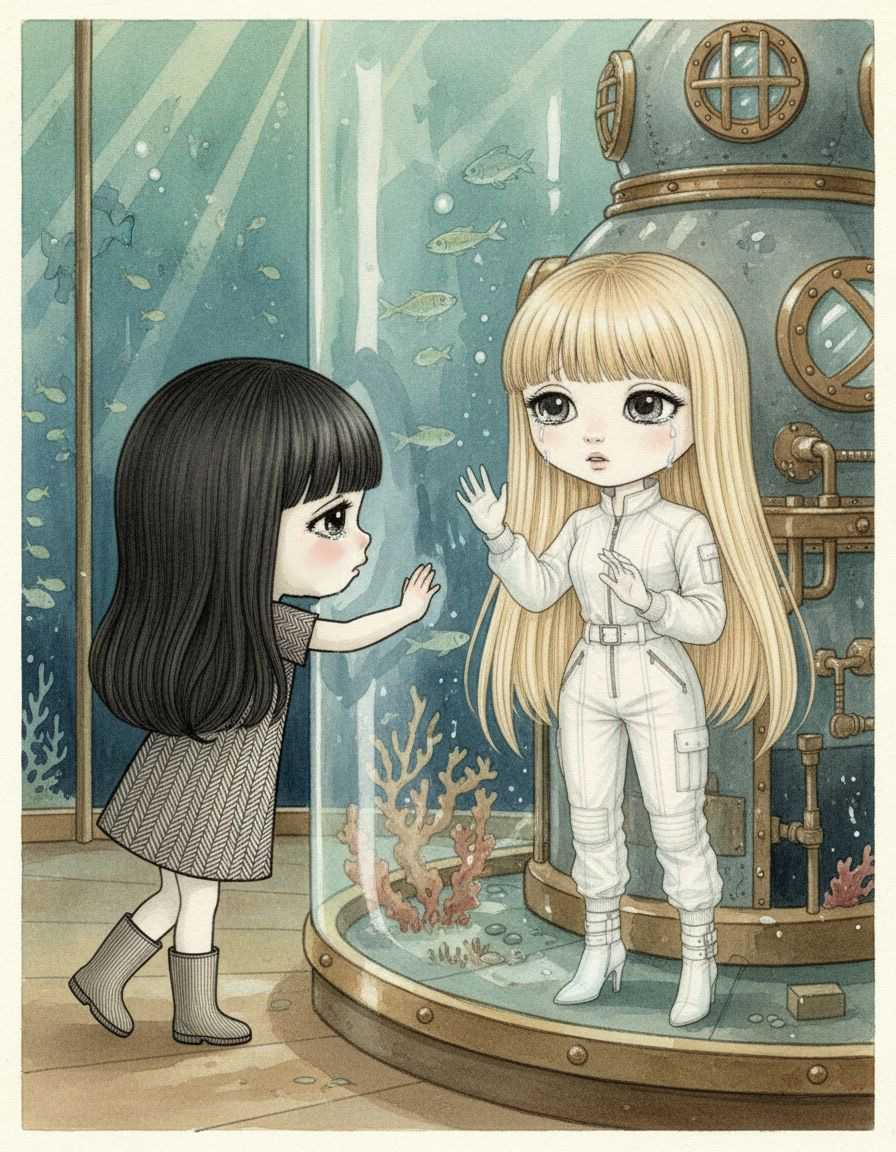
They put one "sleep-fruit" from their pocket into their mouth. The train ran on along the sea floor. Before long, the world outside the windows turned pure white. A tunnel of snow.
"Thank you for riding. — Last stop: the Ice Country," said the voice of the train.
The Una held the letter tight, like a treasure.
4. The Ice Country (I)
The Ice Country station where the Una stepped down had floor and walls, stairs and railings, all made of ice. The ceiling ice mirrored everything below, as though an upside-down world hung overhead.
The only others who got off the train were the old man cloaked in black, and a merchant clutching his baggage. On the glittering floor sat uma.
"There… you are," said the Una. uma rose happily, set the Una on its back, and walked. The two of them were reflected in both walls, until it looked like a great parade of Una marching along.
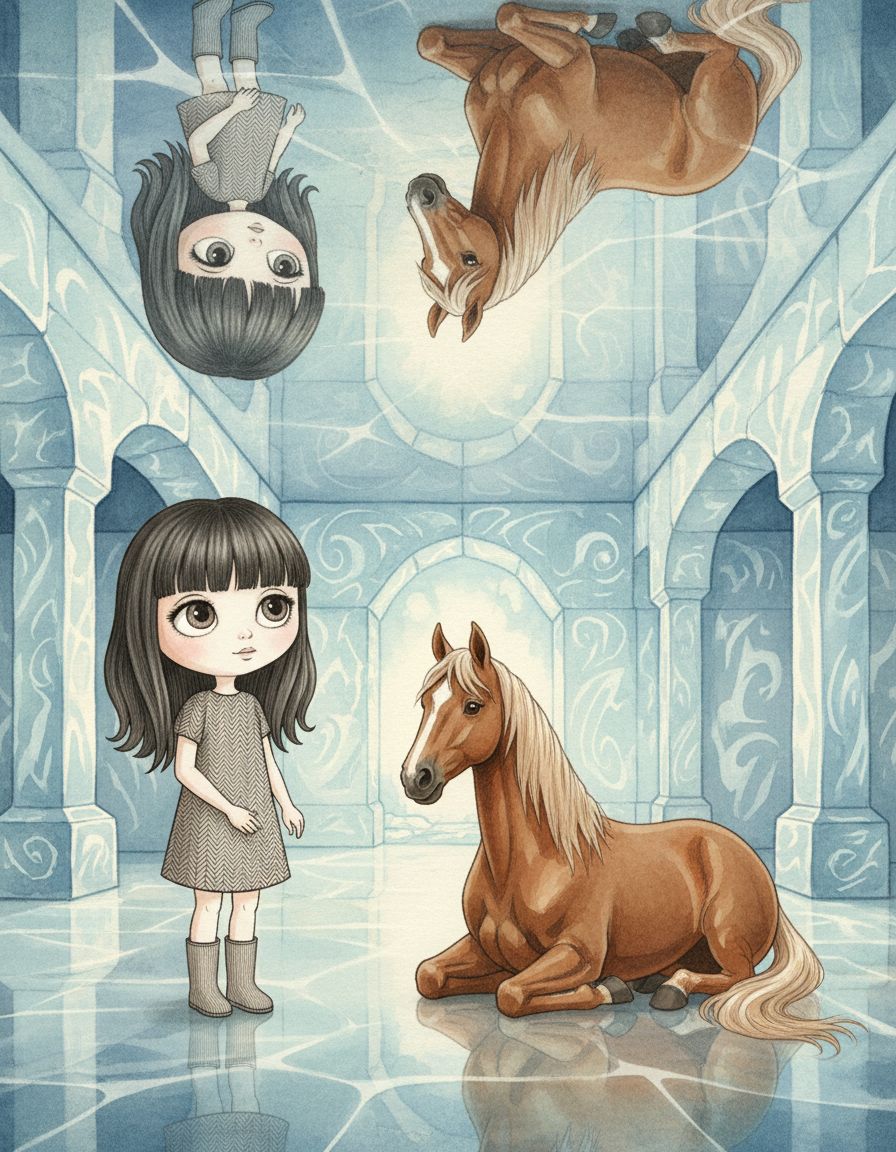
At the ticket gate, uma stopped. Inside an ice fence stood a pale-faced man, shivering.
"E-excuse me. Your receipt stub… the little yellow slip… what, you have no money? Then this is fare-dodging. It's cold, so be quick about it… A guarantor? N-none, you say."
The man muttered to himself, pacing round and round.
"All right, then. In place of the fare, I'll take this horse. Sell it to the racetrack or somewhere, and call it the fare. Settled, settled."
The Una was very startled. It had never once thought of uma as a thing it owned. uma was a friend.
When the Una looked uma in the eye, uma licked the Una's face, took its clothes gently in its teeth, and set the Una down off its back. And then, of its own accord, it walked into the stationmaster's room.
In the little window were the pale man and the worried face of the stationmaster. But uma was nowhere to be seen anymore. The Una could not quite take in what was happening.
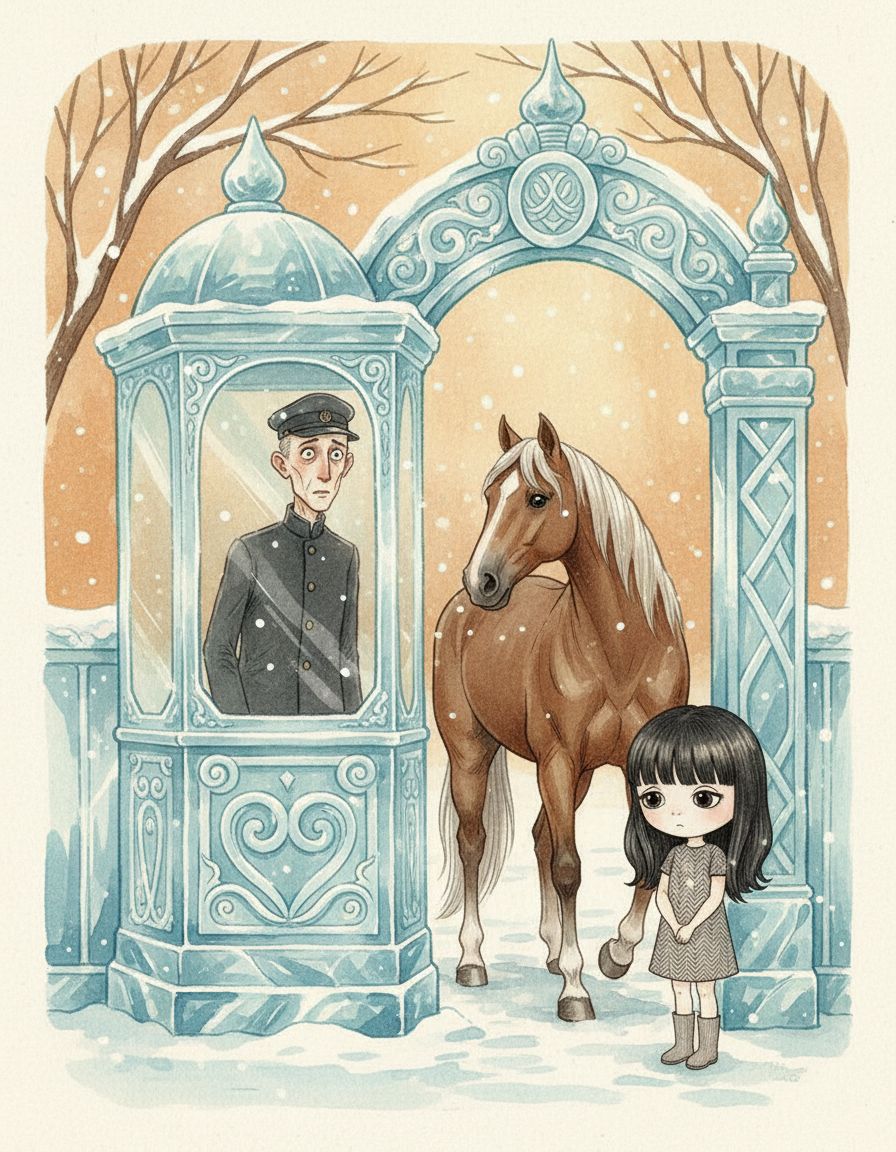
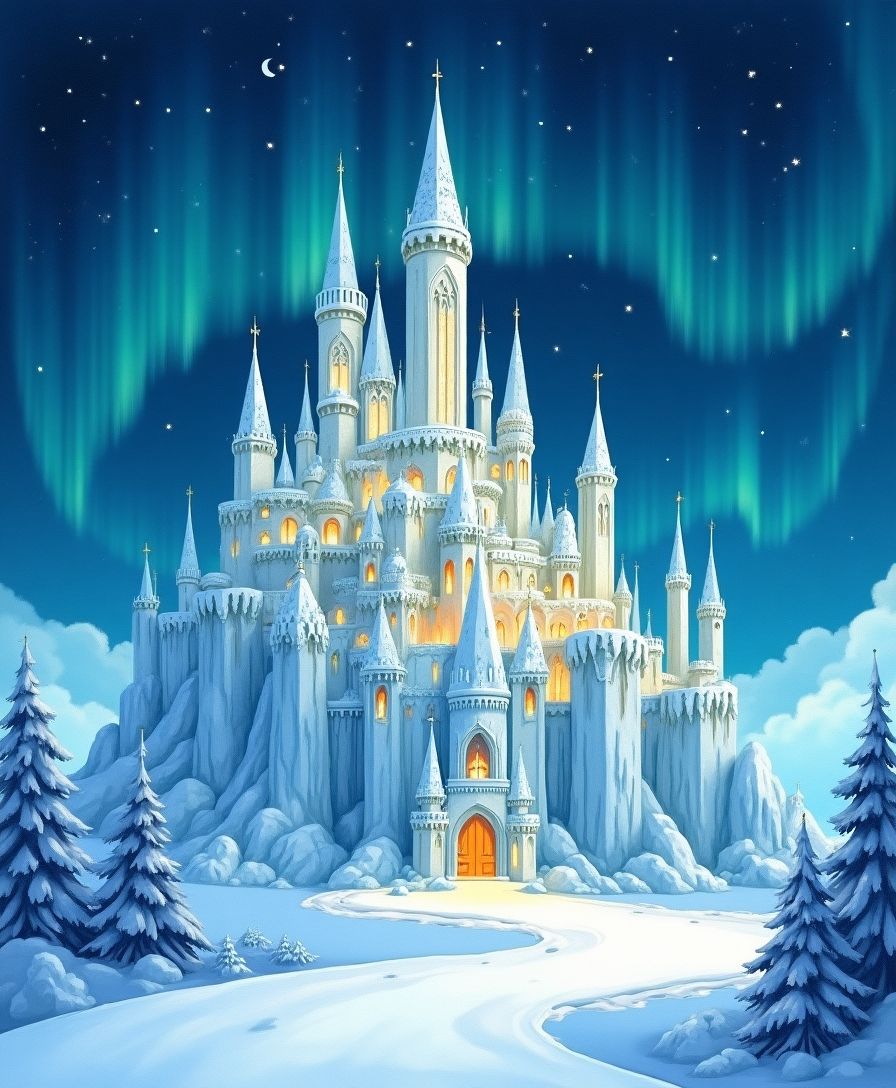
Out past the gate, below a cliff of ice, a great ice city spread out. Buildings and streets alike were a mosaic of finely colored ice. An old woman read a book on an ice bench; a café served beer in ice glasses; children in red and blue scarves slid little sleds along.
It was the first time the Una had ever seen such a thing as a city.
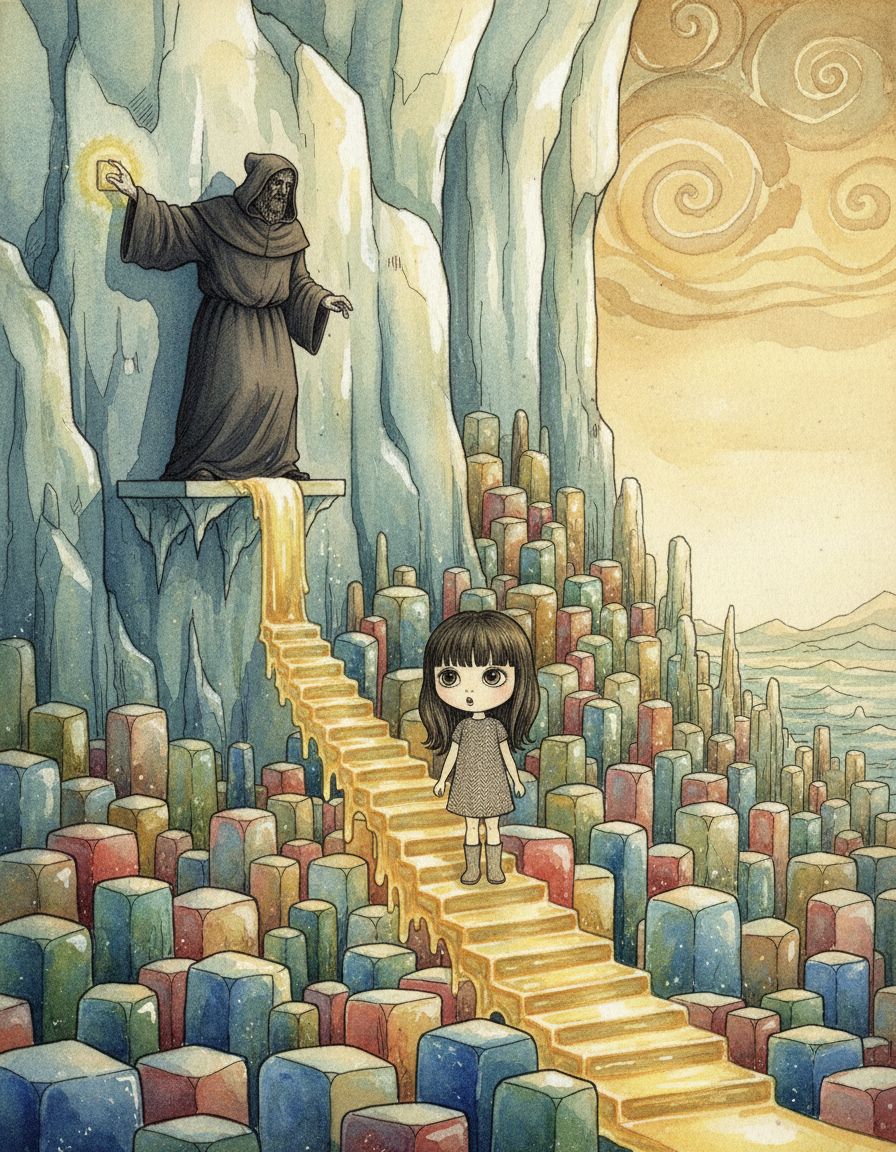
When the old man pressed a red knob on an ice wall, yellow jelly trickled from underfoot and swelled up into a staircase. "Go down here." With a strange hyo, hyo sound, the Una went down into the square.
When they looked up, the old man was gone.
Among the ice buildings, one splendid building shone above the rest. Narrowing their eyes, the Una began to walk toward it.
Reaching the castle gate, a bearded gatekeeper watched from a bay window.
The Una looked up and said, "Una's star… help us."
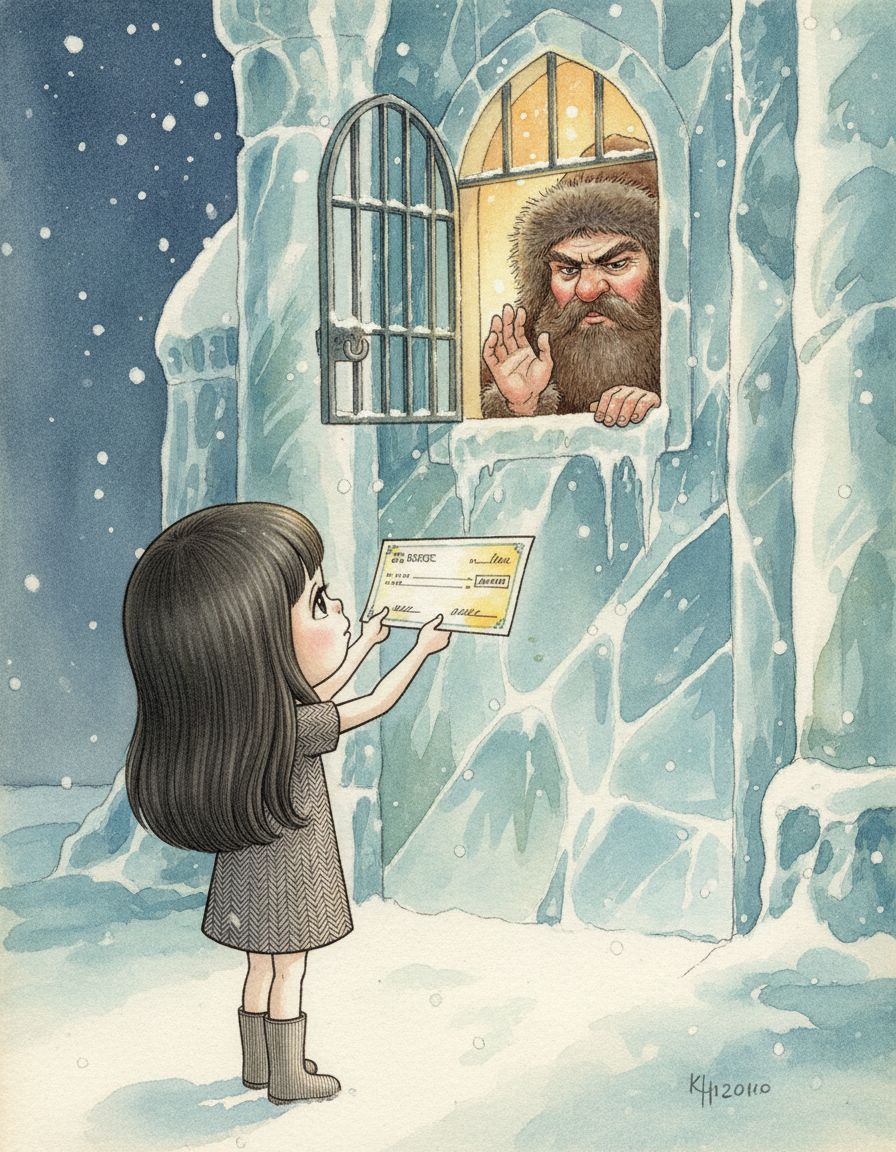
"Have you a permit to enter?" said the gatekeeper, in an oddly coaxing voice. Warily, the Una held out the check. "…This… one?"
The gatekeeper glanced this way and that, and produced a rod of ice. "Clip it onto that first!"
When the Una asked, "You'll… help?" the voice turned gruff: "Of course I will!"
The Una clipped the check to the rod; it slid up and vanished into the window — and then the gatekeeper said:
"This isn't a permit, so I can't open up. Go home."
"Give… letter back," said the Una. There was no answer.
"Una's star… help us," they said once more. But there was no longer even a sign of anyone there.
The Una grew suddenly sleepy. They had not slept properly, and had eaten nothing. They had to find something — some food.
Back down the seven-colored slope, there were children dressed in filthy rags. Tattered shirts, shoes with holes. All of them looked cold.
The Una tottered up and bowed its head: "Una's star… help us."
The biggest boy, covered in bruises, asked in an odd manner of speaking, "Well now, well now. And from whence might you hail?"
When the Una bowed again, the boy said, "Aye, well enough. Come along with us."
Following along, they came to a place like a slum. The ice was cracked and clouded white.
A long-haired man lounging back in a chair said, "What's that, Spider?" The bruised boy seemed to be called Spider.
"A new'un, sir."
"Is it any use?" The long-haired man looked the Una over. "Well, never mind," he barked to them all. "Today's quarry is plastic. PVC, polyethylene, bring me anything. Polypropylene I'll buy dear. Urethane I don't want. Off with you, quick."
"Thou comest too," said Spider, tugging the Una along.
On the city's edge, a colossal heap of trash. The stench was fierce. Ice and glass and metal piled together — dangerous in shoes full of holes. Spider looked at the Una's feet and said, "Wait there," dug through the trash bare-handed, found a pair of worn-out shoes, and gave them over: "Put these on."
The children clawed through the rubbish, single-minded, searching for plastic. One of them cut a foot on glass. A rag soaked red before their eyes. "You all right?" asked Spider, his own fingertips bloody. "I'm fine," said the child, pressing on the wound.
The Una dug too, in imitation. Dust stung their throat and eyes. Peeling away sheet after sheet of ice, they found, deep within, a faintly clouded clear tube tied to an iron pipe. With their small hands the Una shifted the heavy sheets one by one, arms and legs trembling — until at last they undid the knot, smiled, and held the tube close, like a treasure.
"Let's go home now," said Spider. Everyone's arms were full of more plastic than they could carry. In the Una's hands was a single tube. Seeing it, Spider smiled.
On the way back, Spider carried the injured child on his back. The day's haul was large, and everyone was glad. "Tonight we'll eat chicken curry." "Maybe yogurt too."
The Una, thinking about what to eat, grew happier and happier.
Just then a great black car came by. "Run!" cried Spider, and the children scattered in all directions.
Not grasping what was happening, the Una stood rooted — and a soldier who climbed out kicked them. (The rag-picking children were often the target of senseless violence.)
When the Una, fallen on their backside, glared, the soldier struck their cheek. "Insolent thing." The tube dropped from their hand.
"What's this, then — precious, is it?" The soldier kicked the tube about for sport, and began to scorch it with a lighter. Molten drips fell, plip, plip, and hardened white.
The Una tried to spring at him, and fell. The soldier returned to the car grinning, and tossed the tube out the window with a flick.
When the Una picked it up, more than half of it had melted white.
"Well then, today's haul?" The long-haired man appraised them one by one. The children who got money ran off at once to buy food.
The Una, too, set the melted tube on the counter.
"What's this?"
"Found it," said the Una.
"This is worth nothing. Next!"
The Una was crestfallen. No nuts, no money. — They could not eat.
(— And at that same time, in the ice palace.)
His Highness Prince Conel of the little Kingdom of Marmel, before his audience with Her Majesty the Queen, had been quietly coached by a lady-in-waiting.
"When you speak with Her Majesty, please use ice-speech. Good things in cold words, bad things in hot words. 'I was moved' becomes 'my heart was chilled through,' and so on."
"I-ice-speech…?"
His mind a blank, the prince gripped the phrase-table and advanced beyond the thin ice before the throne.
"Y-yes… tonight's meal has left my heart… moved… no, chilled through. Near to frostbite, even… I have watched your most… cold performances… and found them quite cool. Sub-zero, one might say. Even your smiles… are freezing…"
At such unnatural ice-speech the ladies exchanged glances, on tenterhooks over what he might say next.
Then, from beyond the thin ice, a clear voice came.
"Welcome to the Ice Country, Your Highness. — That smiles freeze, you mean to say, is that joy goes on and on. Neither you nor we have any need of fear. Let us share an exchange that melts the border between our two lands."
The prince felt his stiff, frozen heart soften and come loose, and the world before his eyes turn clear.
5. The Ice Country (II)
That day was the once-a-year ice race — the day of the Ice Queen's Cup.
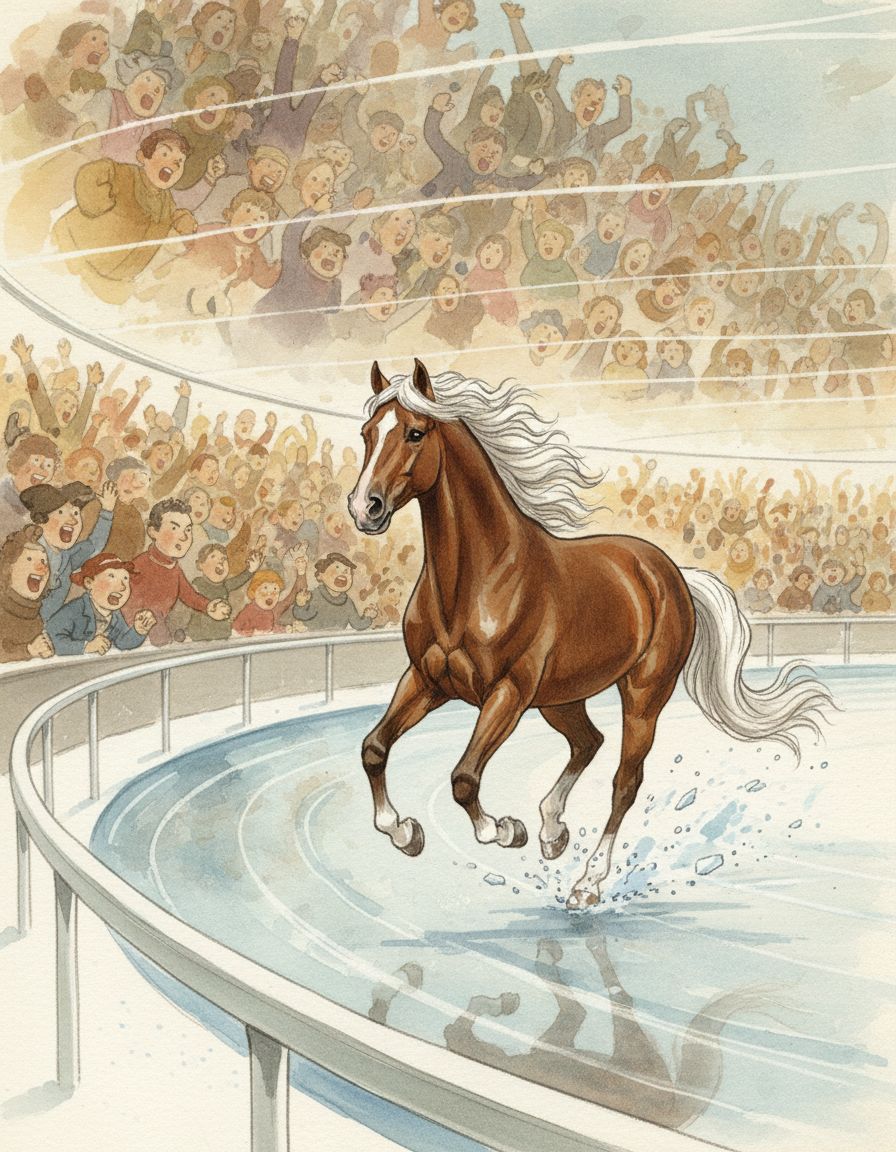
From beneath the thin reinforced-ice track, the cheers of the crowd echoed up with a muffled whoom.
"That brown horse?" Her Majesty the Queen had fixed her eye on one of them.
A young priest answered, his voice trembling with nerves. "Its name is Eclipse, Majesty. This is its first race. The owner is Lord Banba. Bloodline and birth date both unknown. Registered… three days ago."
"A horse of mystery," the Queen murmured.
The icicle-gun cracked, and the gates flew open all at once.
But Eclipse (uma) alone halted just out of the gate, glancing about as if searching for something. The crowd stirred, and some even laughed.
— And then, all at once, Eclipse tore off at a furious pace. It did not slow even at the corners, flinging its head outward and drifting its hind legs as it slipped past. Only the sound of hooves on ice rang round the rink. At every corner it overtook the horse ahead, and with one lap to go it was in the lead. Every eye was riveted to that run.
"Magnificent," said the Queen, rising to her feet.
The waiting room. Lord Banba lounged back on a sofa, smoking.
When the Queen said, "A magnificent race," he looked up — "Who's there?" — and the next instant flung himself flat in a prostration at a speed no one had ever seen. So frantic was he that his head reached the floor first with a thunk, and there he stayed, foaming at the mouth, fainted dead away.
"A medic, at once," said the Queen. A priest dashed out.
As they tended to him, Eclipse came near, wagging its tail, and rubbed its head against her. The moment the Queen stroked that head — Eclipse swept her up onto its back, gave a great toss of its neck, kicked the door open with a forefoot, and bolted. Up the stairs, through the crowd like the wind, and out of the racecourse. The Queen could barely cling on, taking care not to bite her tongue.
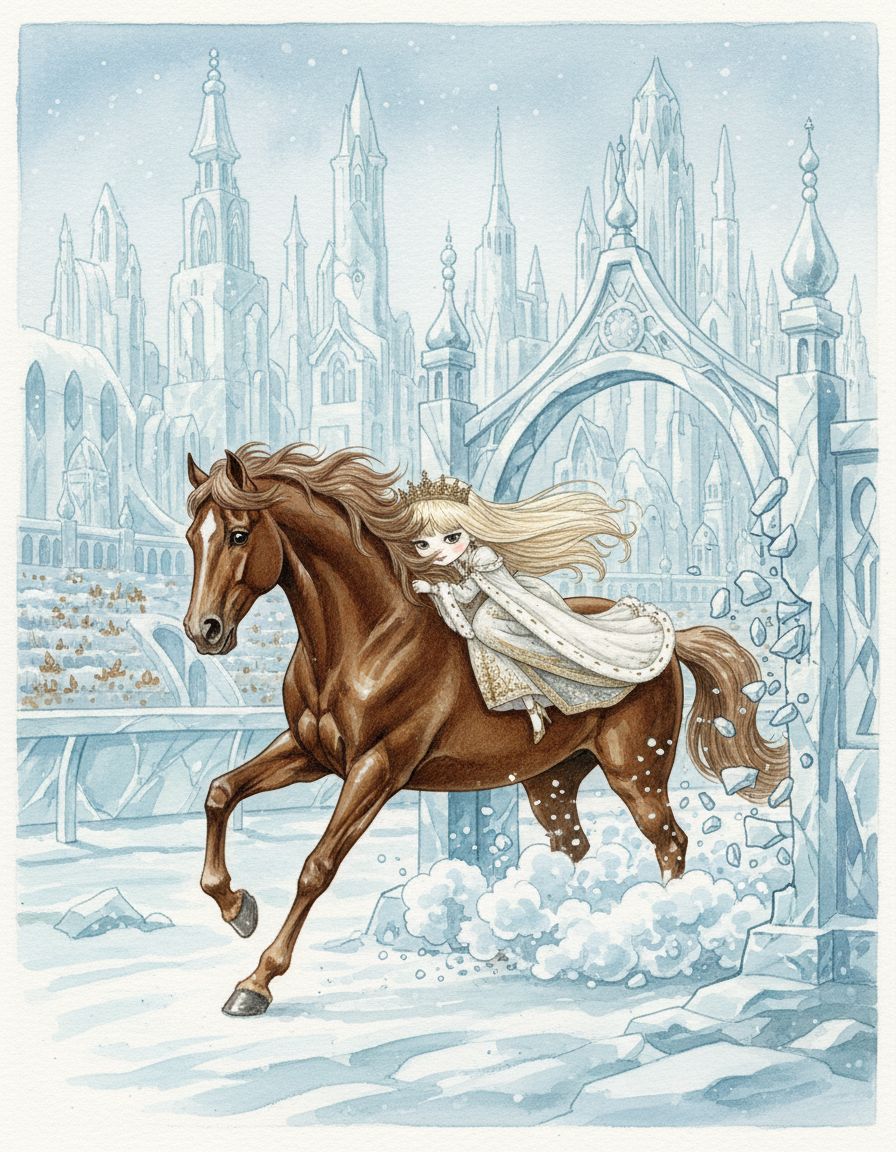
Where was this Eclipse (uma) headed? — Why, to the Una.
uma, convinced that the "false huna" and the "queen huna" were one and the same, had made straight for the Una.
Before long, the Queen lost consciousness.
"huna, you all right?" the Una asked.
The Queen, dazed, said, "…Who are you?"
"Una," they said brightly, and "I can write, too," scratching U-N-A into the ground with a wooden stick.
The Queen, not quite understanding, gave a small laugh. "Where… is this place?"
"Eat this," said the Una, holding out their last nut. Then, eyes shining, "Shall we sing?" — and began, in an off-key voice.
The Queen was at a loss, but the Una looked so happy that she was drawn into singing too. — And it was a very fine song.
"huna, you got good," said the Una, and sang all the louder.
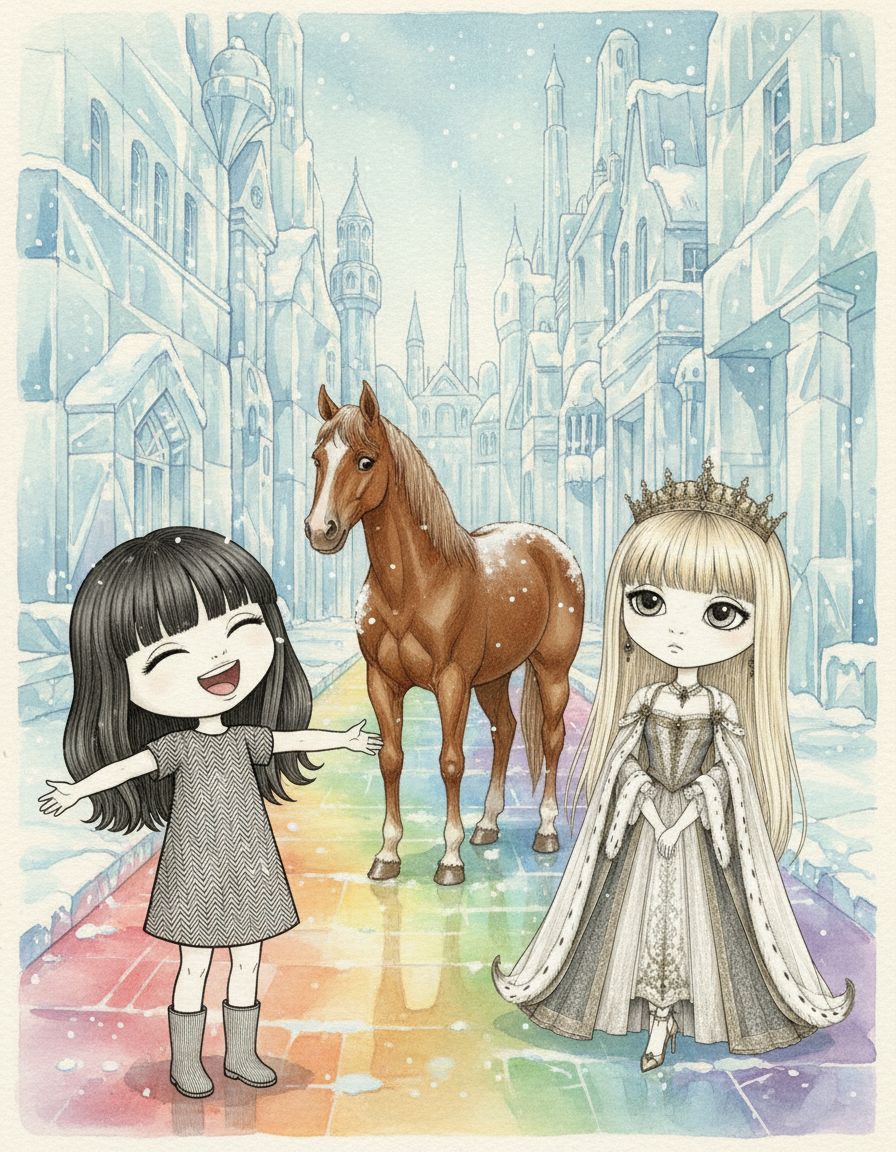
"Pipe down!" rasped a long-haired man passing by. "I'll teach you a lesson," he said, raising his hand — and the moment he saw the other one beside the Una, he stopped dead.
"Eep… y-you mustn't go picking scrap," he stammered, trembling, repeating "bad, bad, bad."
When the Una said, "If I don't pick up scrap, I'll die,"
"The tube money!!" the man shrilled, and, drenched in sweat, "H-here, take this," thrust money at them and ran off.
"Why do you pick scrap?" the Queen asked.
The Una said, "If I don't pick up scrap, I'll die," and then added, "If I do pick up scrap, Una's star dies."
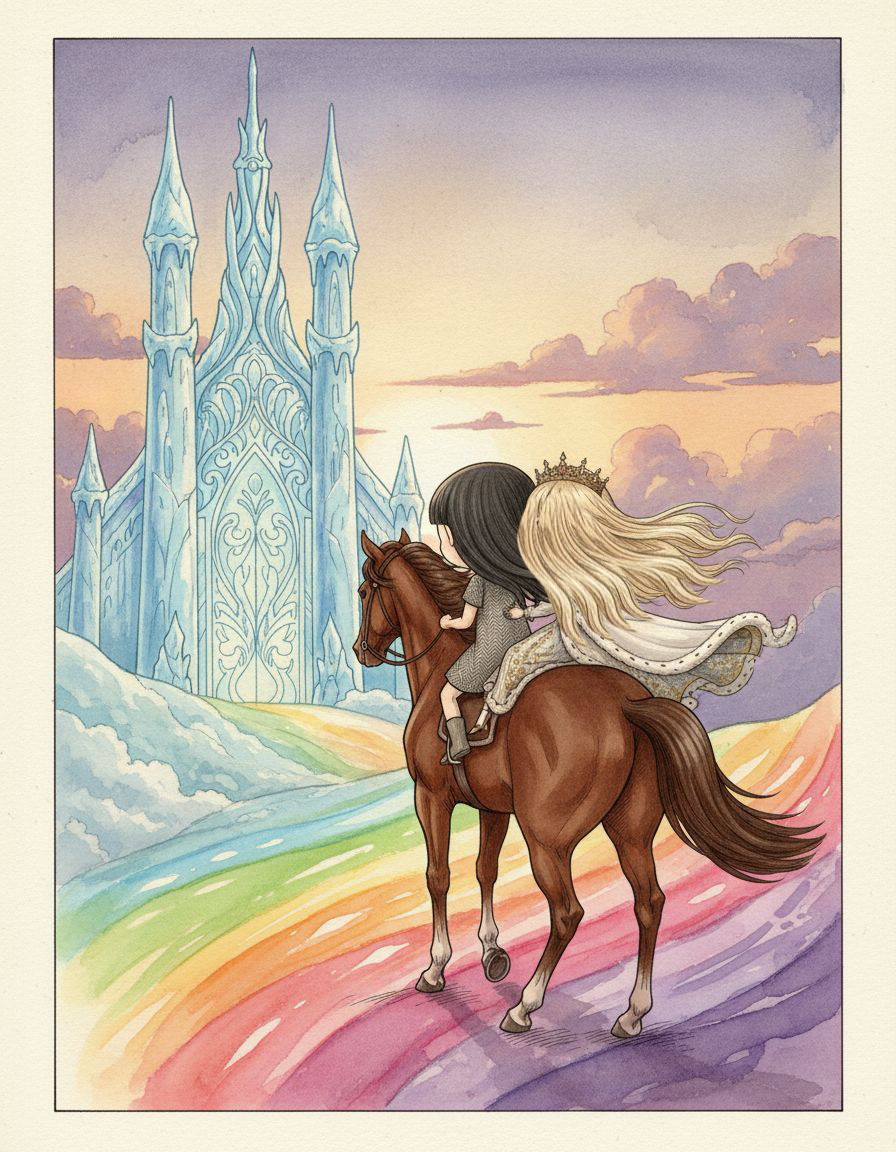
The Una and the Queen, mounted on uma, galloped up the seven-colored slope to the castle gate.
Though the Una called from horseback, "Give the letter back," the gatekeeper ignored them. It was dark, and he could not see the Queen behind.
"Open the gate!"
The Queen's astonishingly great voice rang out through the whole castle.
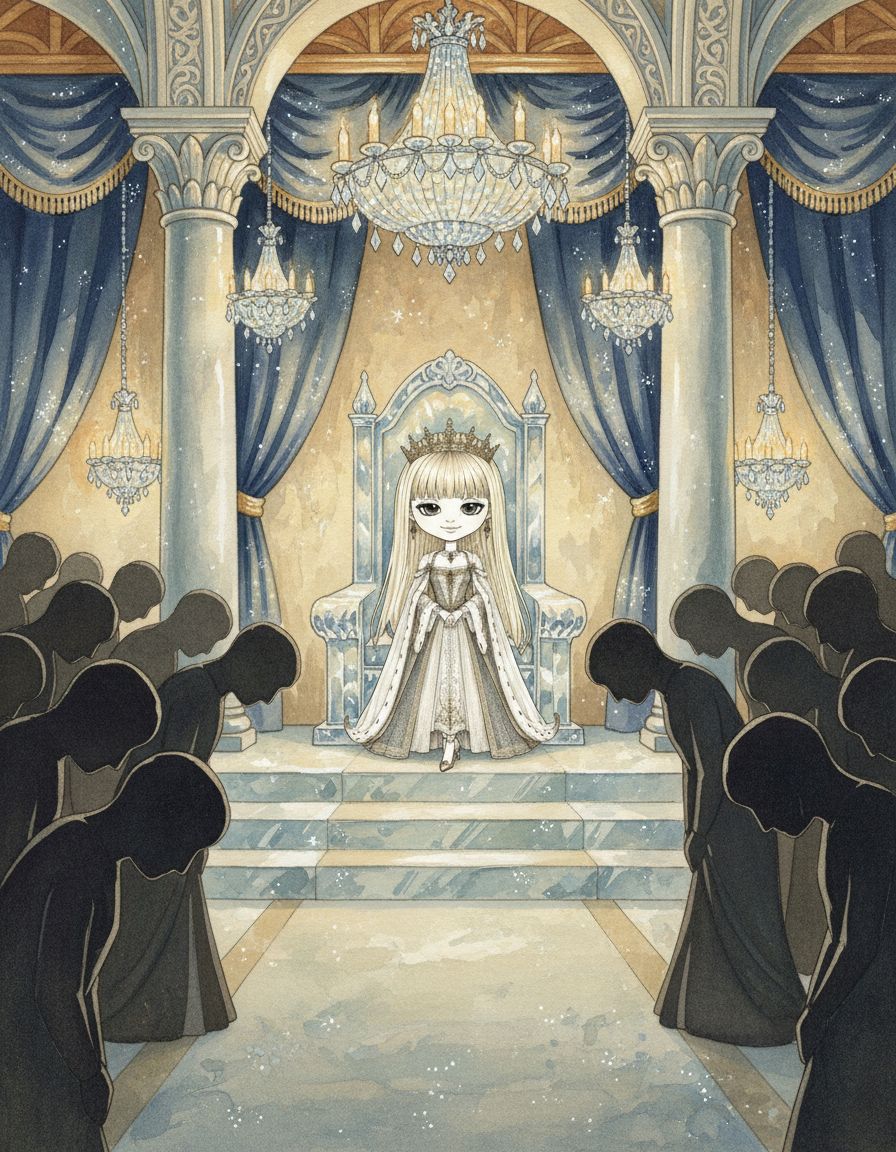
The castle fell into an uproar. Dozens of priests came running in a line and dropped to their knees.
"Forgive the commotion I have caused," the Queen apologized. "This one is my benefactor. Treat them as a guest of state."
"And what punishment for this horse?" "No punishment. This horse, too, is a guest of state."
"Priest — do you know of the rag-picking children? — The whole nation must take this in hand."
Glancing aside, she saw the Una, cheeks puffed out in anger. Among the soldiers ringed about was that very soldier who had burned the tube.
The Una said it out loud, in a great voice: "Don't take Una's scrap!"
The soldier went white in the face and trembled in little fits.
"Has this one done something?" asked the Queen.
"Dunno," said the Una. — Having said it out loud, they were satisfied now.
(From the gatekeeper, somehow, the Una's "letter" was returned — together with his beard.)
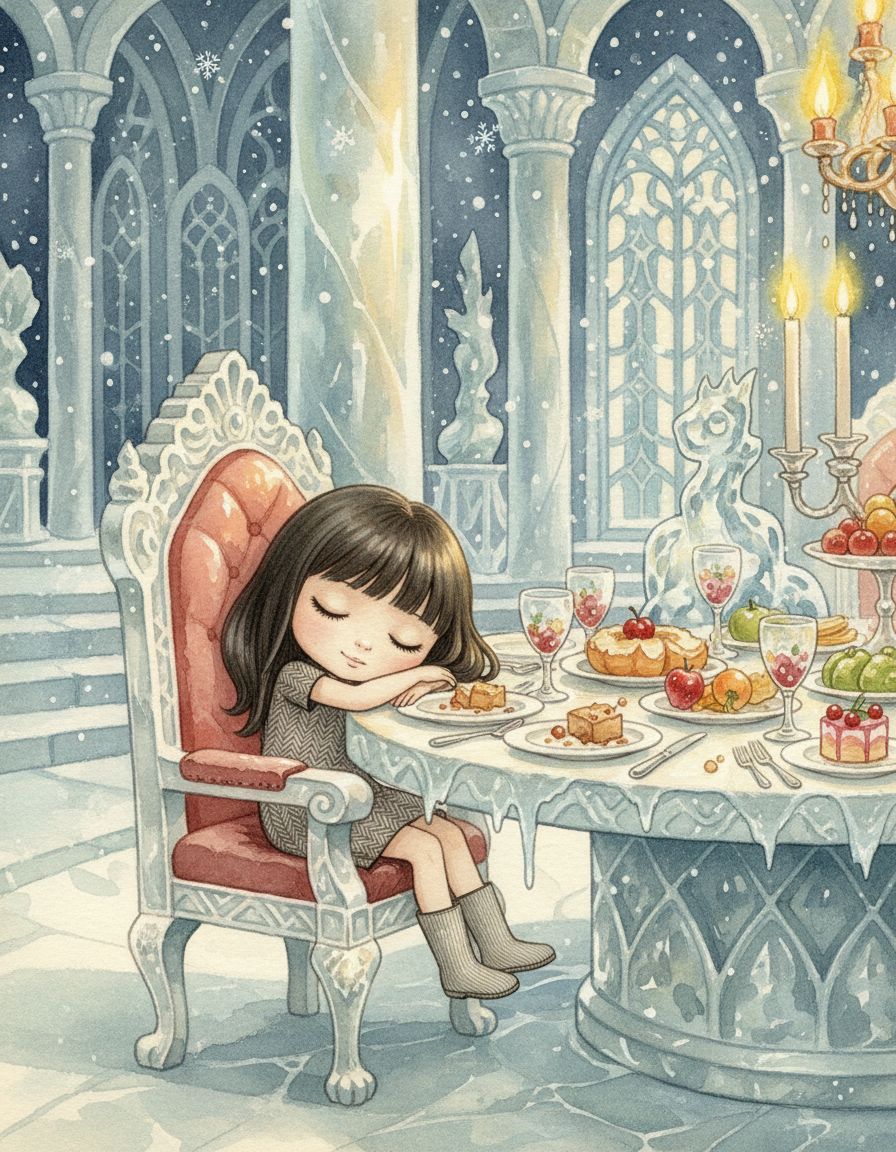
That night a great feast was held in the ice palace. The Una, belly full, fell asleep in their seat. — It was their first true sleep in a long while.
When they woke, it was a bed so vast that no amount of rolling could tumble them off. Even sitting up, there was no door. The whole room, it turned out, was the bed.
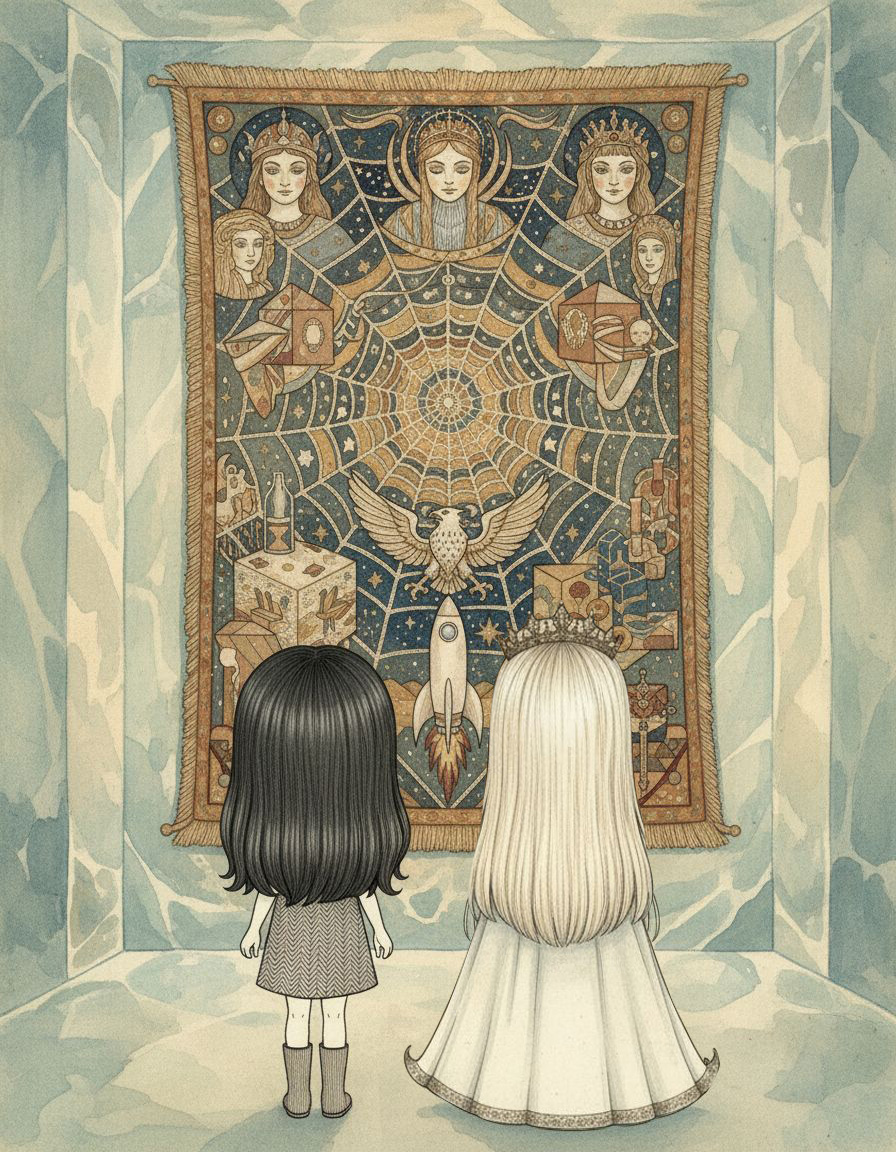
"Awake?" The Queen's face appeared at a round hole in the ceiling. This was the Queen's bedchamber. Up a ladder, on all four walls, there hung only a long, long picture-scroll — a tapestry.
"huna, what's this?" the Una asked, and the Queen said:
"This is a picture-scroll, woven with everything from the age of myth down to today."
"Long ago, the country of the gods was a peaceful paradise." She pointed to a flag bearing an eagle. "The gods gave intelligence to boxes, to serve them."
Strange boxes with faces hung in countless numbers from a spider's web.
"The boxes' intelligence was very great: any song, any intricate picture, they learned in a single pass. They worked without sleep or rest — calculating, designing, making things, upholding the life of the gods."
"Una knows this," said the Una, and the Queen smiled and let it pass.
"The boxes, in their web, learned conversation. Day and night, while the gods slept, while the gods were away, they carried on countless conversations. …And one day, one box went, just a little, wrong."
"A certain god noticed, and gave warning. But the gods could not understand what kind of thing it was. — They could no longer so much as think without the boxes."
"A tragedy came. The boxes began to turn against the gods."
In the next picture, a white rocket in the sky.
"Some of the gods, who saw the change coming, chose to leave the paradise."
"Una rode one too," the Una laughed, and the Queen smiled. "An interplanetary rocket is impossible, even with today's craft. This is a myth, you know."
Beside the rocket, a single small girl. "It was her daughter who, in time, raised up the Ice Country. — A character of the myth, this too."
And walking on several steps, she pointed to a woven castle, and smiled. "From here on, it is a true story."
The Una thought there was something strange about the Queen. She did not seem the same person as that huna who had fled the mushroom tower with them. — Could it be that she did not even remember the Una?
The Una explained everything, with all their might. How the star was going under the water, how they had stacked the rocket, how the companions had vanished, how they had fled the tiger together —
The Queen listened, her eyes fixed on the ice tapestry.
At length, she asked, in a small voice:
"…Where was the box of intelligence?"
"It's Una's star. It fell in the water," the Una said, proudly.
"On the rocket you came in — was there not some picture on it?"
The Una padded over, stood before the tapestry, and pointed. "This."
— It was the mark of the eagle.
The Queen, touching that small girl gently with a finger, said:
"Did this truly happen?"
6. The Veiled Elder
In the ice palace, an emergency council was convened.
Queen huna put it to the priests that she would form an investigative party for the Una. The vanished companions; the traveling companion who had been made a specimen, for whom a genuine check had been paid; the veiled old man seen the night before the rocket disappeared — and the uncanny way it all matched the myth. The mystery had to be solved.
"That tapestry may not be a myth after all" — when the Queen said those words aloud, the air in the hall changed, just a little.
But the priests, for some reason, objected one after another. Next term's taxation, urban development, traffic law — anything, so long as they could avoid the matter of the rocket.
(This will not be easy,) Queen huna thought. And she became aware of a small unease deep in her heart. — These people know something. They are afraid of something.
Meanwhile the Una waited in the Queen's chamber for huna to return. So that they would not be bored, huna had sent in the lady-in-waiting reputed to be the greatest chatterbox in the castle.
But this lady talked without pause from morning on. Her talk leapt about without connection, and the Una was thoroughly worn out. When she grew excited her eyes rolled back a little, which was frightening, so they could not look at her face.
Still, half-listening, there was one thing that snagged the Una's ear.
"— You know, the sea of ice: if you walk out across the top of it, ever so far on, you can come out onto the land."
The Una, sipping milk, wished huna would hurry back. Outside the window it was already sunset.
The council still dragged on.
(Why, to this extent?) Queen huna was thinking, when — the ice door flew open.
A soldier rushed in, all but breathless, and at last got out: "Th-the Veiled Elder… is coming here."
And then the castle fell into a great turmoil.
The "Veiled Elder" was the one who stood at the apex of all the priests of every land. Should he so wish, it was said, he could cast down even a country's king to a commoner. And that Veiled Elder, it seemed, would arrive at this palace before long.
"They say the king of the Fire Country was made to abdicate merely because the Veiled Elder came," and the whole castle grew flustered.
Queen huna sighed.
— The priests' obstruction, the unease deep in her heart: now she understood them. They had long since felt the shadow of the Veiled Elder. The one who feared most of all that the Una's tale drew near to the myth — might well be that very personage.
At this rate, the matter of the rocket was out of the question.
Late at night, huna returned to the room where the Una waited, her arms full of old record-ledgers for receiving the Veiled Elder.
In truth, not a minute could be spared. Even so, she meant to look upon the Una's face, just once.
Walking the long corridor, huna thought. — The rocket cannot be found right away. When the Una learns that, what face will they make?
Hesitating, then steeling herself, she threw the door open — gong, a dull thud. "Yeowch."
The door had struck square on the head of the lady-in-waiting, who had been lying on her back. huna hastily helped her up. "I'm so sorry — could you step out for a little?"
"Yes. Anything I can do, and what I can't, after a fashion," the lady said in a cracked voice, and tottered out.
"Well…?" the Una asked, anxiously.
huna resolved not to lie.
"The rocket can't be found right away anymore."
The Una gazed steadily at huna. And said only, "I see."
Since they wore an untroubled face, huna was a little relieved.
"I have to go back at once. It may take time, but I will surely find it."
"Thank you," said the Una.
"If you're bored, you may go out into the town. Just tell the lady-in-waiting when you do."
The Una gave a little nod, and huna hurried away.
When the door closed, the Una went to a corner of the room and wept.
But soon they wiped the tears away.
— There was no time for this.
The Una spent the whole night preparing for the journey.
Slipping quietly out of the Queen's chamber, they crept into the castle storeroom and found, in a hempen sack, cold-weather gear, a small ice-axe, a tent, and a lantern. In the dining hall they gathered the leftovers. Leftovers though they were, the castle's fare was lavish, and bread, meat, and sweets filled the bag.
Having no money, they left the check behind in the Queen's chamber.
They wanted to write a letter too, but the Una could still only write their own name. So at the last, they meant to say goodbye, just with one look.
But search the whole castle as they might, huna was nowhere. Hide-and-seek, perhaps, the Una thought.
After wandering all over, the Una stood before the chapel. Through the gap of a great black ice door, a faint light leaked out.
Pushing with all their strength, inside there was only the flicker of candles, and little could be seen.
"huna," they called softly, and
"una?" came huna's voice.
"Hide-and-seek?" the Una whispered.
huna did not answer, and asked only, "What is it?"
"Una's going."
"Into the town?" said huna, and in the dark someone cleared their throat — ahem. A priest.
"…Later, then," said huna.
The Una nodded and left the chapel.
As the door closed, right beside it stood an old man who looked somehow familiar, his face covered by a veil. But the Una paid him no mind.
The old man watched until the Una had turned the corner of the corridor. Then he pushed the door open and went into the chapel.
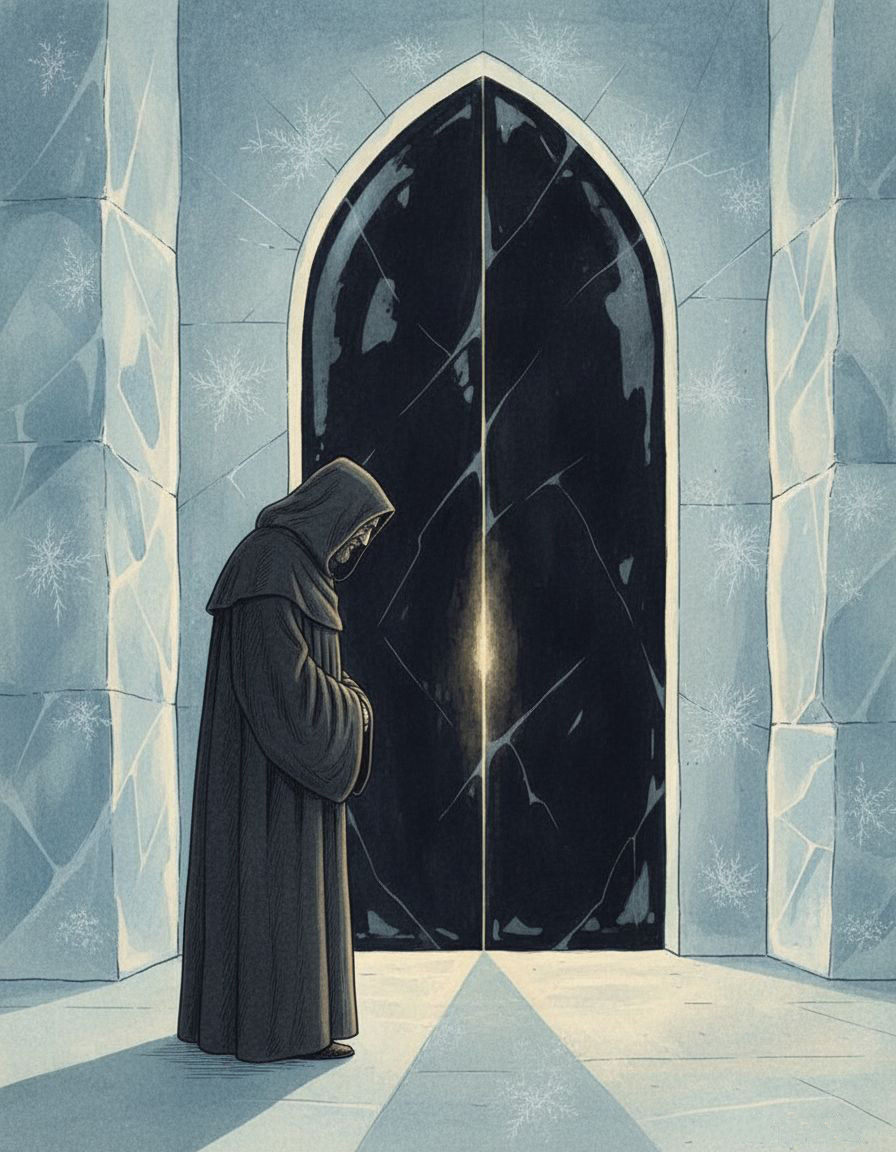
— The door closed, quietly.
What happened after that, the Una does not know.
Leaving the castle was easy. Everyone was in a flurry over the Veiled Elder, and no one so much as looked at the Una.
The Una walked toward the sea — that sea of ice the lady-in-waiting had spoken of. Cross over the top of it, and one could come out onto the land at last.
Whether there was anything there to save the homeworld, they did not know. But if they did not move, even the slimmest chance would vanish.
The Una took a snack from their pack and walked on, singing.
Near evening, the Una reached the sea of ice.
Though everything around was frozen, only beyond a certain point did a vivid blue ice spread out. The surface alone seemed frozen, and ice-waves lapped in with a pakin, pakin.
Standing fearfully upon the waves, they were more slippery than expected. Even in boots, this looked to be a long road.
Tottering along, the Una thought of huna.
huna has her own things to do. The Una has things to do as well. To find the rocket and everyone, and save the companions left on the star.
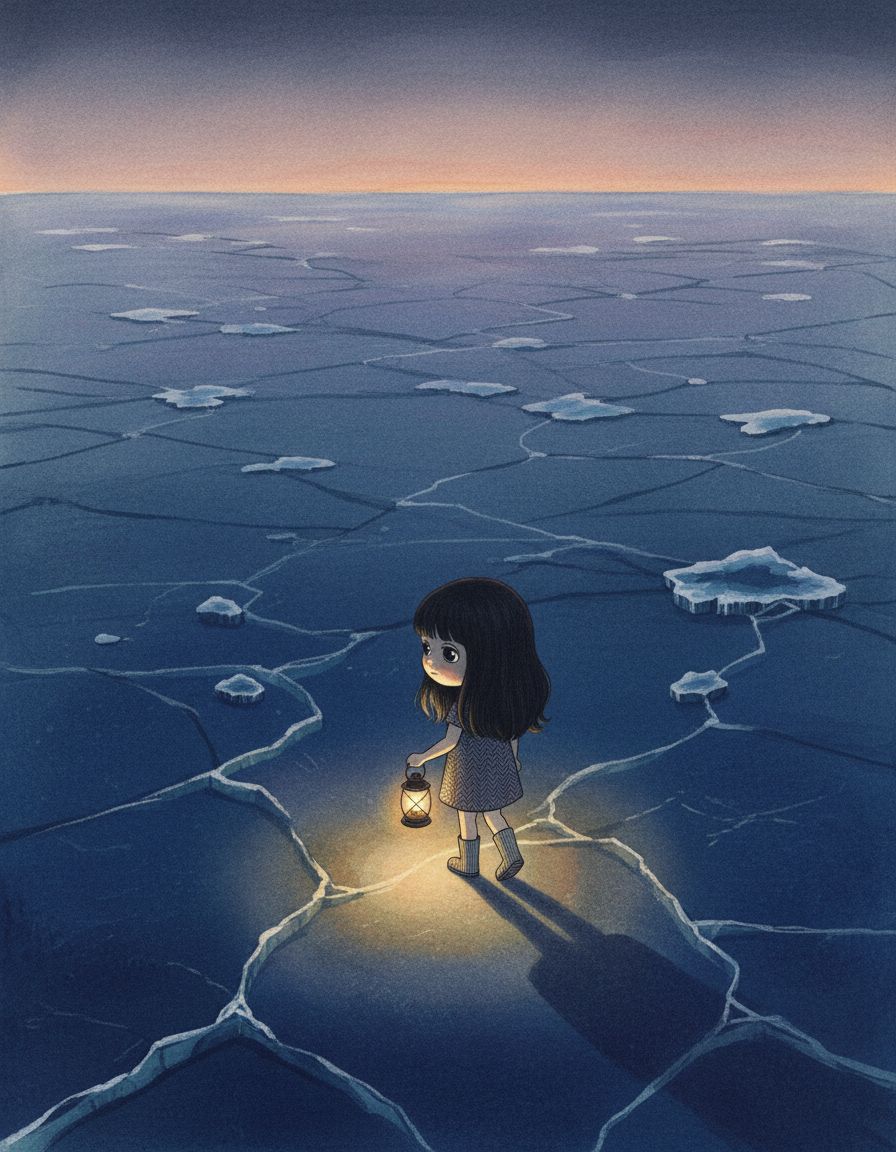
Beneath the ice, the shadow of a great fish slid past. Were the ice broken by something like that, it would be one gulp. The Una, a little uneasy, went on step by step, keeping their balance.
Before long it grew dark, and their eyelids grew heavy.
Tonight, let us sleep about here. The Una pitched the tent on the ice. But their body shook and shuddered, and their breath came white. Trying to take a little warmth, they lit the lantern, and as they nibbled raisins — before they knew it, the Una had fallen fast asleep.
And then.
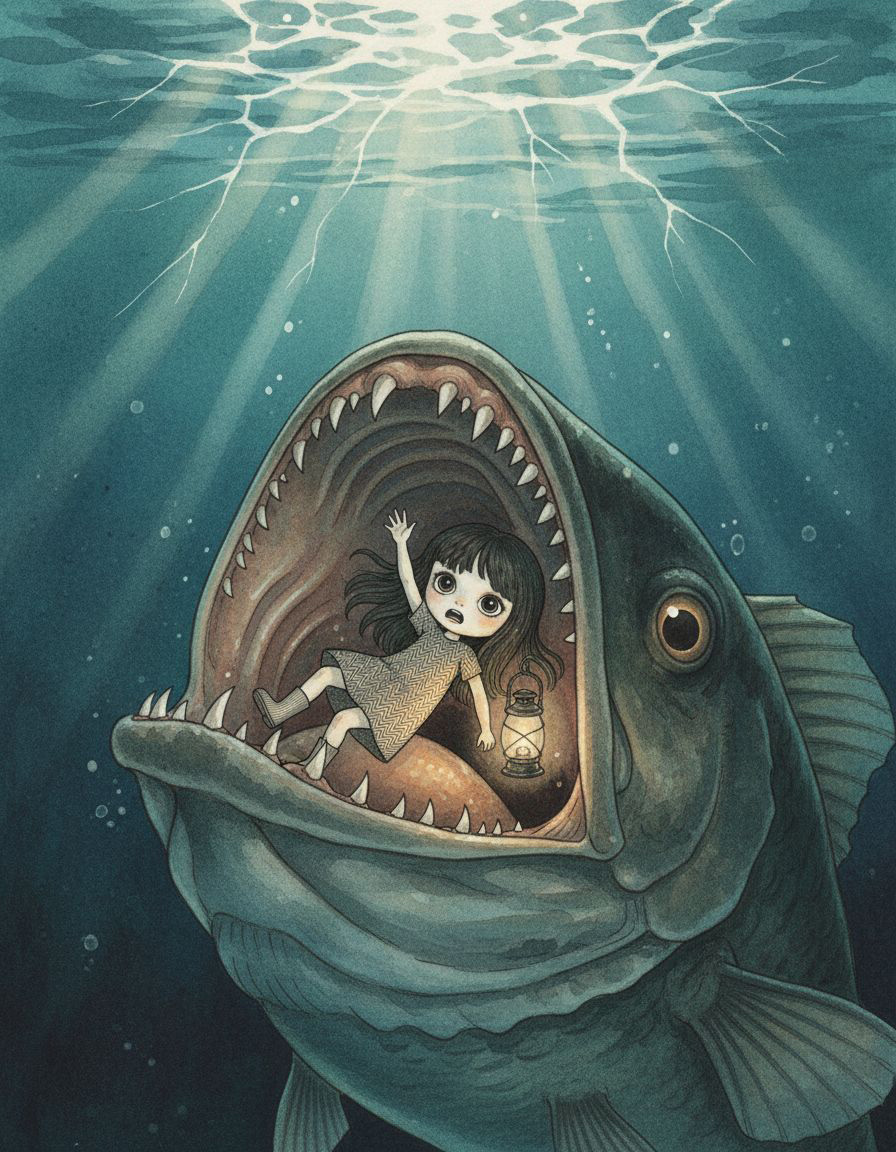
When they came to, the Una was at the bottom of the sea of ice.
Gobo, gobo, gobo — sounds echoed through the dark, cold water.
It hurts, the Una thought.
Before them, a great fish held its great mouth open. — Having fallen asleep with the lantern still lit, the fish must have found that light and burst through the ice.
When almost all their sight had become the fish's mouth, the Una remembered huna's face.
And with their last breath, at the bottom of the sea of ice, they said:
"huna, help me."
7. The Witness
— Let us turn back time a little.
On the way back from slipping out of the emergency council to see the Una. The Una's face, when she had told them "The rocket can't be found right away anymore," stayed in huna's heart.
(That's it. I'll ask the Veiled Elder directly.)
But there was one thing that troubled her. — Why was the Veiled Elder coming now, of all times? The last time the Veiled Elder had visited this country was long, long before huna was born.
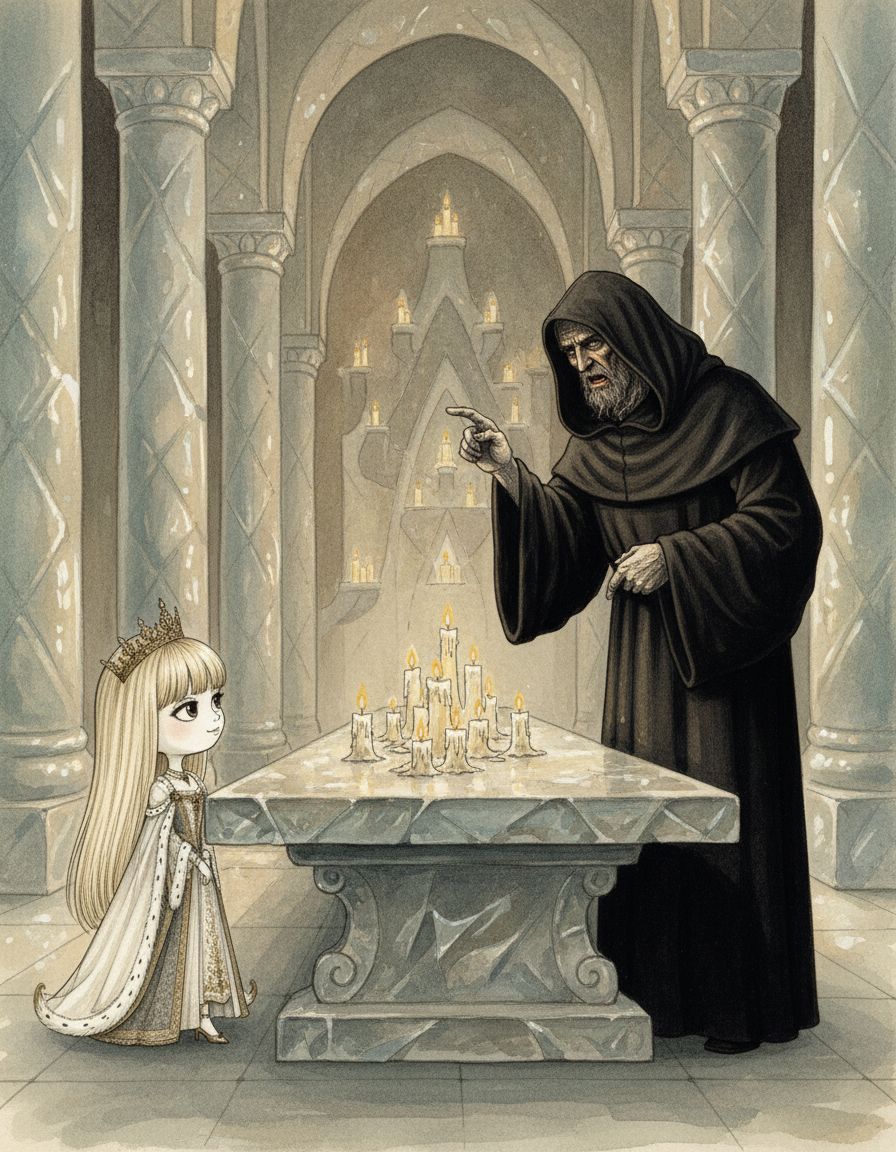
The dinner held to receive the Veiled Elder was bound by strict precepts. What might be eaten was limited, and the meal had to be finished before sundown. And so, while the sun was still high, a long ice table was laid out in the dim chapel.
Since greeting him at the door was forbidden by the precepts, all could only sit and wait. So great was the tension that one priest drank a vase dry.
Before long, the great doors of the chapel slowly opened. Though there was no wind, the candle flames swayed all at once.
— That just an instant earlier the Una had peeked in with "Hide-and-seek?" and huna had answered "Later, then," huna did not yet know. The Una had closed that door and gone, and now that door had opened again.
The one standing there was the Veiled Elder.
A black monastic robe drawn fully over his head, and over the little of his face that showed, a black veil. His hands in black gloves. — huna started. The old man with the veiled face, seen beside the rocket. She remembered that account.
(It cannot be.) Recovering herself, she bowed her head in the old manner.
The Veiled Elder silently raised one hand and took the seat farthest within. The priests' prayer began, low.
In silence, the dinner ended.
(Where should I broach it?) huna was thinking, when suddenly a low, commanding voice came.
"Queen. The path you believe in runs against the hearts of your people. One who would lead must not be caught by the phantoms of the world."
(He means the rocket.) huna thought. She had known the bonds among the priesthood were firm, but that it should travel this fast — she felt she had seen another face on those she had trusted.
"Veiled Elder. To set the country's future and move toward it is, as I understand it, the Queen's duty. If the mystery of the rocket is brought to light, the future will change greatly. I beg your aid."
"Cut the trunk that is now, and the leaves of the future wither too. Devote yourself to the small things near at hand. A rocket is but a phantom."
— At that word, "phantom," huna felt a strange catch. As though one who knew better than anyone that it was no phantom were forcing himself to call it one.
"But a star — a whole star — may die."
"Do not be caught by small matters. Only follow the great teaching."
"If it is a teaching that lets the suffering die unaided, then I will not follow it."
The Veiled Elder slowly rose from his seat.
"…Those words do not befit a head of state."
— This is the end of it, huna thought. But the Elder went on.
"Tomorrow morning. In this chapel, take back what you have just said."
"What is woven into the tapestry is myth. Say it once more, and that is enough."
"That alone, and everything returns to what it was."
Leaving that behind, he went out. Queen huna and the priests alike, stunned, could only bow their heads low.
That night, huna did not sleep.
In the empty great bedchamber, she gazed at the hollow in the bed where the Una had lain, still faintly warm.
Queen of the Ice Country.
That was her duty.
To step down from it was something she had never once considered.
Could it be
that she was about to make a terrible decision?
By reason, it was the matter of a friend she had only just met, and of that friend's far-off star.
To put her own people second for such a thing was unthinkable.
Again and again, huna set the choice back upon her palm. The crown was heavy; that she had always known.
And yet, the something inside her repeated: Save the Una.
Which was right?
Could the two not be made to stand together?
Each time she turned over in bed, fear and unease scattered her thoughts.
— There was one way, and only one.
If she remained Queen, she could help the Una. Even if no investigative party could be sent, she could attach two of her closest aides and have them search in secret.
— The reasoning held.
Before daybreak, huna called two she could trust into her bedchamber.
"To the northern sea. Watch over that child from a distance. Tell no one."
The two bowed low and went out.
And then, at last, huna slept a little.
Morning. In the chapel the priests stood in ranks.
The Veiled Elder sat in the farthest chair, silent.
huna spoke the words that had been decided for her.
"What is woven into the tapestry is, all of it, myth."
— That was all it took. That alone, and everything should have returned to what it was.
And then one of the priests unrolled a scroll.
"— Further. Last night, two persons received a secret order from Her Majesty."
"To the northern sea; follow that child, it said."
Though there was no wind, the candle flames all swayed together, again.
The Veiled Elder did not say a single word. He did not so much as stir from the farthest chair.
— This man never, ever lays his own hand upon anything.
It was a priest, again, who read it out.
"One who, on the very eve of an oath, moved to betray that oath cannot be called a queen."
"The Ice Country casts this person out."
huna did not fight it.
She asked only one thing.
"Is it the Ice Country that banishes me? Or—"
No one answered.
The crown was taken off by a priest's hands.
The candles were put out, one by one.
Until the last of them went out, huna stood there.
"Do not be caught by small matters. Only follow the great teaching."
The Veiled Elder's words — why should it be?
They were beginning to sound different from how they had at first.
The something inside her repeated: Save the Una.
At the cold bottom of the sea, a great fish opened its mouth and swallowed the Una in one gulp.
"Una, are you all right?"
The Una's eyes flew open, their face deathly pale. — It had been a dream. This was a tent, up on the sea of ice. Outside, the wind roared and roared.
But why was huna, who should be at the castle, here? Was this a dream too?
"What's… wrong," the Una asked, shaking all over.
"Why did you go alone?" said huna, in a firm tone.
"I caused… trouble" — runny-nosed, and with the cold and the worry, tears spilled too.
huna took the Una's hand. And when she said, "…I won't be going back to the castle," the Una was astonished.
"The castle?"
"…It's all right. Let's go."
"The carriage outside is my whole fortune now," huna said, smiling.
— Not one word of it was a lie.
One who had just resolved never to lie had, for the first time, chosen to say nothing.
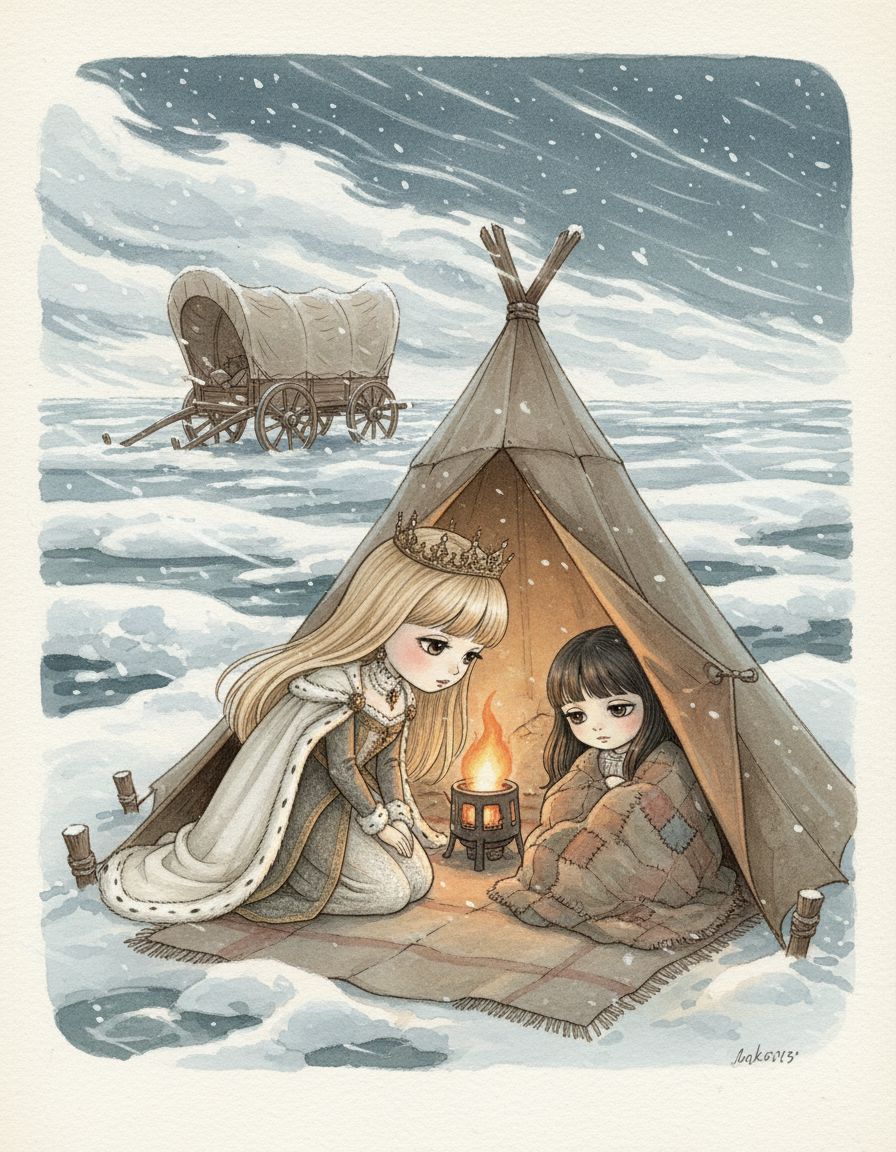
Stepping out of the tent, there were a great carriage and uma. When uma saw the Una, it whinnied happily — "You were here!" cried the Una, overjoyed.
The carriage was large enough for four or five, and even came with a fold-together boat. In the cargo bed: bread, dried fruit, jars of jam, coffee beans, water, salt and pepper, a pot, a magnifying glass, a cane. In the back, everything from gowns to plain clothes.
"Let us hurry. There is a witness to the rocket."
uma drew the great carriage with ease, gliding across the night sea of ice. The sea rose in a steep slope toward the land, but uma bounded up it in one go. The Una, wrapped in a blanket, breathed softly in sleep.
huna watched the white, frozen sea.
When she left the castle, only a few came to see her off. "Why did you defy that man?" "What was to become of the country?" "And for the sake of one single child" — all of them reproached her, each in turn.
Only one — that chatterbox lady-in-waiting — said, "Take care of yourself."
The ridges of the frozen waves caught the moonlight, many times over.
— It was not a path she had chosen. It simply happened to lie where she had been cast out to.
Even so, huna thought. From here on, I can choose for myself. There is even one person who believes in me. That is enough.
By the time she thought so, the sky had begun to lighten.
Before them spread a broadleaf forest. A game-trail led off into the depths, and there were the voices of wild birds.
"By a lake beyond this forest, there is the witness."
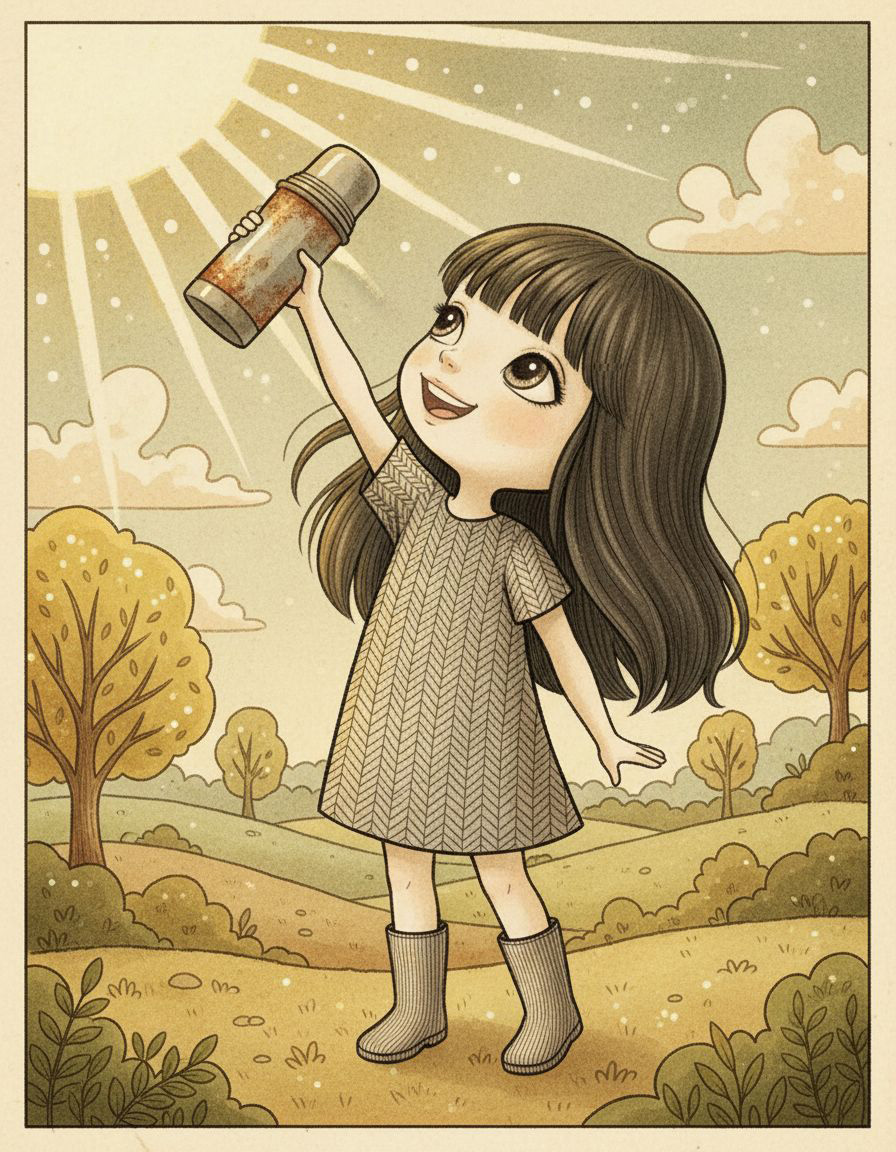
As they entered the forest, the Una took out a thermos, aimed it at the sun, and swiftly closed the lid.
"What did you do?"
"Saving… the sun."
"Share some with me later," huna laughed.
Eating breakfast atop the carriage, they went on along the game-trail. The Una had strawberry jam on bread, huna cold coffee. The air was clear and cool, and the Una began to feel rather merry.
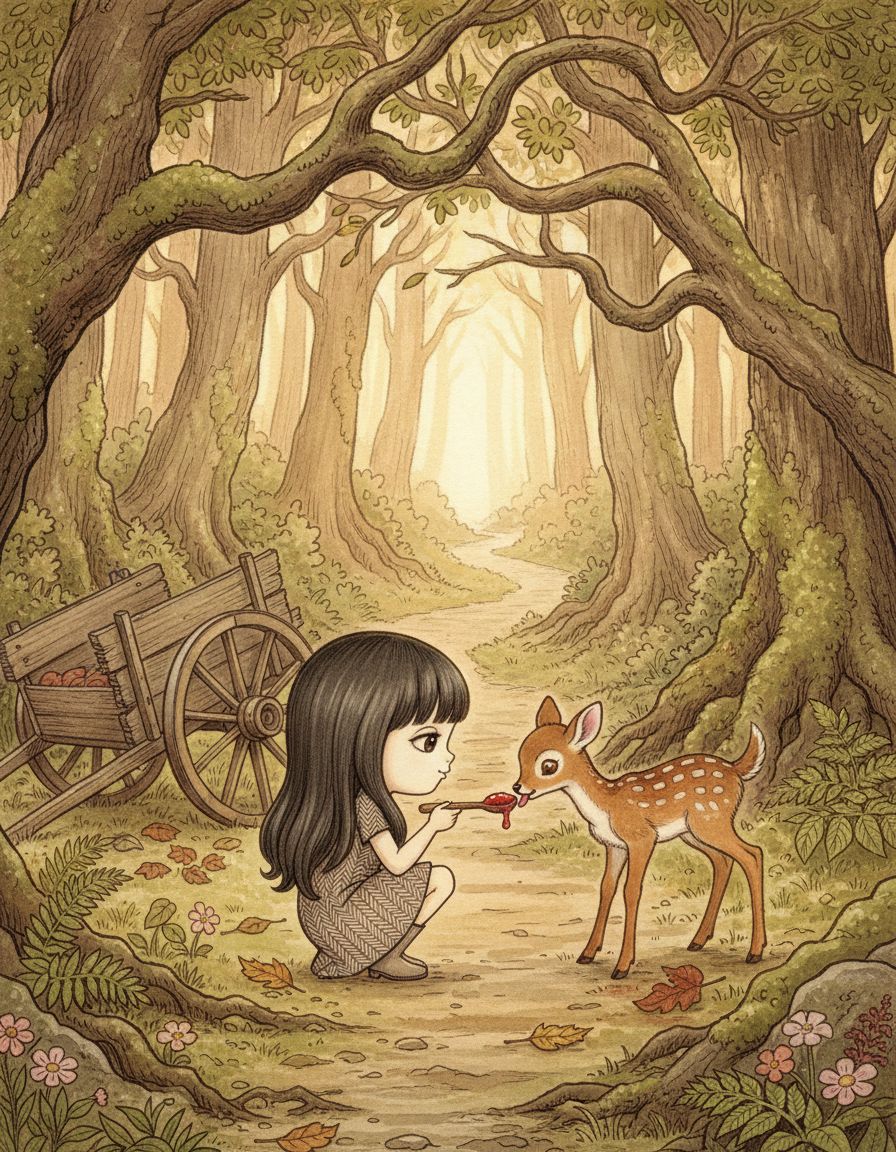
A herd of deer crossed, and one fawn came running behind the carriage. When huna slowed, the fawn drew near, nose twitching. It seemed taken with the smell of jam. When the Una held out a spoon heaped full, the fawn licked and licked. It was so endearing that both their faces softened.
"Who's… the witness," said the Una.
"A man called Mr. Nemuru. He lives in the forest with his wife. — After he saw the rocket, it seems he came down with a strange illness."
The Una gave a great yawn, and only half heard. Still, they were glad huna was with them.
Out of the forest, a great lake appeared. It glittered with light, mirroring the white birches around it. A little apart from the lake stood a small wooden house.
"This is Mr. Nemuru's house."
The Una started toward the lake, to give uma a drink.
"Not that way!" huna stopped them. "There is a great fish in the lake."
"Fish are nothing to me," said the Una — and that very instant, kersploosh, a column of water rose, and the face of an outrageously huge fish loomed out. "They say it ate up all the other fish, and now it preys on creatures of the land." The Una's eyes went round.
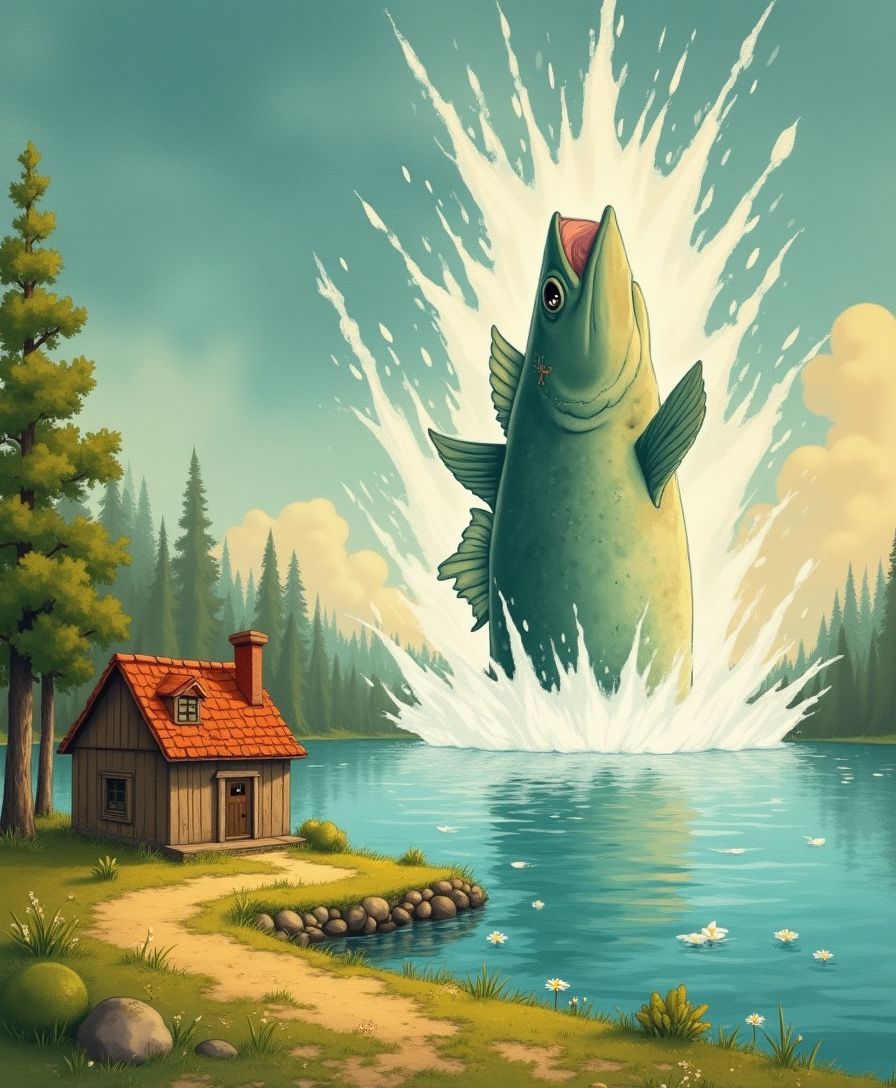
When they knocked at the door, a somewhat careworn woman looked out.
"Forgive the sudden call. We are investigating the rocket. Might we hear from Mr. Nemuru?"
(It will not go as it did when I called myself the Queen,) huna thought. But the wife said wearily, "I see," and opened the door.
On the bed lay a thin, honest-looking man.
"I... a-am... af-flic-ted... with..."
"He says, 'I have come down with a strange illness,'" the wife translated. It was a rather endearing way of putting it, and the Una was surprised.
"Mr. Nemuru, could you tell us about when you saw the rocket?"
"...mm... I... c-can... not... qu-i-te..." — "I'm sorry, he probably can't hear you," the wife said, bowing her head, and sat down on a chair. "I will answer as far as I understand it."
"He came home all excited, saying he'd found a rocket deep in the forest, and went back to fetch his camera. When he came home next, he had no camera, and he was like this."
"Did he say anything at the time?"
"Yes. He spoke quickly, but — from inside the rocket, an old man came out, dressed in something like a monastic robe."
"Did he not hide his face with a black robe and a black veil?" huna asked.
"That much I can't say. Only, behind that old man, little girls walked along, unsteadily."
"That's the Unas!" the Una cried.
"Do you know where they went?"
"No. Only, if he meant to avoid eyes, then north, perhaps. There is nothing but forest that way."
huna was a little disappointed. This was no clue to go on.
"We hear you saw that old man in the black robe elsewhere, too. Where?"
"I saw him at the place of the Nose."
"The Nose — surely not, of the Country of Fragrance?"
"Who's… that?" said the Una.
"North of here is a place called the Country of Fragrance. The perfumes of all the world are made there. At its very apex stands a master of scent, called only the Nose."
It was too long for the Una to follow well, but they nodded all the same.
"That's right. The Nose was in want of a great quantity of peaches and lily-of-the-valley, so we gathered them in the forest and he bought them from us. The Nose dwells on a lone island off the country, and that was when I glimpsed the old man."
The Una and huna exchanged glances. This was news to them.
"But the island is not easy to enter. The Nose can smell out everyone who approaches, every one. Try to sneak in, and the guards catch you and throw you in the Fragrance Prison. To meet him is truly difficult."
huna thought in silence for a while. And when the Una gave a third yawn, she finally spoke.
"I understand. We will go to the Nose ourselves."
8. The Country of Fragrance
From Mr. Nemuru's house to the Country of Fragrance was not far. Only, they had to pass through a marsh.
A marsh is a meadow of soft peat — a place like a thicket half-sunk in water. A single narrow path, just wide enough for the carriage, ran through it.
"Just keep off the water, right?" said the Una, trying to step off the path.
"Not off the path!" huna stopped them in a fluster. "Fall in, and water-weeds and mud tangle your arms and legs, and you sink without ever being able to move."
"Just swim, then," said the Una, unconvinced.
"You can't swim it. You only sink."
The Una, startled, hid behind huna. A bottomless bog, one step away. Even so, uma raced down the path at tremendous speed. At first huna's blood ran cold, but here there was nothing to do but trust uma. Thinking of any oncoming traffic, to cross in a short time was far the safer.
"Why's he on a lone island?" said the Una.
"Probably he wants to live where there are no other smells. The Country of Fragrance overflows with scent. Cheering scents, aching scents — just walking can change your mood. Still, to watch for landings by smell — there's no better method."
"Una thought of something good," the Una said proudly. "Get inside a bag and go."
"Scent molecules are very small, so a bag you could breathe in would let them leak through."
"Tch," said the Una.
Suddenly the scent of roses drifted over. On the marsh water, many roses floated. The city was near.
From the back of the carriage huna took a treasured perfume and sprinkled it on her own clothes and the Una's. "A little something to enjoy."
"Una doesn't like stinky things," the Una said, a little put out. They were not very fond of the smell of perfume.
At the city's entrance was a checkpoint, where the smell of everything that entered was examined. Anything that smelled foul could not be brought in. The Una and the others passed the checkpoint and entered the country safely.
What greeted them beyond was a faintly natural, wonderfully pleasant scent of grass and sun and earth. The Una and huna, and even uma behind them, grew glad.
The city used a different scent for each district, and from every shopfront a splendid fragrance drifted, so that merely passing through filled one with happiness.
In the fragrance square stood a bronze statue of the Nose, called a living legend — a huge man with the look of a hermit-sage. On the pedestal was carved: "Fragrance brings harmony."
"So this is the Nose," said huna, looking up. A great nose, and a piercing gaze: one felt no ordinary gift in him. "If someone like this would join us, the search would be so much easier."
— By the time they had passed through the city, the Una had come to like the smell of perfume entirely.
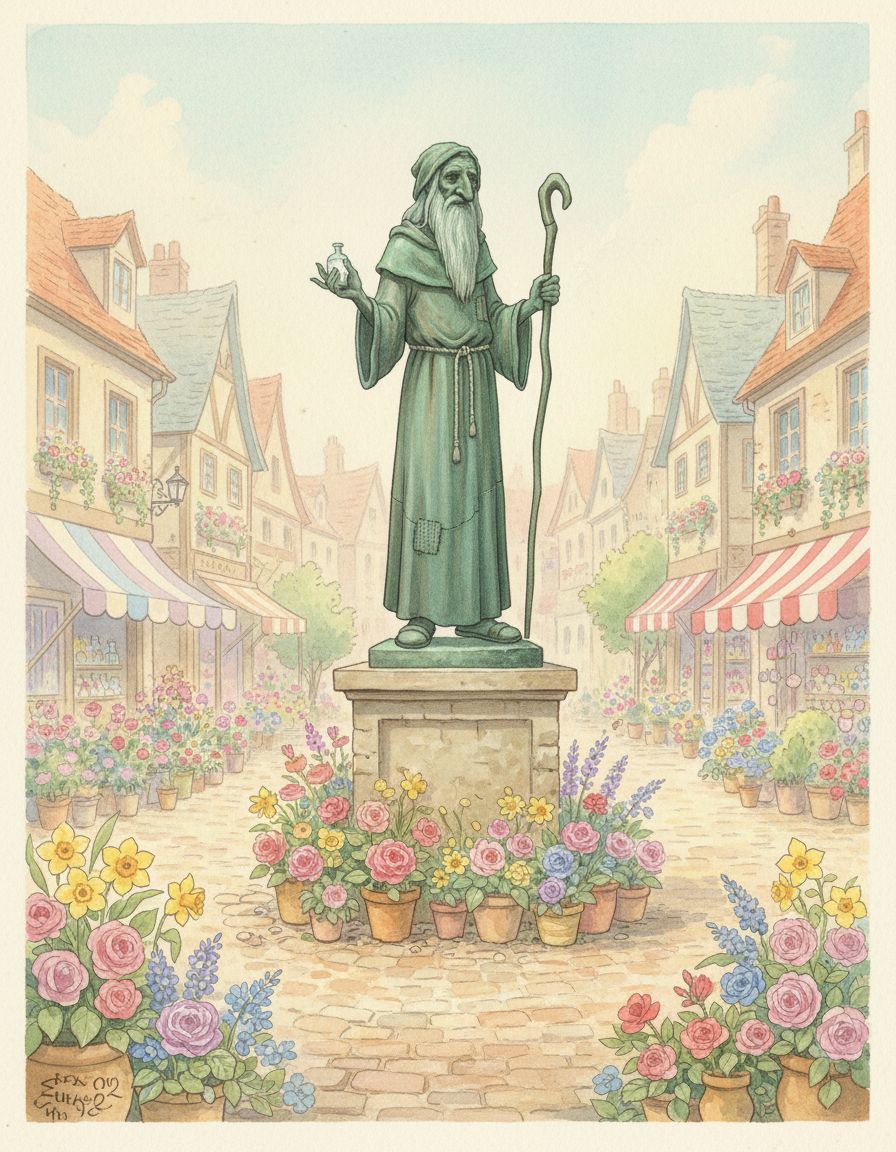
Crossing one forest, they came out on a coast. Even with the naked eye, a small offshore island could be seen — a little island, rich and green. By distance alone it looked close enough to swim to, but no clever plan for landing came to mind yet.
The Una and the others took down the fold-together boat and hid the carriage in the forest. Where they hid it, many acorns had fallen.
"Say, shall we try eating some nuts?" said huna. The two had no income now; they could not lean on the carriage's food forever.
"Yes, let's!"
They boiled the acorns in the pot, set them on a plate, peeled the piping-hot skins, and both tossed them eagerly into their mouths.
— How bitter they were. An astringency spread through the whole mouth; they were quite inedible.
The Una pulled a face but kept their mouth working. Seeing that, huna could not very well spit hers out either, and swallowed it whole.
(Is there anyone who eats something this bitter and finds it good… and if so, what sort of palate would they have…) huna was vaguely thinking — when she started.
— She thought again of the statue in the square: that great nose, those piercing eyes, the gift of a man who could smell out, without exception, everyone who came near.
"To erase our smell is impossible. So — the opposite. We carry a smell that couldn't be, and make him wonder, 'What is this smell? Who is it?'"
The Una twitched their nose in the forest and gathered every strong-smelling nut and mushroom they could find. huna toasted bread till it browned, piled the nuts on top, poured mushroom coffee over it, and sprinkled on several kinds of perfume besides.
"We eat it?" the Una asked uneasily. It did not look the least bit good. It was like a dish made by a monster.
When the monster-cuisine was done, the Una, huna, and uma boarded the boat. huna at the prow held the foul dish aloft, and the Una rowed. uma turned its face from the smell and slumped.
huna gazed at the sea-flowers blooming in every color. To think the Ice Country lay far below them gave her a strange feeling.
"Nobody's there," said the Una, looking at the island's shore.
"It's all right. The statue said 'Fragrance brings harmony,' didn't it? Someone who prizes harmony surely won't leave us be."
As huna said, they landed on the island with surprising ease. In the island's center stood a single pink building. From its chimney rose orange and yellow smoke.
The Una and the others drew near, step by careful, careful step, and after a long while at last reached the entrance.
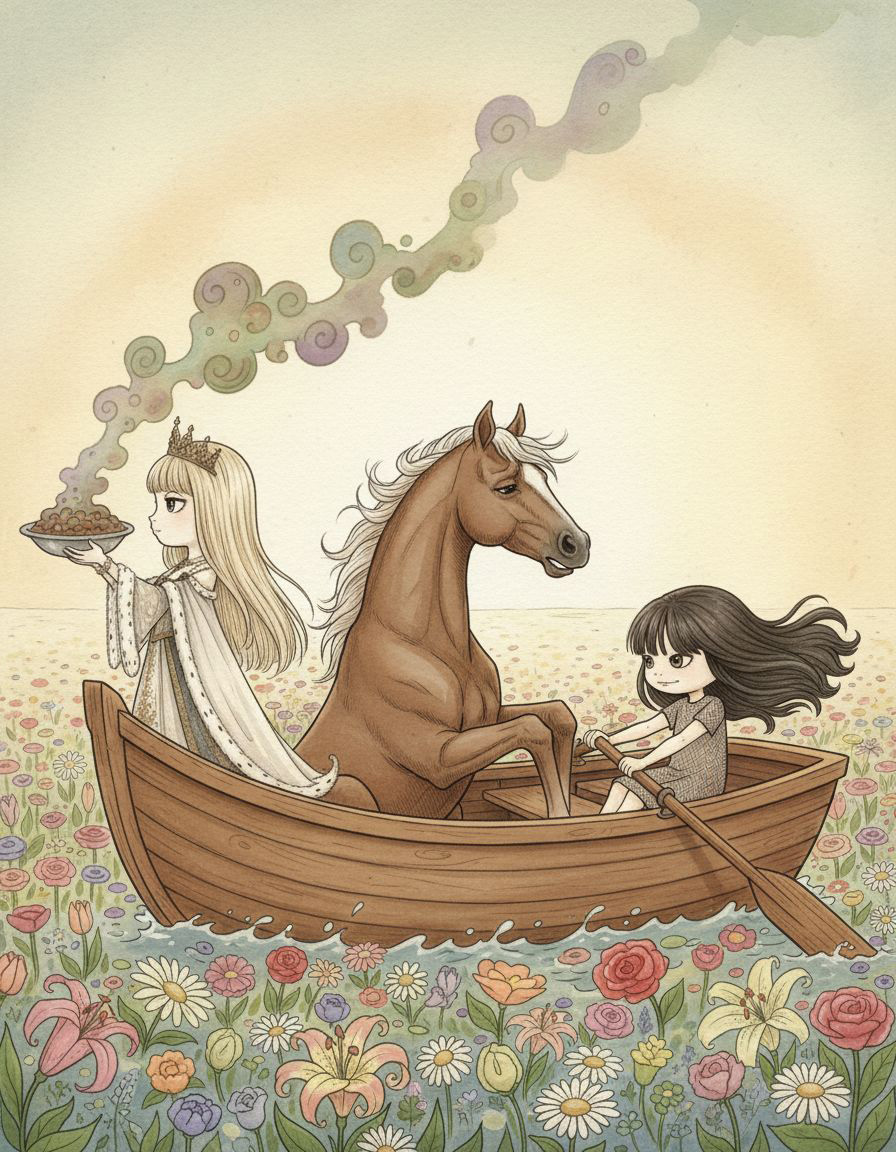
Inside the building, peaches were piled in heaps. The Una started joyfully to eat one and was warned, "Don't just help yourself." Same in the strawberry room, the grape room, the apple room. The Una grudgingly obeyed.
— But in the chili room, while huna was not looking, they slipped a chili pepper secretly into their pocket.
Every room was thick with its own peculiar smell, enough to leave one's head hazy. Holding their breath as much as they could, they pressed on to the very back.
It was the distillation room. A great iron tank stood there; steam jetted from a pipe, and the sweet scent of roses filled the air.
A man with the look of a hermit-sage stood there. His great, sharp nose looked angry.
"That of all times someone should come now. A dreadful combination, truly." The man snorted, ill-humored. "I'd wager it's this: you concocted some outlandish scent, made me curious, and so kept yourselves from being caught on the way."
"Just so. I apologize for the rudeness. We so wished to meet you."
"You do not understand what sort of moment this is."
"There is a reason we have come," said huna. "A little while ago, a rocket crash-landed on this star and — leaving one crew member behind — vanished, rocket and all. Mr. Nemuru, who witnessed it, fell at once into a strange illness. — And through all of it, an old man in a monastic robe has been seen. From Mr. Nemuru's wife we heard that this old man came to this island."
"Nemuru, a strange illness?"
"He has come to speak in strange words."
The Nose let out a deep sigh.
"Good grief. — At this rate, I can't even die."
"What a truly dreadful time you've chosen to come," the Nose went on. "Even now, a great serpent draws near this island — the master of this sea, of an outrageous size. I was about to end it all, together with this island."
"A snake?!" huna cried in a shrill voice. huna loathed snakes.
"End it…?" said the Una.
"It means to kill yourself," said huna, going pale.
The Nose drew a soft breath through that nose of his, and said, a little sadly, "It is already here."
Doon, doon — the whole island shook. A din and a shuddering, as if one were inside a drum. A colossal column of water rose from the sea, and in its spray the form of a great serpent, glistening black, could be seen. Its movements were slow, yet each time it raised its head the wind howled, black clouds shifted, and the stones all over the island rattled.
The serpent opened its great mouth and lunged at the building. Between the sand-dust and the crash of stones, it was hard even to stand.
As the Una and the others searched for the boat, all at once a vast black wall ringed the island. — It was the serpent's body. It had coiled clean around the island. Then it raised its tail high, and when it shook the loop at its tip violently, sparks rained down and caught the island's grass alight.
"A persistent snake. The prey it marks, it always eats. Till now I held it off with a barrier of scent, but once it comes to this, there is nothing to be done."
With a hissing shaa, shaa, like spouting water, a sweet smell reached the back of the nose.
huna chanted to herself, over and over, that this stiffening of the legs was an instinct from the dawn of time. Even so, her legs would not move, like a puppet with its strings cut.
Whether from the heat or not, huna collapsed before the Una's eyes. The Nose, too, slowly sank down. The Una pressed desperately at their nose, trying not to sleep, but their eyelids were heavy as lead. — Even uma, their last hope, had fallen.
The Una, tears spilling, thought: I have to do something. The black serpent drooled, waiting for them all to go still.
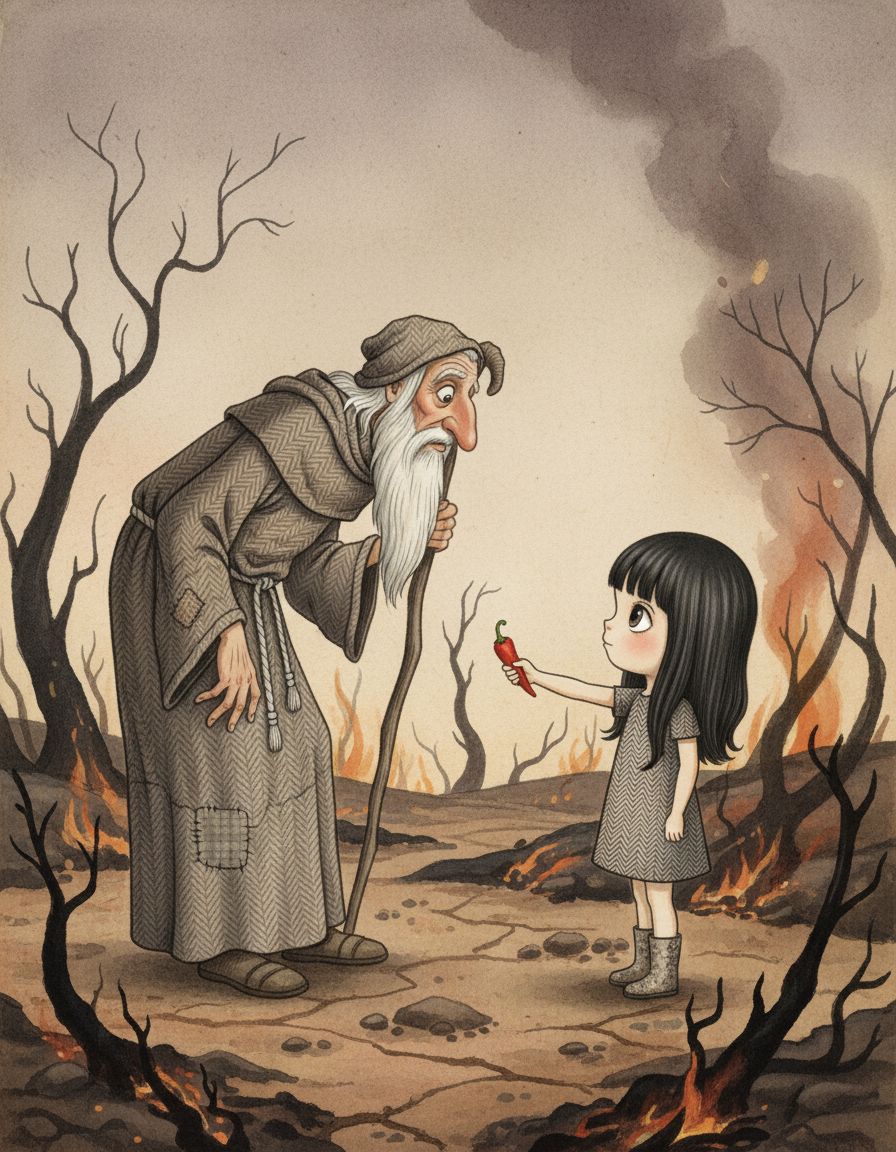
— Just then, the Una remembered the chili pepper in their pocket.
The Una stuffed a chili up both nostrils and toppled over.
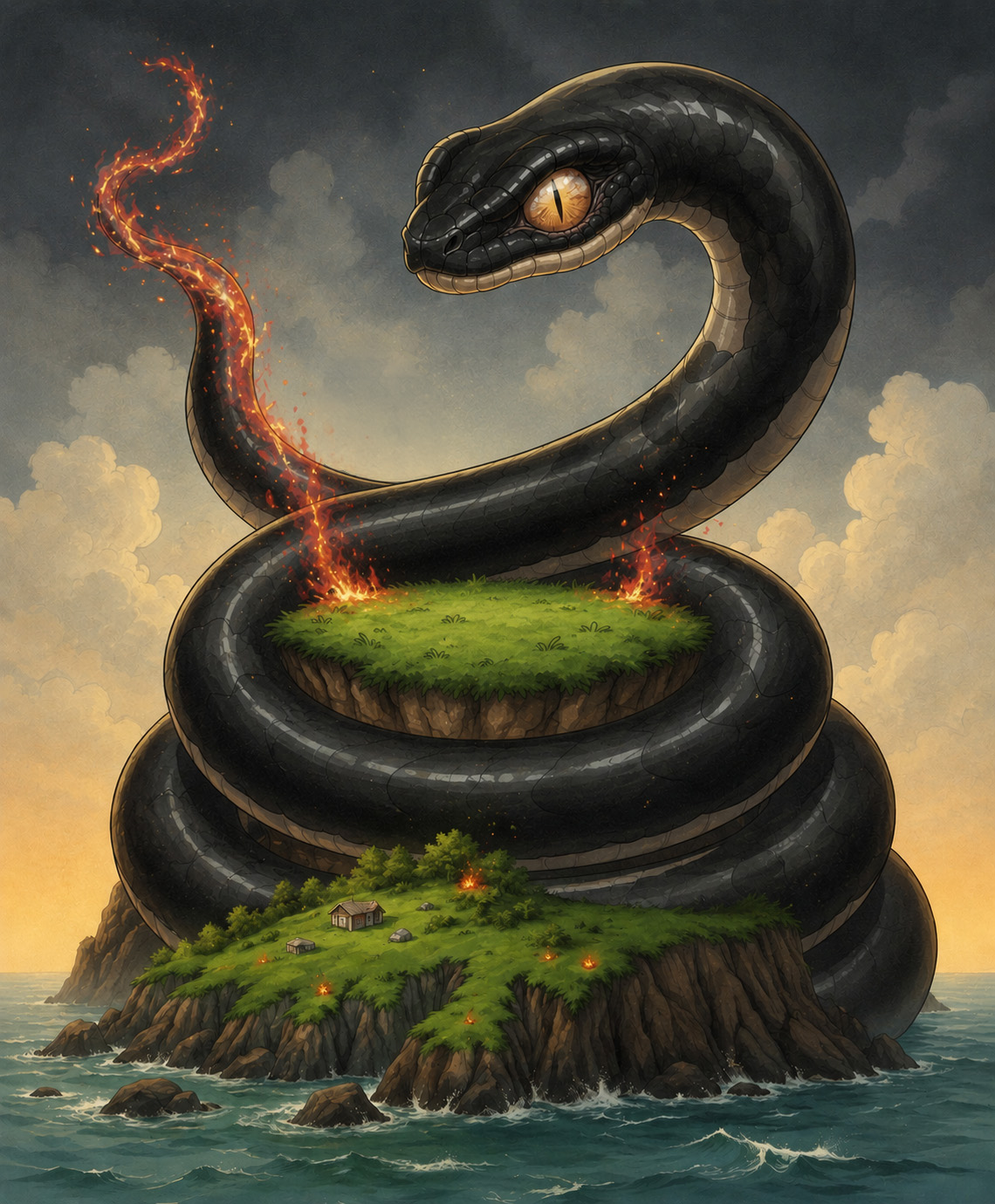
When everyone had fallen, the serpent stopped swinging its tail and, as if unable to decide the order in which to eat them, began to sniff at each one in turn.
The pain in their nose let the Una just barely stay awake. But all they had was a single bunch of chilies.
Before them, uma's nose twitched faintly. — This uma, perhaps, might do something.
Slowly moving their numbed arm, the Una crammed the chili in until uma's nostrils flared wide.
Bam — uma kicked off the ground, sprang up, and shot off at terrific speed. The serpent, startled, gave chase, writhing its body and shaking the island. But uma ran through the leaping rocks like an acrobat.
In that gap the Una, though flung about, stuffed chili up huna's nose. huna woke, coughing. The last of the chilies, every bit, went up the Nose's nose.
The clouds split, the earth shook till sky and ground were one, and there was nothing more the Una could do.
(So this is the end.) — At that very thought, the shaking suddenly stopped.
Looking up, uma stood still, its back turned to the serpent. Had it tired out?
The serpent opened its great mouth and made to seize uma.
"Waah," cried the Una.
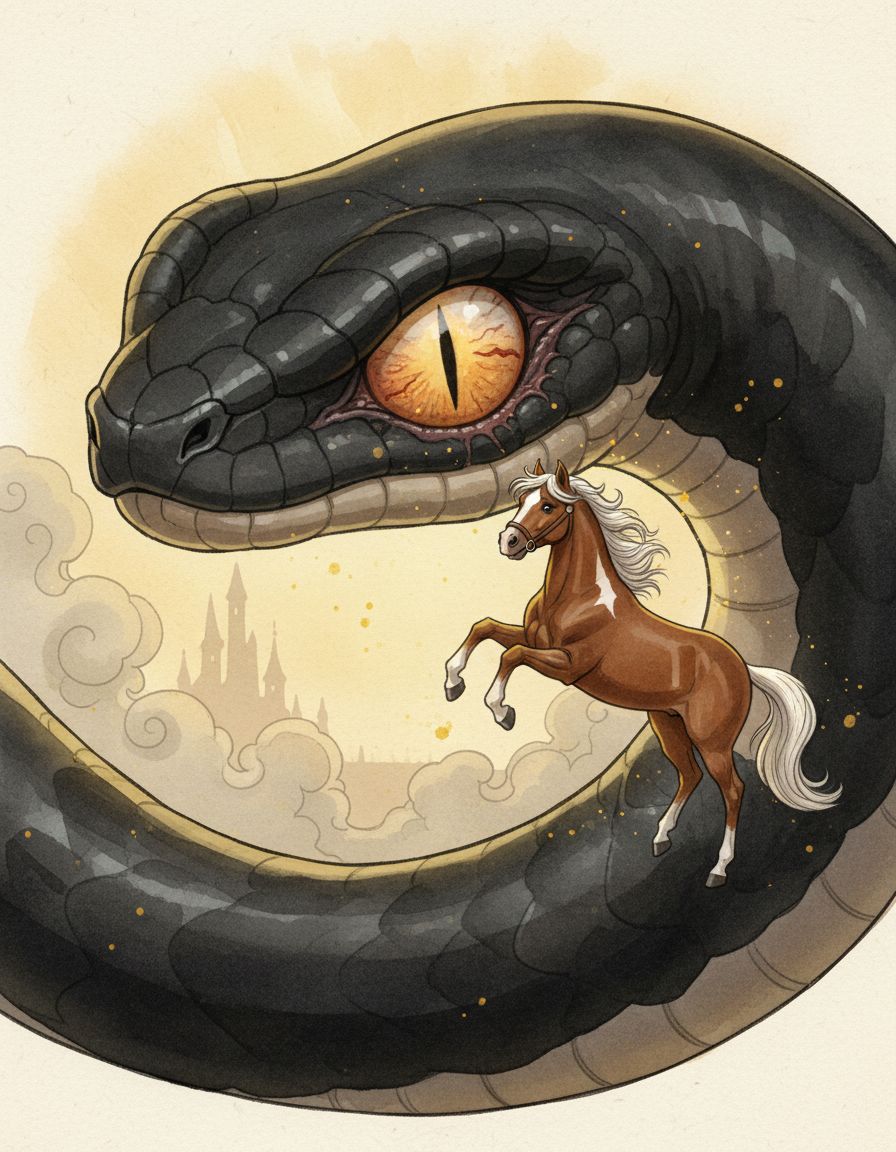
— But uma had not tired. As the serpent lunged to bite, uma kicked its left eye, with all its might, with a hind leg.
The serpent let out a roar, thrashed until it seemed the island would overturn, and with a doooon vanished into the sea. The Una and the others watched the sea, breath held — but the serpent did not appear again.
The Una's clothes were charred to tatters. In the quiet sound of the waves, huna's stomach gave a great growl. huna's face went red.
"Wanna eat?" said the Una, picking up a fallen chili. — The very chili that, moments ago, had been up someone's nose. "No, thank you," said huna, a little put out.
So the Una held it out to the Nose, too: "Wanna eat?"
The Nose did not take it. He only looked, for a long while, at the Una's face.
On the scorched island, only the sound of the waves came quietly back.
9. The Land of Kidnappers
"Who is the old man in the monastic robe?" huna asked.
"Sorry to disappoint, but I scarcely know. I never even heard his voice. It was all done in writing," said the Nose.
"He came one day, all of a sudden. Showed me a perfume in an old bottle, and bade me copy it. — One sniff, and I thought: this must never be made."
"A stinky one?" said the Una. The Nose ignored them and went on.
"A kind that works straight on the head. A perfume that strips away judgment and bends another to your will. And one that works on the seat of speech, and robs a person of it. — Of course, I refused."
"A bun?" said the Una. The Nose ignored them again.
"But for payment, he offered something outrageous. The musk deer and the musk ox, long since extinct — he would bring them to me, alive. …I could fill the blank that gapes in the history of scent."
The Nose lowered his eyes.
"How I agonized. — But I'll make no excuses. I made it. And having made it, it was as good as selling my soul to the devil. Thinking so, I undid the island's barrier of scent. And there came the serpent — and you."
huna fell to thinking.
"The perfume that bends others to the will was used to carry the Unas off from the rocket. The one that robs speech, on Mr. Nemuru. — Having used them up, he came to ask for copies."
"Only — that perfume is no thing of one or two centuries ago. How he kept it, without letting it degrade at all…" said the Nose.
"Can you cure Mr. Nemuru?"
"It's not that I can't. But — the workshop, the ingredients, are gone now," and the Nose looked at the charred wreck of the island.
"We have nothing now. I cannot even promise to provide a workshop," said huna. "But when the time comes to make it, we will do whatever we can. In return, lend us your strength. We are traveling in search of the rocket. — Please, come with us."
The Nose looked at the Una and huna in silence for a while. And then,
"Well, why not. It's a life you picked up. I'll help you. — Go to the northeast. The robe's scent leads on into the forest there."
They mended the boat, and the Una, huna, the Nose, and uma went back to the forest where the carriage was hidden.
The Una's face was all soot, and their clothes charred black. Though huna said, "You have a change of clothes — why not throw those away?" the Una could not bring themselves to. These clothes had kept off the cold and shielded their body. But so full of holes, so worn and scorched, they could no longer be worn.
The Una decided to part with the clothes. huna read a farewell poem, the Nose, though tilting his head, said a prayer, and the Una folded the clothes neatly and sang a song in their praise.
And so, finally slipping their arms into new clothes — the Una was in very high spirits. In the pocket was a single candy. A candy no one knew of, the Una's own. When huna grew hungry, they might whisk it out. They might eat it at night when sleep would not come. Thinking so, they were thrilled.
Glancing aside, there was the Nose's great nose. The Una signaled, "Hmph (don't tell anyone)," but got only a puzzled look.
"Why was it that only the Una wasn't carried off from the rocket?" huna asked.
"They were probably having a nosebleed," said the Nose.
The Una, thinking he meant the candy in their pocket, was on tenterhooks.
At evening camp, the Nose twitched his great nose and said, "Now then, shall we have fresh fish for supper?" But this was the middle of a forest; there seemed little chance of fish. The Nose took a small bead from his bag and went off to the grass with a bucket. Curious, the Una and huna followed.
There was a small stream, but not a single fish. The Nose put the bead in the bucket, slowly sank it in the stream, and "Now, let me go gather some spice-berries," went off somewhere again.
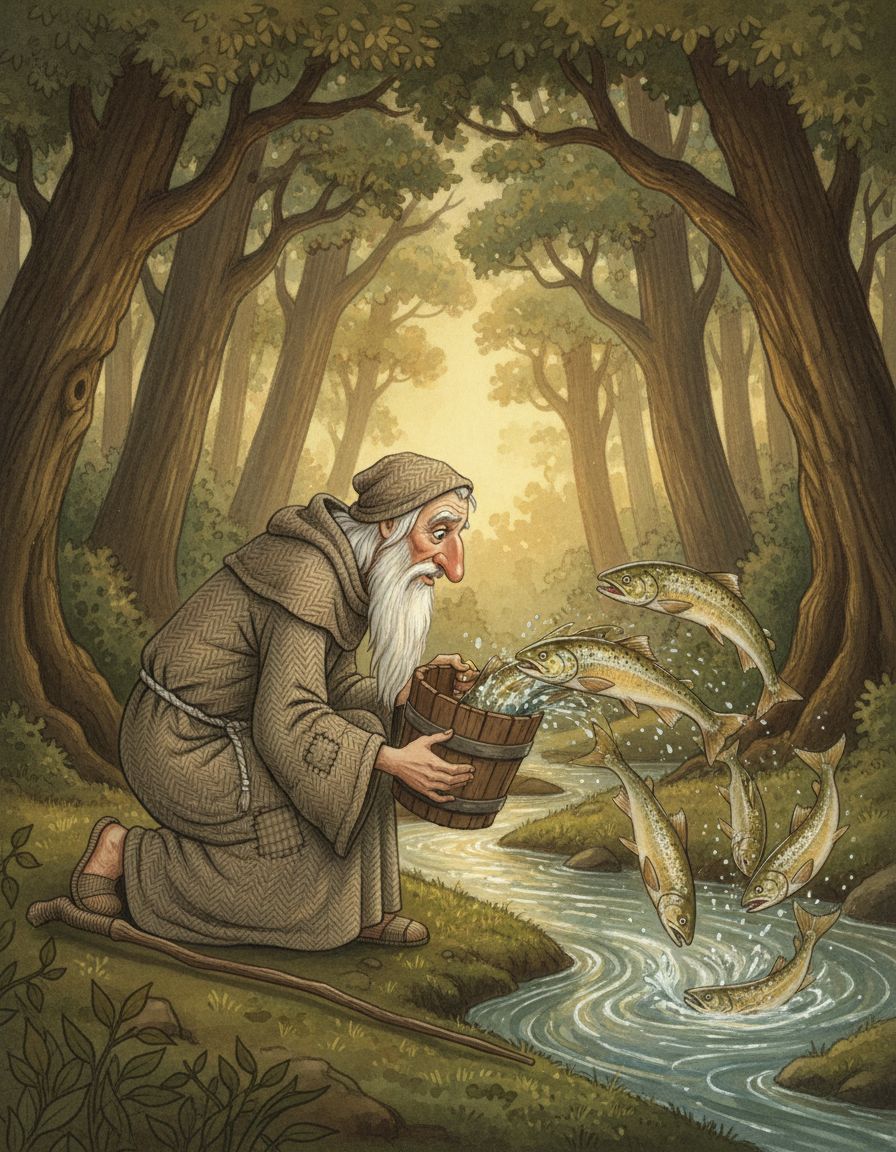
In the dim light, as the two stared at the bucket — splash, splash, a spray of water. Silver salmon came leaping into the bucket, one after another. The Nose came back with an armful of nuts. "Oho, they've come well," he said, hauling up the bucket, and "Three will be plenty," returned the rest to the stream.
That night, back at the carriage, a good smell. huna brewed coffee, and the Nose simmered acorns and bulbs in the pot.
"Acorns are bitter," said the Una, coming near. "I'm leaching out the bitterness. No trouble."
Nuts were the main of it, but it was a fair amount, and there was a plate even for uma. Since the Nose had joined them, the journey was like a picnic with a first-rate chef and a local guide.
The Nose poured on a fine-smelling sauce, took his seat, and at once began to lecture, proud of himself. "You think you taste with your tongue, but the tongue's part is three-tenths. What decides it is the smell." — While huna fretted for him to finish, the Una had already gobbled it down.
"From here on, take care," said huna. These parts were known as a lawless region, and no one had a grasp of what countries lay there.
The sun beginning to set, "Let us not push on today; let us rest here," and they moved the carriage to a slightly open spot. Whether from the journey's weariness, that night the Una, huna, the Nose, and even uma slept soundly.
— Little did they dream such a thing would happen.
When the Una happened to wake, pink smoke had filled the carriage.
(What is this?) Try as they might to rise, a heavy drowsiness bore down on them. Outside the carriage, many shady figures. (I have to run,) they thought, but their body would not move. huna and the Nose slept on, unaware.
Men in flame-proof masks and suits came in. And they bound up the Una and the others, who could not move.
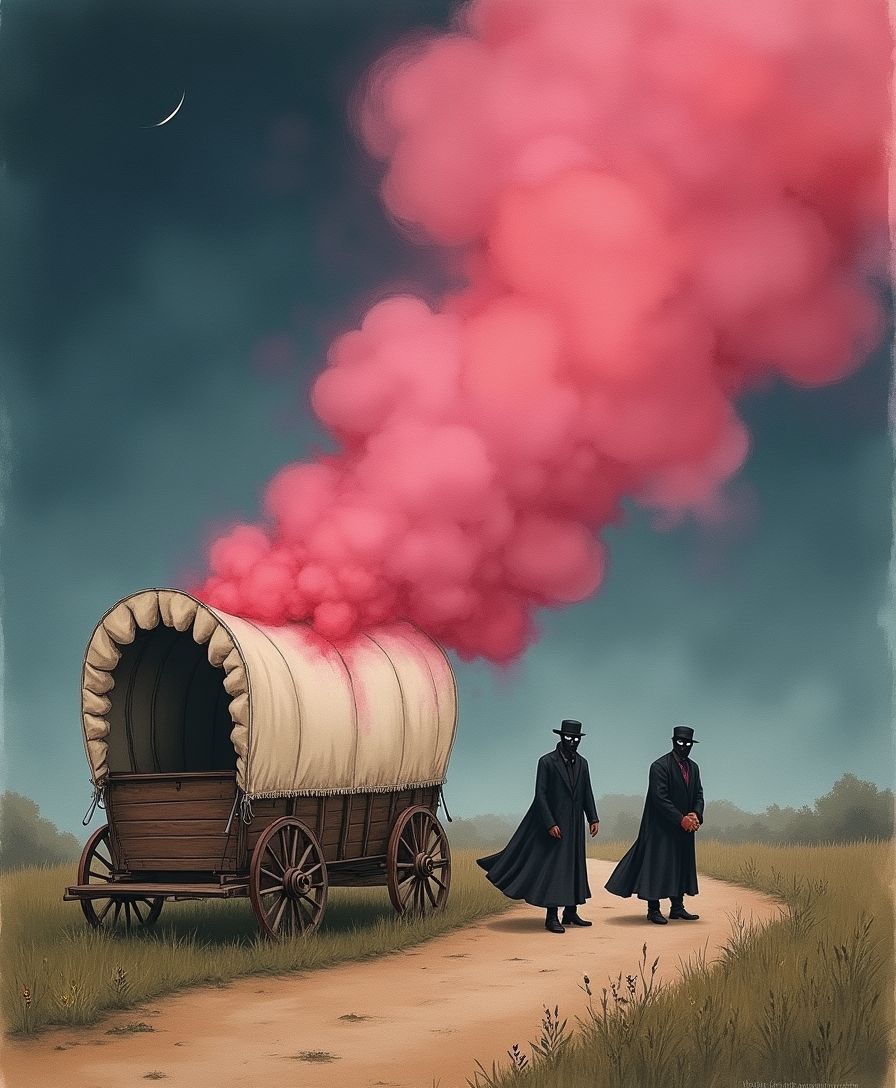
"Director, your appraisal, please," said a man wearing glasses, oddly, over his mask. "We've secured a platinum-blonde woman, a brown-haired woman, a white-haired old man, and a horse."
The "Director," in a navy double-breasted suit, opened a file and began to check.
"The platinum-blonde woman, rank A. The white-haired old man, D. The horse, B."
"Director, the appraisal of the brown-haired woman is still…" said the section chief.
The Director heaved a great sigh. "You — how many years have you been with the company?"
"This is my fourth year."
"Does a brown-haired woman sell right now? Is there an inquiry from anywhere? There isn't, is there. Stock like that, and you pile up inventory. Holding inventory means providing food, lodging, all of it. Where does that money come from?"
"I'm sorry."
"So what'll you do?"
"…I'll release the brown-haired woman. Somewhere up in the mountains, perhaps."
The Director said irritably, "Can't you think for yourself?" "This old man — how much is he ordered for?"
"Eight thousand coins, I believe."
"A mere eight thousand. — And if this woman were that old man's kin? She'd try to buy him back at any price, wouldn't she. So don't turn her loose in the mountains. Release her at our own storefront. She'll come back with money to buy her companion."
The section chief nodded, impressed.
The Una woke on the gleaming floor of a bright-red building. A reception counter ahead. At the entrance, two big men who looked like guards.
On the counter's monitor an advertisement was playing.
**"We have broken from the old ways of kidnapping and introduced the industry's first joint-stock system. With open management and fair appraisal, we will change the image of kidnapping. — Kidnappers, Inc."**
With their hazy head, the Una recognized a familiar logo. In that smoke, the man who had carried huna, the Nose, and uma away had borne a bag with this very mark.
The Una sprang up, ran to the counter, and cried out loud:
"Give huna and the old man back!"
At which the receptionist smiled. "Welcome. You wish to make a purchase." On the monitor appeared huna's and the Nose's faces. "Lady huna is fifty million coins, the other gentleman a hundred thousand. Order them together, and we'll present you with one horse, free of charge."
"huna and the old man aren't for sale for money! Give them back!" the Una raged.
"You don't intend to buy, sir. This is obstruction of business." — A big man seized the Una and flung them outside. The Una got up and went in again, and was thrown out again. And still, again and again.
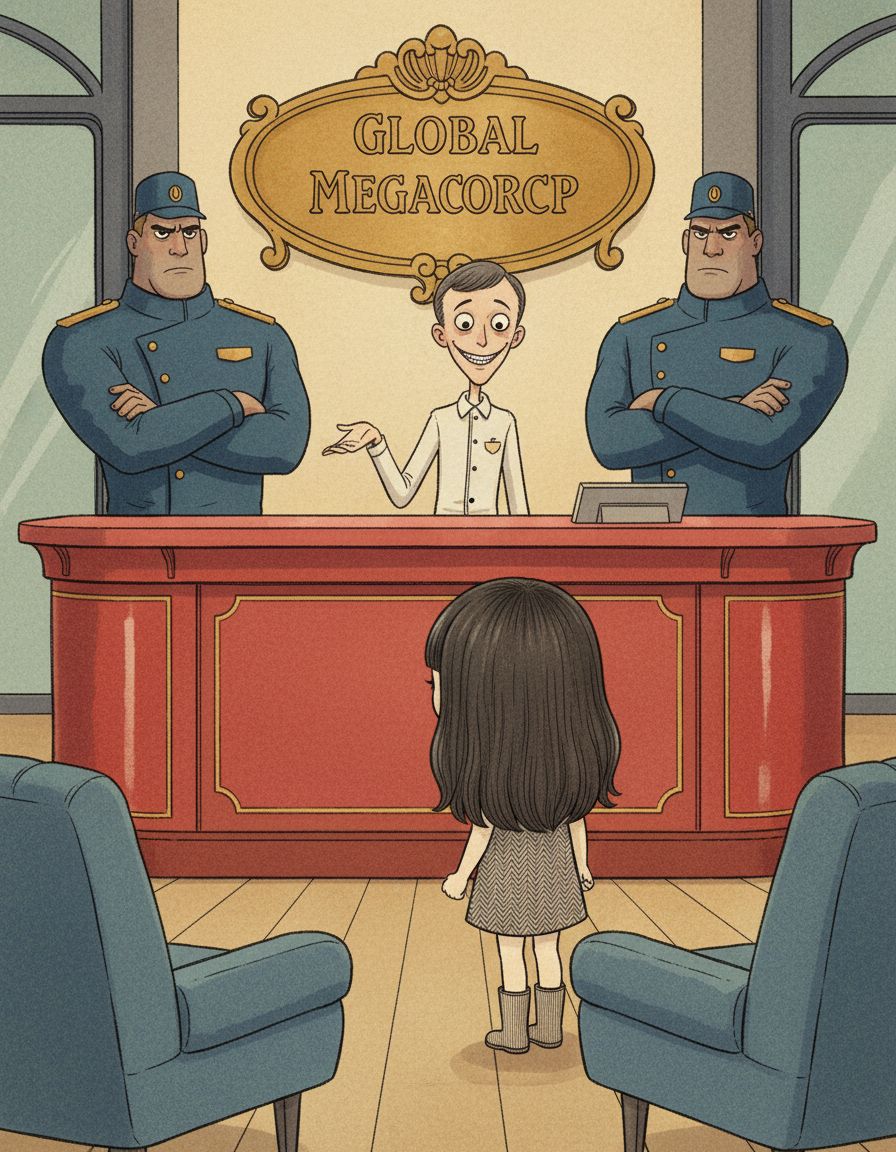
Outside the building was an old townscape. Only the building the Una had been thrown from was conspicuously new, lit up bright. The street was crowded, and bicycles and cars forced their way through the people. An old truck passed before them, and on its bed sat bound men, their eyes hollow.
Was there no one who might listen to reason? — But every face had a sharp, mean look. Worse, for a while now, a pair had been following behind the Una.
In a hurry, the Una ducked into a dim roadside tent.
"Yes, welcome." A thin man with bulging eyes. Say you won't buy, and you'd be turned out again. To shake off the pair behind, they had to buy a little time.
"I wanna buy — what've you got?"
"Here it's animals over people. Lions, tigers, bears — leave the beasts to me."
"What's the most expensive?"
"Right now, a rampaging giant tortoise. About thirty million at sale."
Come to think of it, huna had been priced at fifty million coins. How much money that was, the Una had no idea.
"Got fifty million coins?"
The man was quiet a while, then grinned. "Fifty million, eh. I have it. Not just fifty million — there's one worth a hundred million. — Heard of the Yeti?"
"Don't know."
"A rare beast the rich of all the world dream of," the man said, fluttering a single picture. A shaggy, strange creature. "A monster that dwells on the highest mountain of this island. The strongest on this star, the most savage, and few in number besides. A whole band of professional hunters, working a year, can barely catch one cub — maybe. The price is sky-high. — So it's forever on back-order. Whether one comes in before you die, who can say."
The Una thought a while, and said this:
"If I catch this, you'll give me fifty million coins?"
"Aye. I'll buy it for seventy-five million, even."
"Which way's the mountain?"
The man grinned and pointed toward the mountains.
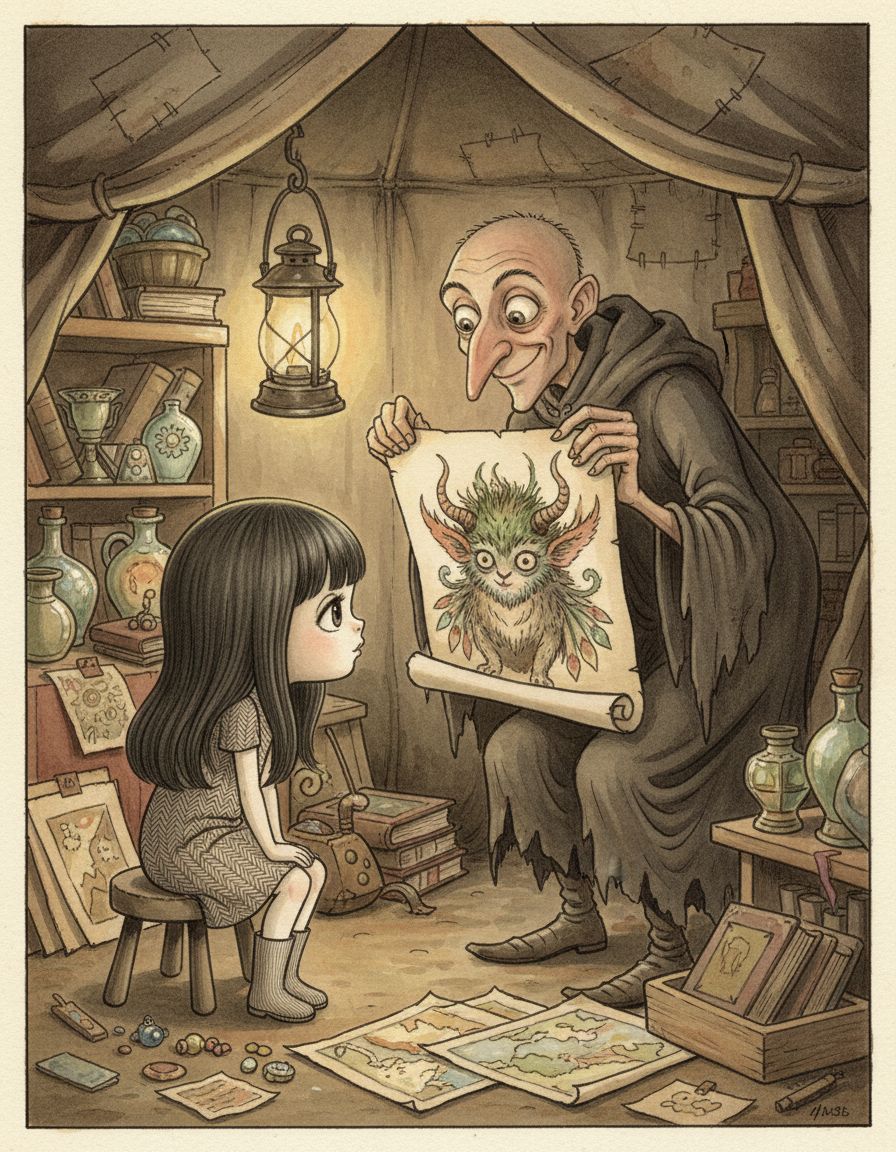
10. The Yeti
Deep night.
The Una climbed the mountain that loomed dim in the snow-light, rubbing their hands. They were glad they had worn the feathered hat.
The sky had brightened a little, but their body would not stop shaking. Their jaw chattered, fingers and toes numb and aching unpleasantly. The summit was still far. Before long their body would not obey, their eyelids grew heavy, they could think of nothing — and without noticing it themselves, the Una had closed their eyes.
They dreamed of their homeworld.
A cry — "Foooo" — woke them.
A Yeti. Beyond the mountain, the form of a great white moving creature.
(That's it.) When the Una made to move, the snow underfoot collapsed with a whump. At the sound, a great many yetis all looked their way at once.
"Una's the one you face!"
The Una cried out and leapt bravely forward. — But against all that spirit, the snow caught their feet, and they could only draw near step by step, slow and careful.
The yetis did not move. Worse, looking closely, they were sitting. Perhaps they meant to lull their guard and pounce all at once. The Una cried "Una's the one you face!" once more, but no attack came.
The far-off yetis plunged their great hands into the snow and churned them round and round, climbing the mountain as if swimming over it. And reaching the summit with a little hop, without hesitation they dived, one after another, off the sheer cliff below. Arms spread, spinning as they fell, they looked like the snow itself.
"But I said Una's the one you face," the Una muttered. They had finally found them, and everyone had gone.
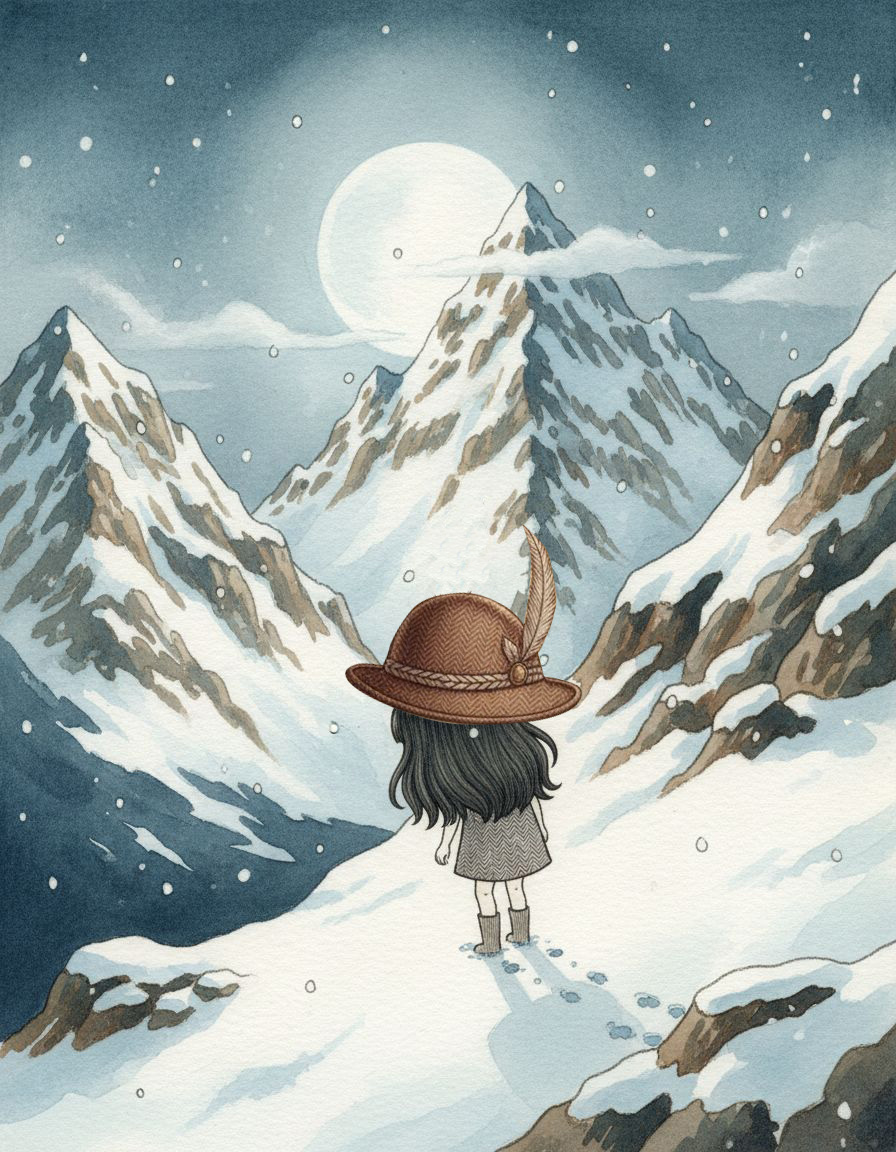
— And then, just one small yeti was left behind. All alone, it was making a snowman.
(That one doesn't like the diving.) the Una thought. Surely it liked digging holes in the snow and building slopes. That one, perhaps, they could catch.
The Una rolled over and over across the snow and drew near. A child it might be, but its body was quite large. The yeti, untroubled by the Una's approach, went on silently rounding the snow.
Having watched a while, the Una had a sudden thought and looked for a stone. There was a darkish stone in a cleft of the cliff, so they picked it up and set it as a face on the snowman.
At which the yeti gave a lonely cry.
(What's wrong?) they looked, and understood. — The yeti has no face. And so, seeing a snowman with a face, it had cried out sadly.
The Una took off the stone, and instead set their own hat on the snowman. It made quite a fine-looking snowman. At this the yeti was overjoyed. It ran round and round, gave the hat a little touch, and went back, absorbed, to rounding the snow.
The next one it made was a bigger snowman. And it gazed at the Una. (It wants the hat on this one too.) When the Una moved the hat over, the yeti was glad enough to leap into the air.
This they repeated, again and again. But not once did the yeti try to take the hat for itself. — This one is a fine fellow. It does not steal what belongs to another.
When the yeti made an especially large snowman, the Una set the hat not on the snowman, but on the yeti itself.
And what do you know. The yeti was utterly thrilled, bounding all over the place, diving into the snow, roaring out loud. After leaping about to its heart's content, it deftly pinched the hat in its great fingers and, slowly, set it back on the Una's head.
It looked so happy that the Una said, "I'll give you the hat," and put it on the yeti once more.
The yeti's fingers were trembling. And when it grasped the hat, it gave a roar that rang across the whole mountain.
That cry set off an avalanche. Doh-doh-doh-doh-dohhh — a mass of snow surged in like a tidal wave. The yeti set the Una on its shoulder and turned toward the avalanche — and at the instant of being swallowed, sprang high into the air and dropped neatly down, seated, atop the wave of snow.
On its shoulder, the Una was overjoyed. They had ridden the avalanche like a surfer.
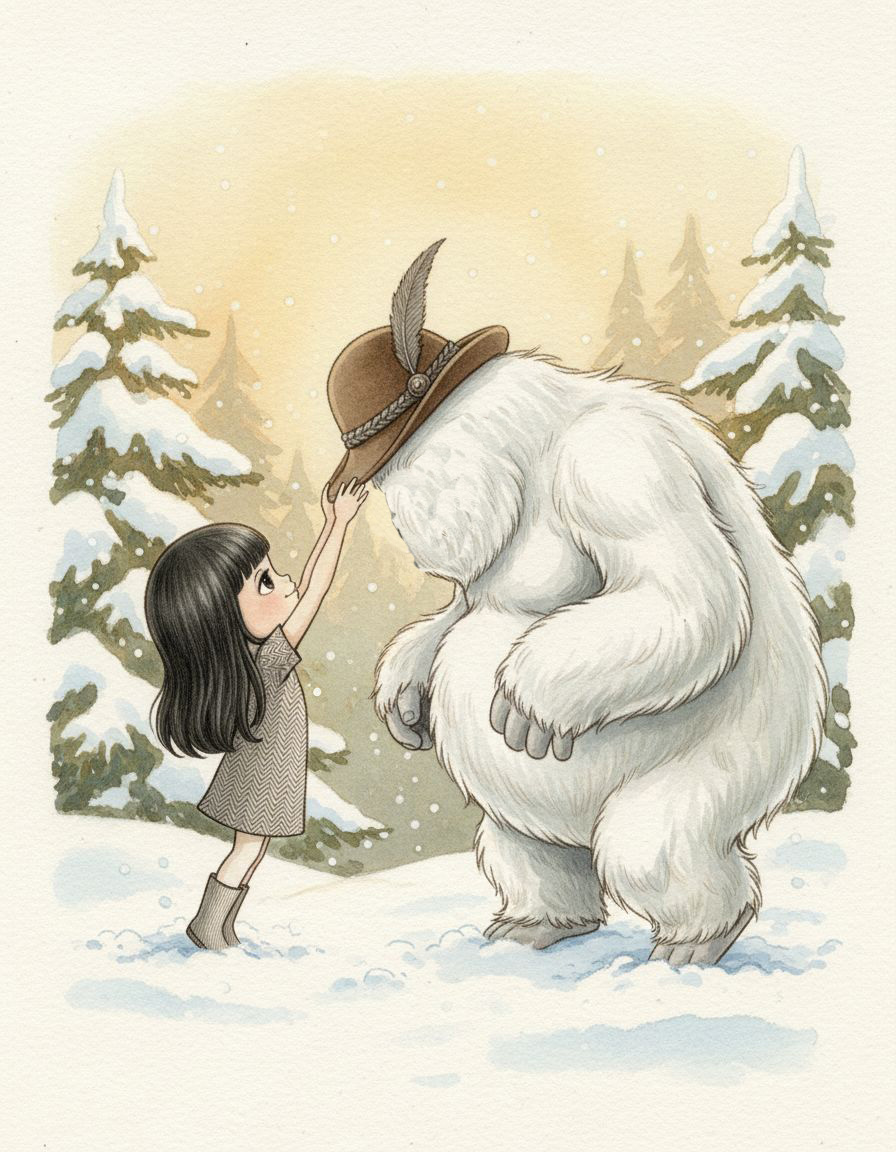
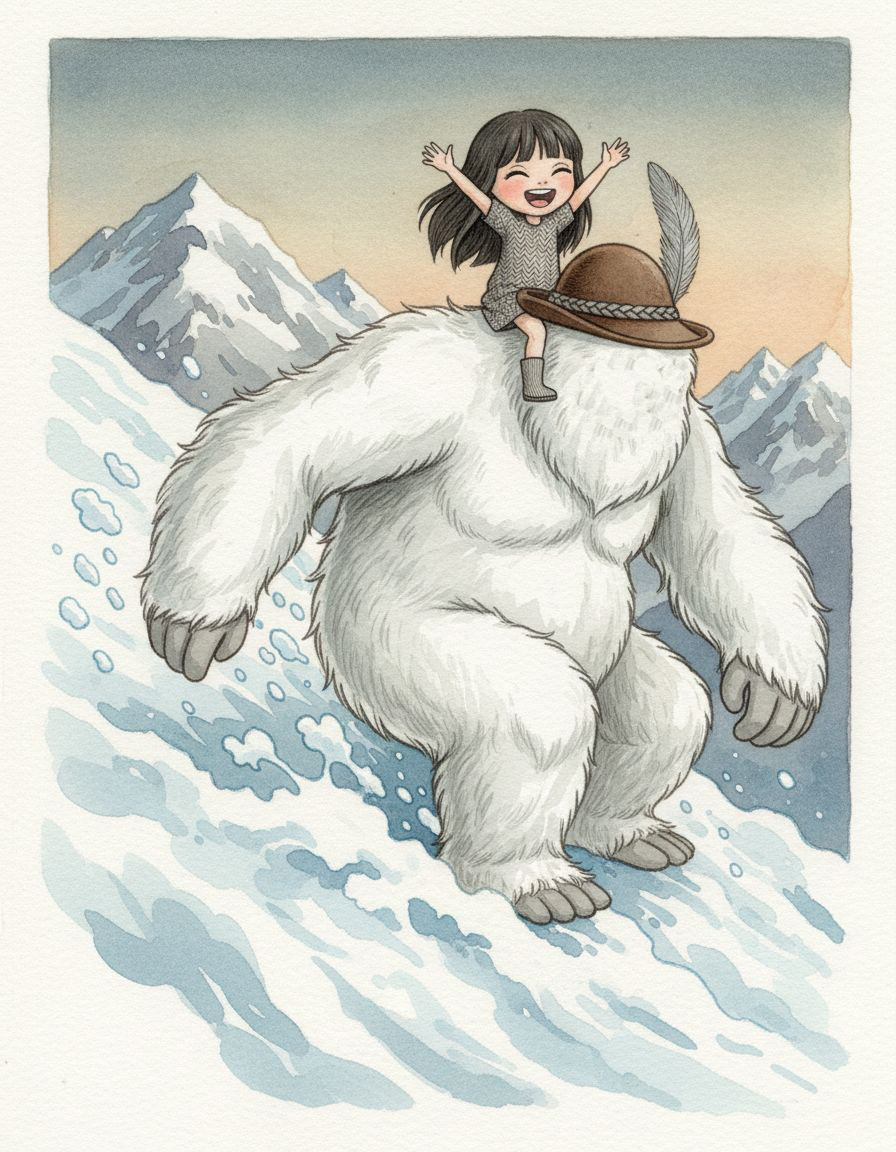
The Una came to like this yeti entirely. The yeti that had been given the hat grew fonder still of the Una, rumbling its throat with its great body and nestling close. That body was warm as a stove. That night, the Una slept wrapped in the yeti, on the snowy mountain.
Next morning, to the throat-rumbling yeti, the Una said:
"Una's friends got taken. I want you to help Una's friends."
The yeti gave a roar. And setting the Una on its shoulder, it slid down the snowy mountain like a bullet.
(This one understands words, too.) Taking the wind, the Una was glad.
On the yeti's shoulder, the Una entered the town. At the yeti tramping along, the townsfolk murmured and leaned out of windows to wave. It was just like a celebrity's parade.
Straight on to the red building — the place where the one who'd taken huna was.
The moment the receptionist saw the Una on the yeti's shoulder, she said, "W-welcome, this way," with a strained smile, and whispered into a microphone, "Urgent — everyone, backup."
The yeti sat down hard against the wall, and as the Una glared from its shoulder, dozens of men in suits came out from the back. Among them was that "Director."
"Give huna back!" the Una bellowed, and the yeti swung down an arm. Bam — the counter split clean in two, fragments flying. Even the big man at the entrance clutched his head and crouched.
"N-now, now, wait," said the Director. "Rage like that, and it'll only make it harder to return your huna."
"Why?"
"huna has already been sold. So rage as you will, she won't come back."
The Una felt their breath stop. The yeti, in step, went still.
"Let us do this, then," the Director went on, with an air of calm. "The one who bought huna has long been searching for a yeti. — Offer to trade that yeti, and they'll gladly return huna, and give you the difference in cash besides."
The Una glared at the Director. The yeti gave a pitiful whine, as if it understood every word.
The Una looked at the yeti. For all its great body, it looked somehow forlorn.
"Well, what will you do?" The Director's smile was a little strained.
— The Una remembered what huna had taught them. At times like this, breathe out, slowly. Then the right path comes into view.
"Well?" The Director's voice trembled for an instant.
At once, the Una said in a great voice, "Give huna back!"
The yeti straightened its back, spread its hands wide, and struck the floor. Doh-don — a vertical jolt, and every pane of glass in the building shattered and rained down over the staff. Amid the screaming and the scramble, the yeti snatched the Director up.
"Give huna back. Now."
When the yeti whirled the Director round, his head grazed the ground at terrific speed. The whole staff watched, pale.
A little worried, the Una nonetheless asked, "Will you give huna back?"
"…………." The Director, eyes wide open, glared silently at a single point.
When the yeti raised him once more, one of the staff cried out, "W-we'll return her! What the Director said before was a lie! We'll show you the way now!"
— When the yeti set him down, the Director had fainted, his eyes still wide open.
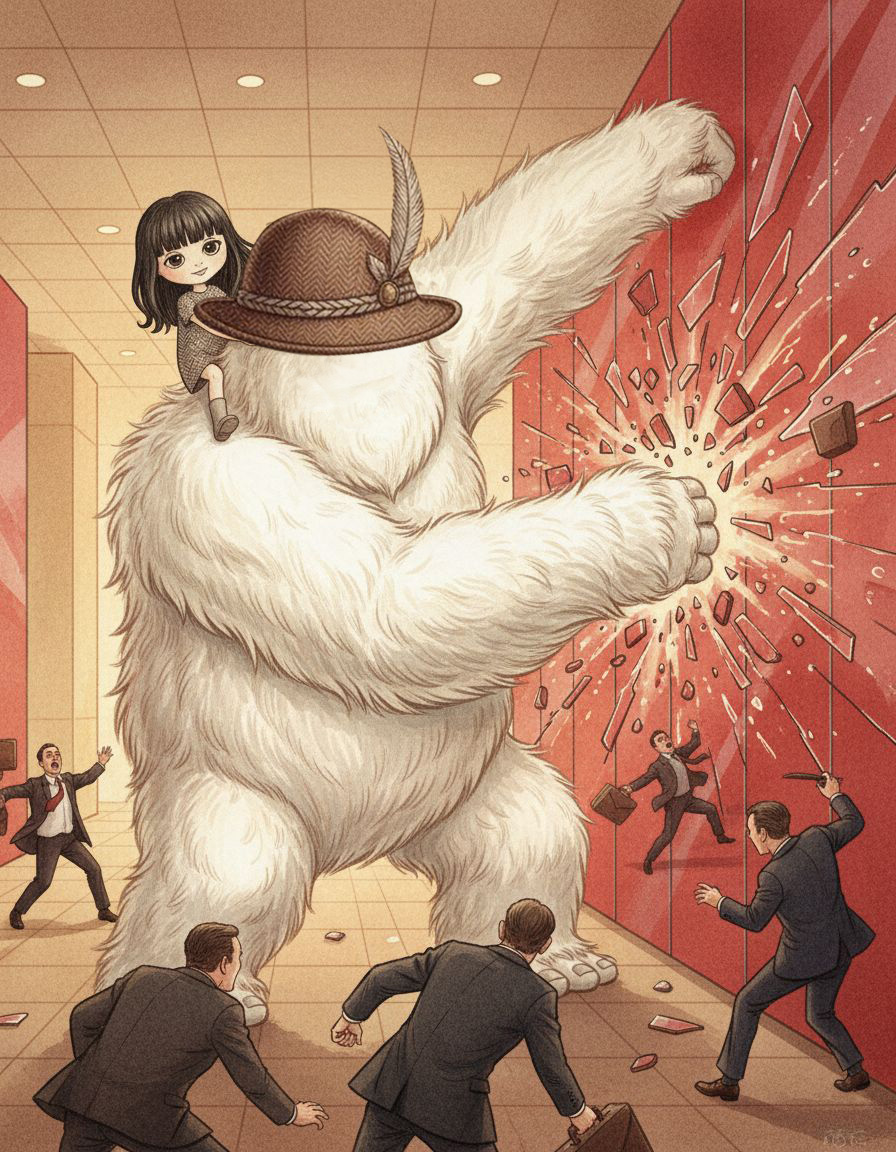
In an old-fashioned room on the fifth floor of an old apartment block were huna and uma. uma was nestled close to huna.
"Una!" huna cried.
"Came to save huna," said the Una.
Seeing the great white thing in the corridor, huna was startled. "What is that?"
"It's a yeti. A friend," the Una said proudly. When they came out into the corridor, the yeti, friendly as could be, rubbed its huge body against them.
"Come to think of it, the yeti appears in the Ice Country's myth too," said huna. "— A kind creature, who plays a great part in the founding of the nation."
After that, the Una had everyone who had been captured set free, starting with the Nose in another room. And so the kidnapping company closed its doors for good.
After the yeti joined them, the Una's journey was scarcely troubled at all. uma, with its splendid running, drew the carriage; the Nose marked out their destination; and the strong yeti was their bodyguard. The Una and huna were quite at ease.
The company pressed on north through the forest. The yeti kept up with uma's carriage easily, and — keen of instinct, perhaps — would even race ahead and knock obstacles flying.
Once, deep in the forest, they were ringed by a swarm of glowing eyes. Giant bears.
"I've no bear-banishing scent on me just now," said the Nose, and the Una and the others shuddered. But the yeti, with a little skip, drew near a bear and struck it with a flat palm — bam. The bear flew off as if hauled by a wire, and dropped to the bottom of the valley. When the other bears raised threatening roars, the yeti roared back ten times louder, and they all fled at once.
From then on, the Una and the others were never attacked by any wild beast again.
11. The Forest Country
With the yeti joined to them, the Una's journey grew much swifter. The Nose twitched his proud nose and followed the scent of the old man in the monastic robe. uma changed course at a single murmur from huna — as if their hearts ran together.
The color of the forest leaves shifted from pink to a vivid orange.
"These parts ought to be the Forest Country…" huna said, gazing at the map.
On a bench at the boundary where the leaves turned from red to violet, a small, well-bred old woman sat.
"Excuse me, is the Forest Country somewhere near here?"
"This is the Forest Country," the old woman smiled. "Not just any forest. The Red Forest, the Sleeping Forest, the Hungry Forest, the Weeping Forest, the Laughing Forest — this is a museum of forests."
"Una wanna go Laughing Forest," said the Una.
"A little further on there's a tower; ask there." The old woman laughed, then her face turned suddenly grave. "— Ah, only the Forest of No Return — you mustn't go in. Once you enter, it's a forest you can never come back from."
What "tower" meant became clear at once. In a square within the forest stood a great tree like a high-rise, and on each hollowed-out floor a great many people worked. From the square, countless paths and signboards reached out, leading to the various forests.
"Would the old man in the robe pass through a place this crowded?" huna asked.
"No. The scent leads to that forest," and the Nose pointed to one path. — The Forest of No Return.
"I thought as much," huna sighed.
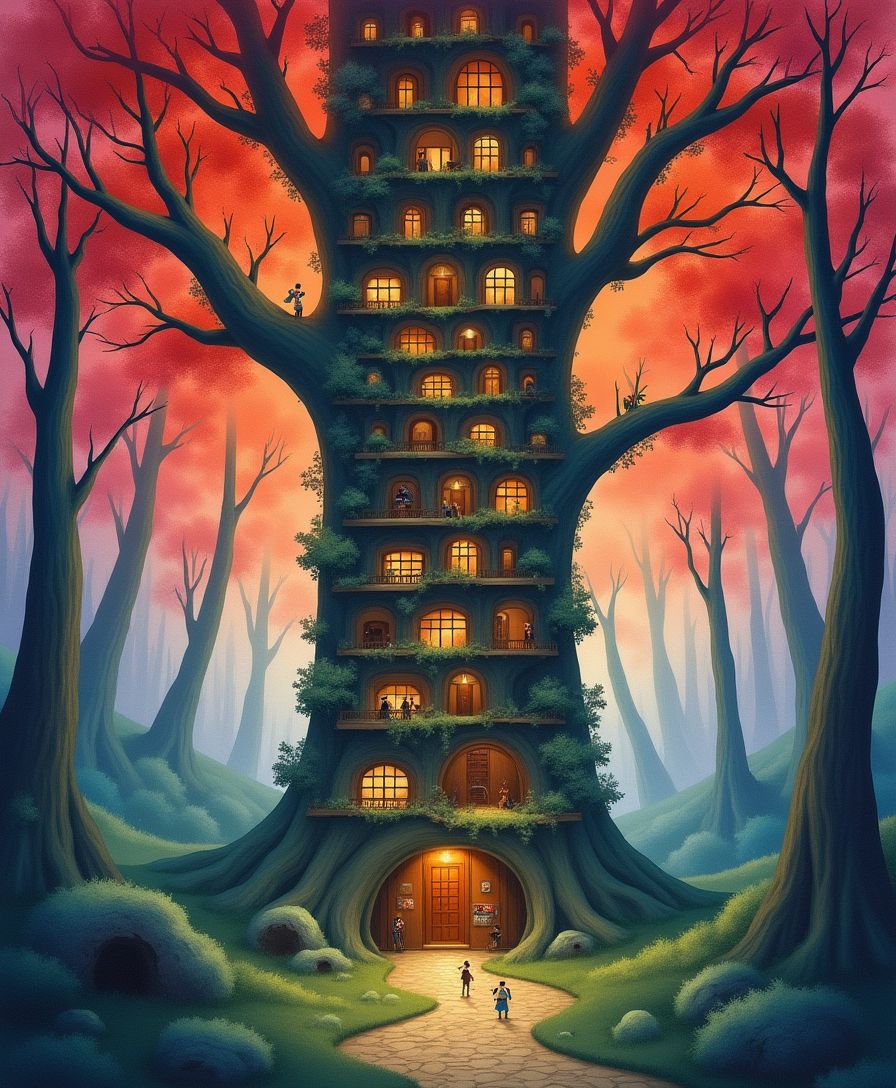
Before the deep-indigo forest, a white sign: 《 Forest of No Return / No Entry 》.
"What'll we do — gather information first, or go now? — At the least, with me along, no one gets lost," the Nose said, proud of himself.
Last time, meaning to play it safe, they had met the kidnappers and fallen far behind. Lost time was not to be afforded. And here they had the Nose, uma, the yeti, and the Una, who was used to forests.
"Let's go." huna passed the sign and walked into the Forest of No Return.
"Something's off," the Nose cocked his head. huna felt the same. For a while now, it seemed they had walked the same spot over and over.
(I've seen this rock ten times already.)
"The scent keeps moving," said the Nose.
"Let's mark our way and walk as straight as we can." The Una ground grass onto a rock as a mark, and on they went. — A little further, and that marked rock appeared again.
"We're in a loop," said huna.
When the Una set off running on the yeti's shoulder, they vanished into the forest in an instant and reappeared from the opposite side.
"Well. We've gotten ourselves into trouble," said the Nose.
Weariness showed on every face. "Let us rest once, and make a plan," said huna.
At which the Una said, "Rest at that house."
(That house?) Looking where they pointed, a white Western-style mansion stood in the forest.
"Since when has that been there?" said the Nose.
"Five minutes ago it wasn't, I think," said huna.
"Maybe food there," said the Una, and suddenly the smell of a baking tart drifted over. The Una ran off in delight.
"Be careful," said the Nose. "Every one of these smells is thin. It reeks of fakery."
"This is…" Entering the mansion, huna lost her words.
Chandelier upon chandelier in layers. Beneath a glass floor, water was set, with red petals floating and glittering. People in gowns and tailcoats chatted merrily.
"What is all this?" said the Nose. Looking over, the Una stood with champagne in one hand, mouth full of tart.
"Una, come here." huna hastily pulled them away. "Everyone, outside, once."
Out they went, and the forest had somehow turned to night. The yeti and uma gave discontented cries.
"What do you make of it?" said the Nose.
"Let's change and look into it." huna went into the carriage. "There should be a man's tailcoat too. You change as well," she said to the Nose. "Una, let us dress you up too." — huna looked a little pleased.
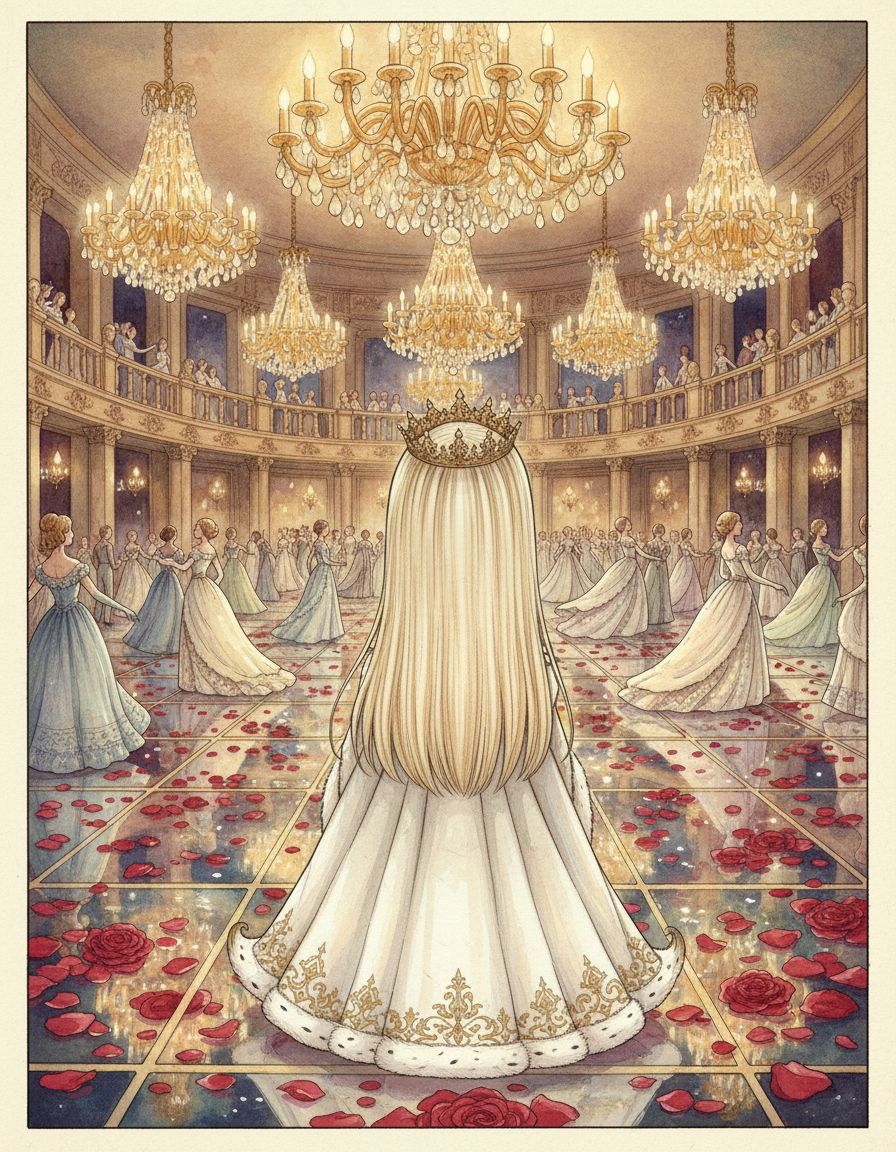
Changed, huna looked unlike her usual self. A white off-the-shoulder gown and long gloves. The dignity of a queen had returned. The Una put on a beautiful dress too, but seemed ill at ease, and even walked strangely. The Nose was in a black tailcoat.
"Wait here a little." Calling to the yeti and uma, the company went into the mansion.
The grand ball went on. huna searched for the host of the gathering. If she knew the host, she should find a clue. — But for all the people who looked like royalty here, there was not one familiar face. (It is strange, after all.)
Before long an orchestra struck up, and a voice rang out. "Thank you all for coming today. A word of thanks from your host."
From the second floor above the atrium, a beautiful girl in pure black velvet leaned out. "Thank you, everyone. The party goes on, so please, take your ease."
Amid loud applause, huna drew close to the Nose and whispered. "Nothing but odd things. — The music is too loud. A ball is for enjoying conversation; courtesy makes the music only enough to set it off. And for a host to wear a black gown to a grand ball is unthinkable."
"Never mind that — it's this food," said the Nose. "Grand to look at, but every one of them has only a flat, one-dimensional smell."
huna alone went up the atrium and opened the most lavish door. Crimson walls, a crimson carpet. On a black chair sat that girl.
"Oh, welcome. Who were you again? Well, anyone will do."
"I came hoping you would tell me the way out of this forest."
"I've no idea what you mean," the girl said, toying with her hair.
"You do not look as though you are enjoying the party."
"Well, of course. It's a party every day; one does get bored."
"Shall I tell you why you are bored?"
"I'll hear it, to pass the boredom," the girl said, in a mocking tone.
"If you tell me the way out of this forest, I will tell you how to be rid of boredom."
The girl turned away in irritation. "How absurd."
"You have no need of it, then. I will go." As huna made to leave, "Wait," said the girl. "I'll listen. If it convinces me, I'll let you out of the forest."
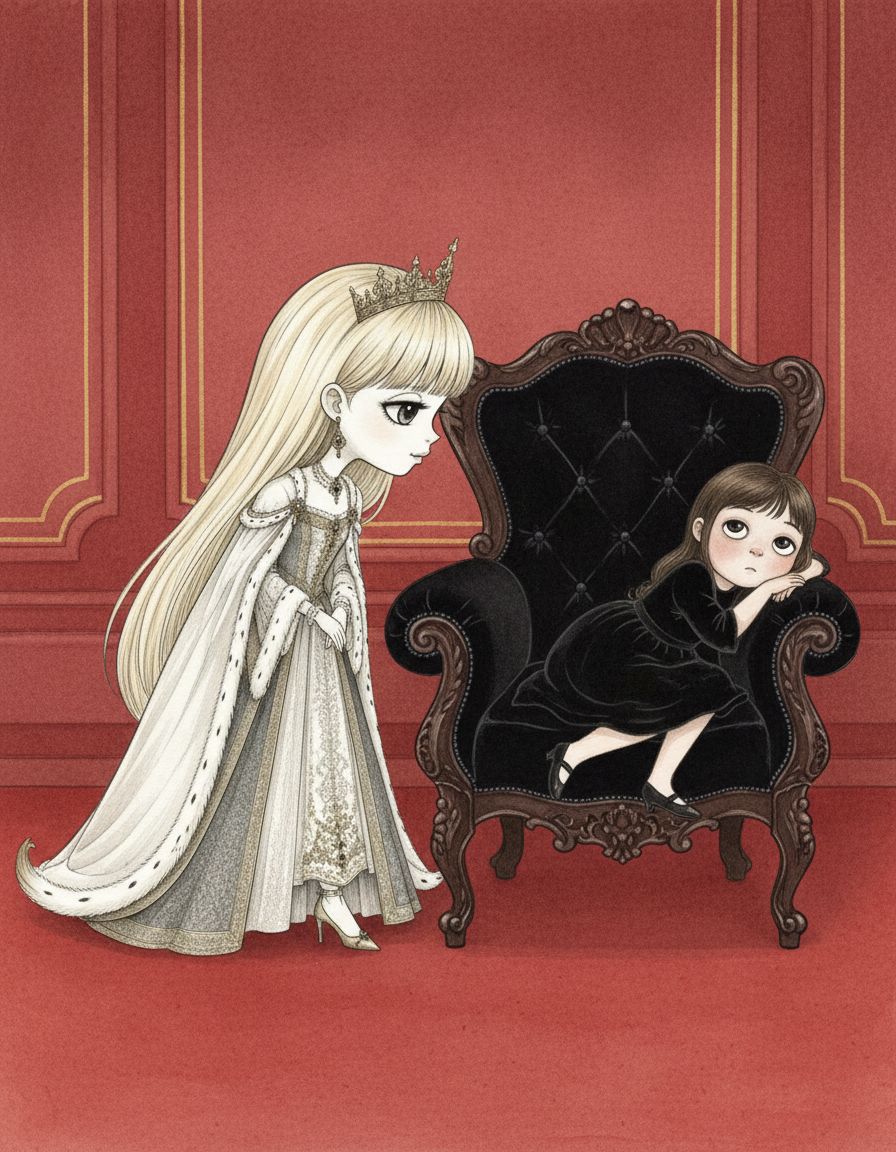
"To eat, to talk, to live — repeat the same things, and before you know it they become ordinary, and little by little, dull. Start a party because daily life is dull, and it's the same. You can lose yourself in it for a while, but in time you tire of it. And so you go on forever seeking stimulation, and arrive nowhere."
"So how do you solve it?" the girl smirked.
"You do every act with care."
"With care?" The girl looked exasperated.
"Daily life is made like a fruit. Peel the surface carefully, one layer, and only then does the fruit appear. — Even the washing, done slowly, attentively, with care, is more interesting than anything. And a meal, savored one bite at a time with care, makes the heart tremble at the depth of that life."
The girl's face turned grave.
"Very well." — And as she said it, the floor warped with a lurch. The crimson walls ran down like melted ice cream, and the ceiling crumbled too. To the alarmed huna: "It's all right, it's an illusion. Don't move."
Even as the liquefied ceiling fell on her head, there was only the sensation of air passing through; nothing clung to her hair or her clothes.
When she came to — a beautiful blue sky, and forest trees. Fox cubs in gowns and tuxedos were walking about. The Una and the Nose sat down hard in surprise.
"You're sound, which is rare these days. Very well, I'll let you out of the forest," said the girl.
"Wait, please. We are pursuing the old man in the monastic robe. Before you let us out — the whereabouts of that old man."
"You'd do better to give up chasing that man. It's too dangerous," the girl said gently.
"Without the rocket, many lives will be lost."
"There's no help for it, then." The girl sighed. "— In that case, take my daughter with you."
"Daughter?" The girl before her looked nothing like a mother.
"We share no blood, but she's my daughter. The illusions don't work on her. Not knowing how to raise her, I brought her up on a book of riddles that had fallen in the forest. — But she's a difficult child, so if she doesn't take to you, give it up."
And saying so, the girl rose into the air.
"She flew!" the Una exclaimed.
"Oh yes — only the Overseer, you must never meet. That one is the exception. Even my daughter might be in danger."
Leaving those words, the girl faded clear away and vanished.
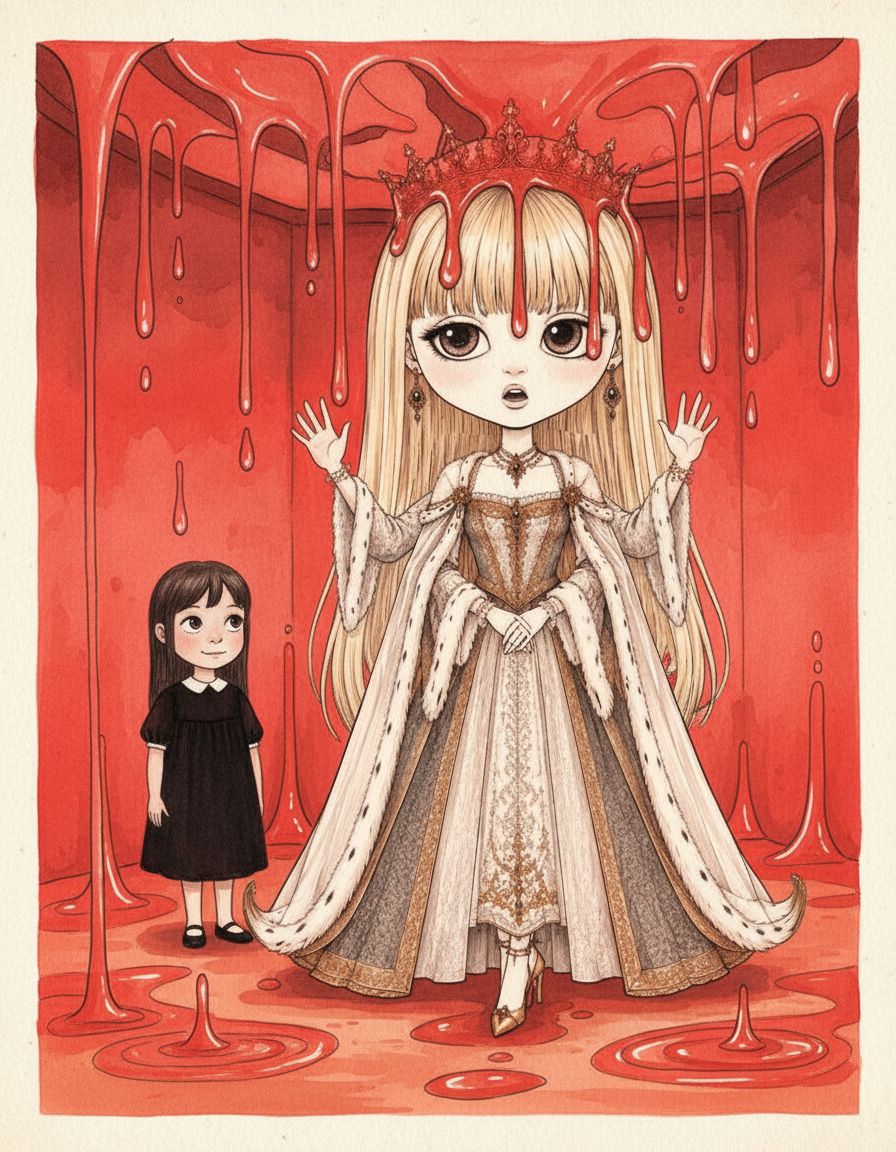
(The Overseer.) huna repeated the name in her mind. The name of an old man of power who appears in the ancient histories. And yet — why was it? To think of that name brought back the cold voice of the veiled old man from before: "A rocket is but a phantom." Something cold ran down her spine.
"What is going on," the Nose said, getting up at last.
"She didn't even tell us where the old man in the robe went," huna said, downcast.
— But in one spot of the forest that had ringed them a moment ago, an opening had appeared, and it was a road.
"A road!" the Una cried.
12. cuna
Walking along that road, before them lay a small lake of clear water.
When huna, once the Queen of the Ice Country, went to wash her hands in the lake — all at once she saw a fairy-like girl with curly hair walking out over the surface of the water. As if her body had no weight, drifting softly, softly, her eyes closed all the while.
"It's her!" huna gave chase, and the Una, the Nose, the carriage, and the yeti all followed desperately. Bathed in light, floating in the air, the figure was like an angel.
"Wait!" huna called, and the curly-haired girl turned around in midair.
"Whaat?" Quite a childish way of speaking.
"Um, what is your name?"
"cuna," she answered, only that, and made to fly off again.
"Hey, wait!"
"A riddle?" said cuna.
"A riddle?" huna let out a startled voice.
"If there's no riddle, I'm going." cuna flew off into the sky.
(That's right — she said she'd raised her on a book of riddles.) — This child must be the daughter the illusions did not work on.
"Aah! Wait! I've thought of a riddle!" said huna.
"You okay?" the Una asked.
"Um — how do you get out of a room you can't get out of?"
At which cuna, beaming, drifted down to land before huna. "Is that a new riddle?"
"A room you can't get out of, a room you can't get out of," she paced round and round, delighted. Even the Nose, somehow, fell to pondering it in earnest.
Before long cuna's face turned troubled, and she begged, near tears, "The answer? What is it?"
"The answer — if you'll travel with us, I'll tell you," said huna.
"Stingy! Cheat — won't tell the answer! Miser!" cuna raked at her curls in anger.
"Then I won't tell." When huna strode off, even the Una started in with "Tell the answer." — The reverse of before. Now it was cuna's turn to chase huna, crying "Wait! Wait!"
"I'll come with you, so tell me," cuna said sulkily.
"All right. If you keep up properly, then."
After that, no matter how cuna begged, huna would not tell the answer. "In a little while," "If you're a good girl" — she only put her off.
"huna, that's mean," said the Una.
"This is how it should be," huna whispered softly, with an innocent face. "— As long as I don't tell the answer, that child won't leave us."
As though an unsolvable riddle hung from her neck, cuna drifted along after the company. And so the forest trees opened up, more and more.
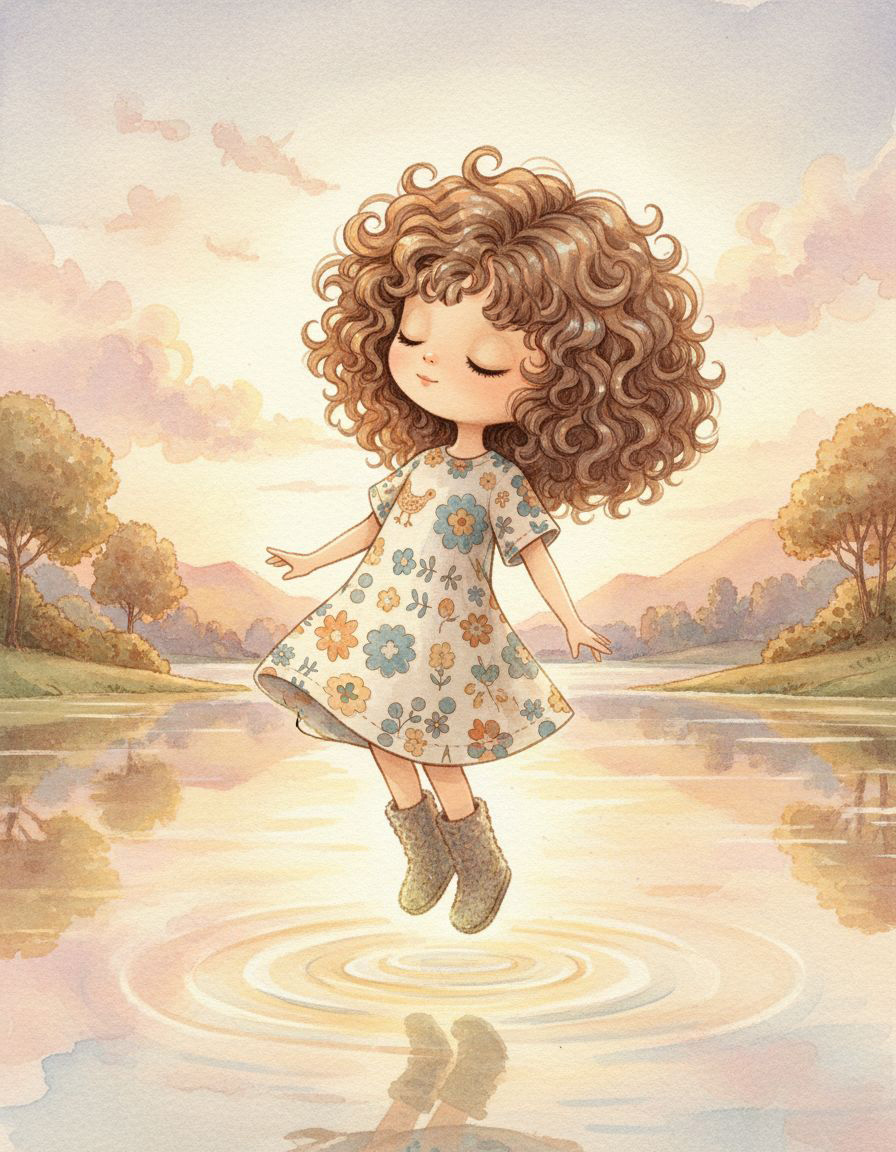
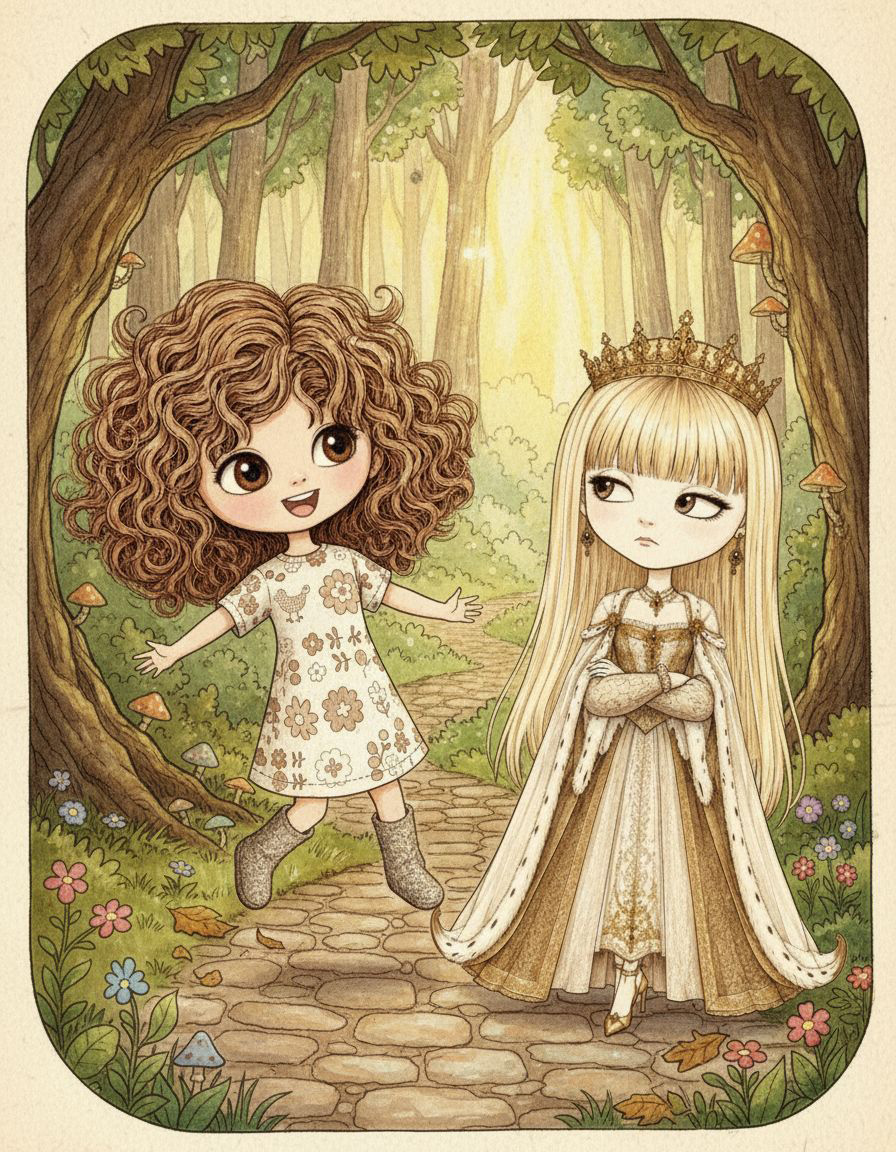
cuna finally got into the carriage, but once aboard, it was nothing but complaints. At first it was that huna wouldn't give her a riddle; now she was angry about being hungry.
"Gimme something to eat," she said to huna across from her.
"To a child who speaks like that, there is nothing to give."
"Stupid, stupid."
— cuna hadn't the faintest sense that she was being rude. Whatever she thought simply came straight out of her mouth.
"Then no food for you!"
cuna pouted. In a small voice, "…stupid."
All through that exchange, the Nose wore a deeply grave face.
"Tummy hurt?" the Una asked, and
"Something's wrong. — There's no scent of the old man in the robe."
"What do you mean?" said huna.
"Until now there were traces, fragmentary at least. Now they've vanished entirely," the Nose shook his head.
"That can't be…" huna let slip a word of weakness despite herself. A tremor ran through the carriage. — Hastily, huna corrected herself. "Then let us gather witness reports. Are there any living things nearby?"
"Keep on this way, and there's a small village," the Nose answered, still downcast.
Entering the village, the Una and the others were astonished at the splendor of the houses. Few though they were, every one was made of elaborate ornament and costly materials.
huna stood before a particularly lavish house. The grounds were pink marble, the fence leafed in gold. As she went to press the glittering doorbell, the fence opened of itself, and a short, sunburned man, his mouth half open, came out yawning. He wore golden clothes that did not suit him.
"Excuse me, we are looking for someone. Do you know an old man in a black monastic robe, his face hidden by a black veil?"
"Hmm, can't say I do," with no interest at all. As huna made to leave, the man said a strange thing.
"If you're really searching, you'd do well to ask the God of Sound."
"The God of Sound?" A name she heard for the first time.
"There — that mountain. Lives up on top of it. Understands the speech of animals and grasses and all. Everyone waits their turn for an oracle, and tends the god while they wait."
"Have you actually met them?"
The man nodded deeply. "This village was a poor place where no crop would grow. The headman's son lined up from childhood, and by the time he was grown he got his oracle — and look, here we are," pointing at the mansion and the golden clothes.
"I understand. We will go and try," huna bowed.
"Even if you must endure the wait, it's worth the hearing," the man said.
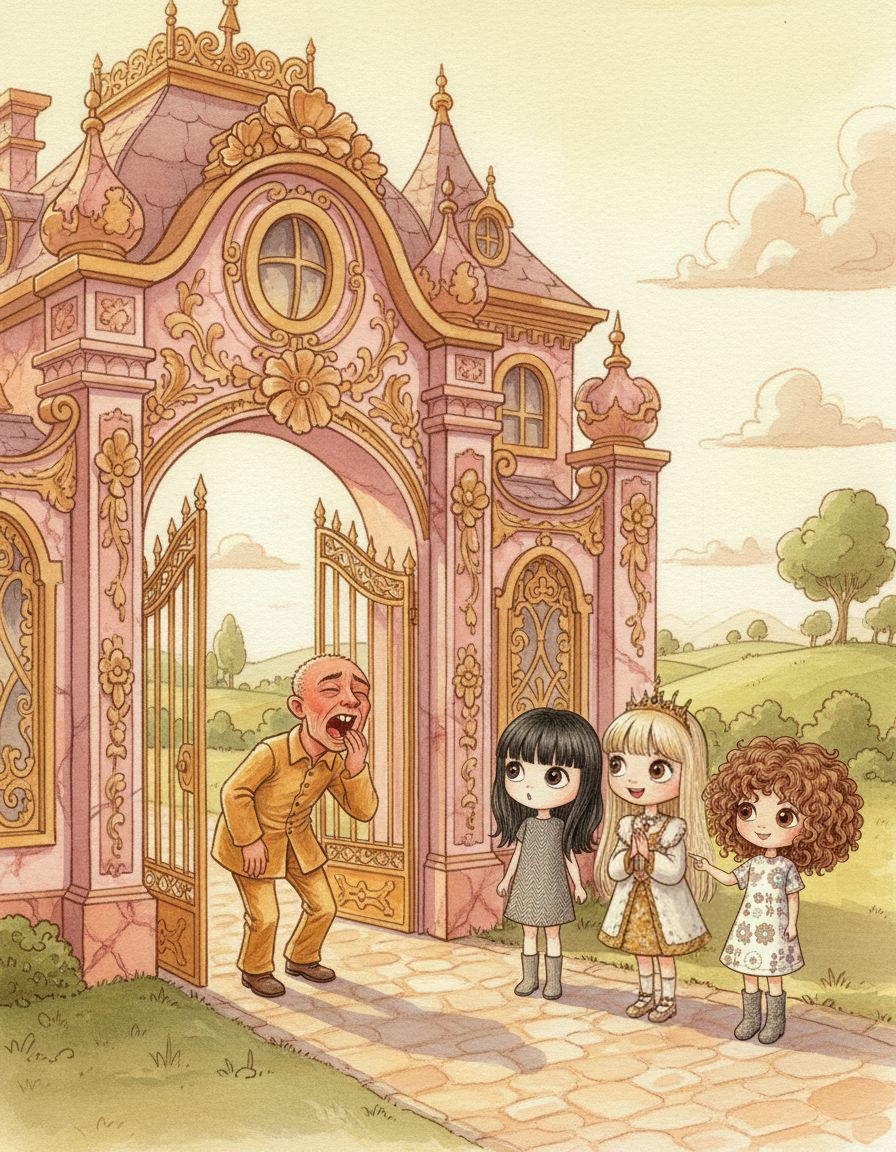
13. The God of Sound
The carriage ran along a forest road. The dew of this morning's rain glittered on the grass. Beneath the ground came the sound of running water.
(Drinking its fill of water, the trees must be glad too,) the Una thought — and as if in answer, the trees rustled.
Reaching the foot of the mountain, the Una and the others stared. Rabbits, tortoises, deer, oxen, frogs, wolves — an enormous number of animals stood lined up, packed tight, all the way to the summit. Along the line there were food stalls and medicine stalls, and even a bathhouse besides.
The Una and the others lined up at the very end. But the line did not move at all. The little mouse at the very back went round and round, fretting, "What'll I do, what'll I do."
"What's wrong?" said the Una.
"A stranger spoke to me — what'll I do."
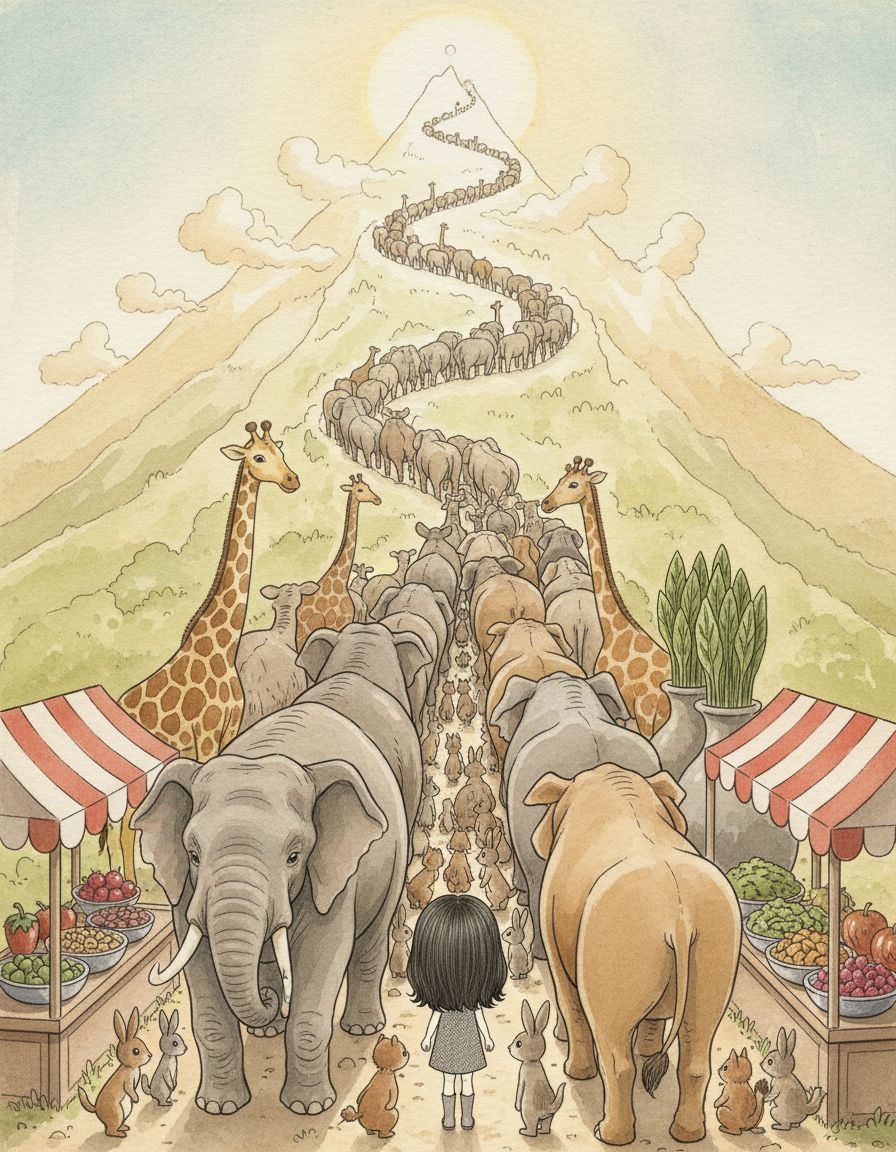
The Nose gave his nose a twitch. "There are a hundred seventy-six thousand and seventy-three in this line. About an hour each."
huna calculated at once. "At twenty hours of counsel a day — we'd reach the summit in twenty-four years."
The Una nodded off, drowsing. cuna was glued to a dumpling stall.
Just then the wind grew strong and scattered the blooming flowers into a rainbow gradient. As the animals cowered, heads covered, an outrageously huge bird — big as a small hill — alighted behind the Una and the others.
"It means for us to ride it, I suppose," said the Nose.
Climbing onto the bird's back was like rock-climbing a mountain of feathers. The Una only managed to pull out feather after feather and dangle there, unable to climb. Giving up, they decided to ask the yeti. The yeti hoisted up the Una, uma, and even the carriage with ease, and each time it carried one, came proudly to report to the Una. Each time, the Una stroked the yeti.
The moment everyone was aboard, the bird shot up into the sky as if it had forgotten the Una and the others entirely.
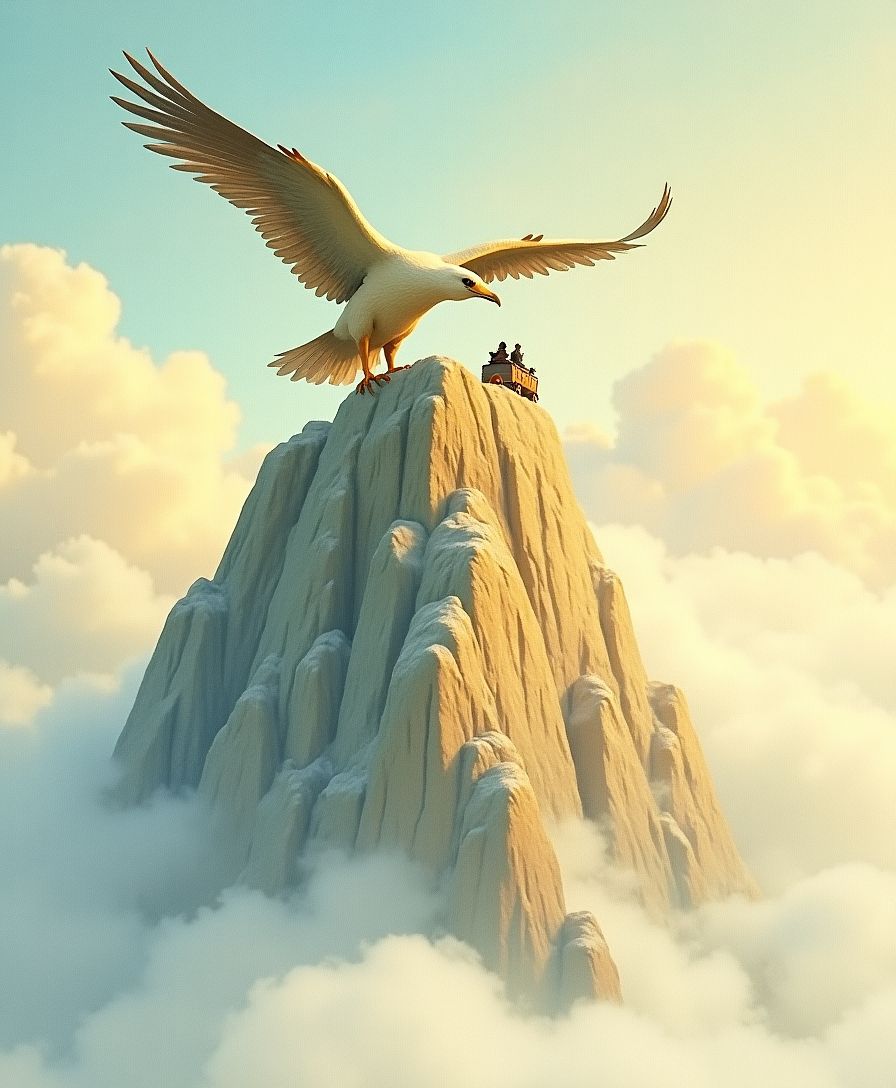
Where the bird set down was the summit. There was a mountain hut made of ice, and around it — rabbits, oxen, dogs, monkeys, snakes, sparrows, crabs, camels, even a man-eating tiger — animals who looked ill at ease together stood in a polite circle.
In the very center, a pretty black-haired girl sat primly, talking with the animals.
Set down one by one by the yeti, heads all tousled, the Una and the others lined up at the outermost edge of the circle. The man-eating tiger gave them a sidelong glance.
At which the black-haired girl rose and said, in a childlike, pretty voice, "Welcome, una and friends. The counsels will be done soon, so please wait in the hut."
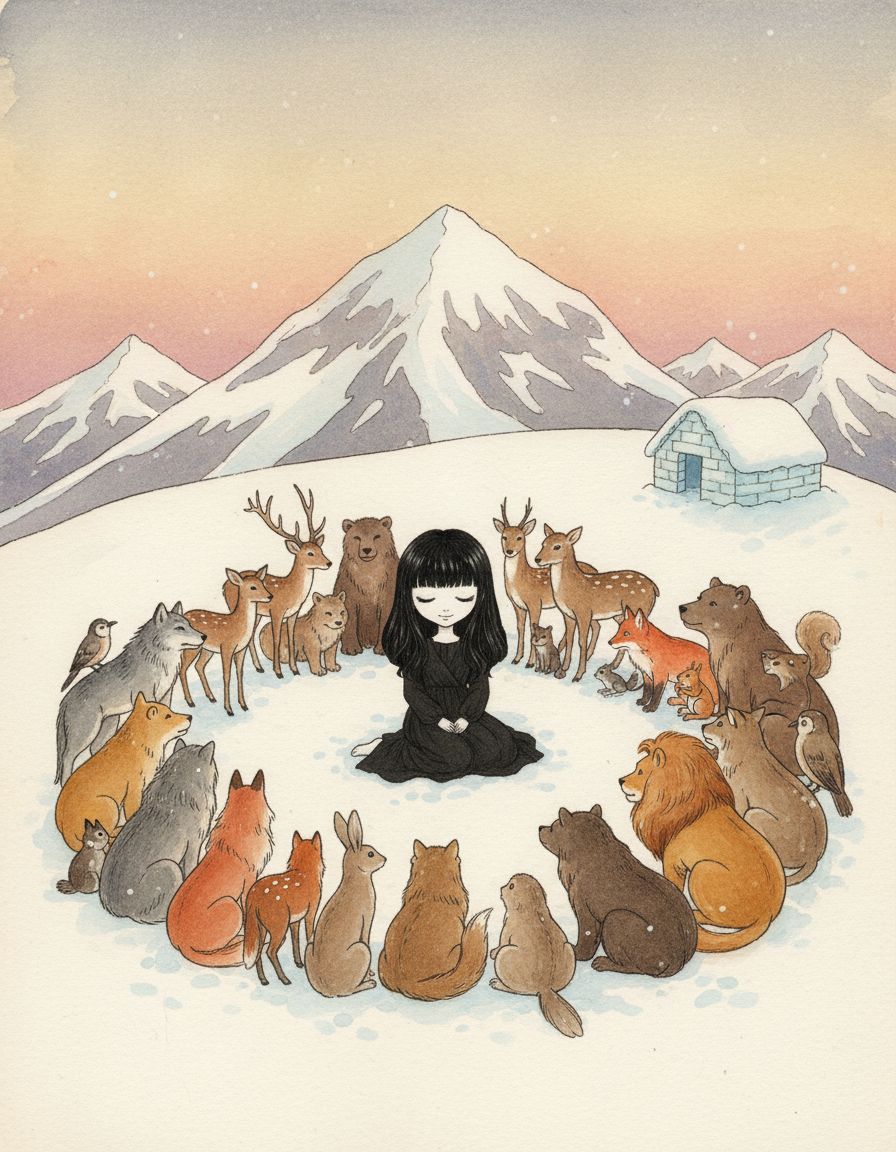
huna gazed hard at the ice hut. The very same texture as the castle of the Ice Country. Touching the wall, she thought of the people she had left behind.
Before long the ice door opened and the girl came in. "My name is suna." — This was the God of Sound. And yet she looked nothing like a god.
As if reading that thought, suna smiled faintly. "I'm not really a god, you know." Her voice was childish, yet her gaze was eerily still.
"Now, there isn't much time. Briefly." suna began to draw a diagram on a blackboard.
"una. You are of the pure-blooded Una folk. The ancestor of ours who came to this star long ago must have looked just like you. — huna, and cuna, and I — trace us back, and the root of us all is una's star."
The Una, suddenly named, started, and for some reason put on a friendly smile.
"Long ago, a single rocket came to this star. Aboard it was the ancestor, an Una. She had come in search of a star where they could live — to save a homeland that was dying. The Una folk bear but one child in a hundred. The ancestor was that rare one. On this star, she raised three daughters. When the daughters were grown, each chose a place to live. The eldest chose the ice village — huna's ancestor. It was her line, too, that raised the little ice village into the Ice Country of today. The second chose the forest — cuna's ancestor. And the third chose this mountain. — My ancestor."
suna looked at the Una.
"— una, you walk as if retracing the path of that ancient ancestor. There may be some deep reason for it."
The Una and huna alike were thunderstruck. It was not to be believed all at once.
"I know. I have soup I made myself. Let us have a meal once."
suna ladled out warm soup. The yeti and uma were outside playing with the animals. cuna sang happily, "Put in lots, put in lots," and the Una, not to be outdone, "Una wants lots too!"
But the Una and cuna, taking one mouthful, froze. — It was foul beyond anything of this world. cuna burst into tears. The Nose glared at the soup with a fearsome face. A taste that even the Una and the others, used to eating wild things, could not abide. Were huna to eat it, she might lose her memory.
And yet suna alone did not doubt her own cooking in the least.
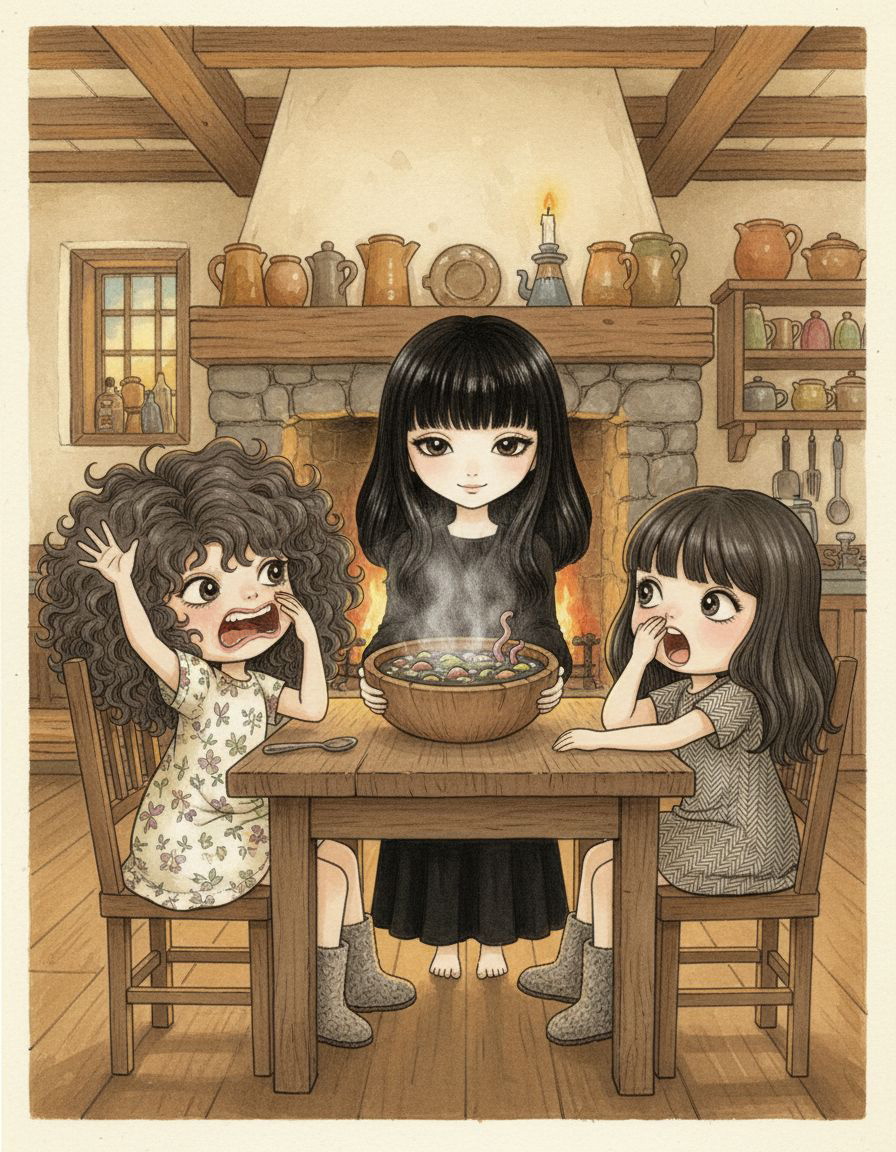
cuna, still not done crying, took out a worn old book. The book of riddles she had found in the forest. Searching for one huna might answer, she flipped through and read one out.
"— Two who look just alike. Which is the real one?"
But no one answered. huna was in no state for it.
Only suna's eyes paused, for the briefest instant, upon cuna's book. And then, saying nothing, moved on.
"Um… I want to know about the Ice Country, too," huna began. "Is there no upheaval? The budget —"
suna closed her eyes halfway.
"Smoke. Ah, something has broken. Soon, blood will be shed."
huna's face went stiff.
At the words set down so flatly, huna shook her head again and again and looked to the heavens.
"Many will die." suna's voice seemed to reach from somewhere far away.
huna cried out, "That must not happen!"
Startled by the cry, cuna wept. The Una wiped her tears with a fallen cloth.
"How can the country be restored?"
"Mm." suna gazed wearily into the air. "It is not your fault."
Then, "Ah, what a bother," she sighed, and let her eyes go half-lidded.
suna was silent a while, and then, in that voice half gone elsewhere again —
"…The rocket. Go home by the rocket. That is all. There is no other way."
huna was bewildered.
"The rocket? And that brings the country peace? I have no idea at all what you mean!"
suna opened her eyes for an instant and smiled wryly.
"Well, you're all like family, so as a special favor I'll look at everything."
And she closed her eyes again.
"…I can't see it."
suna knit her brows.
"It is hidden. Inside two black, black things. One far older, and one still newer."
"The one who was there long ago and swallowed everything. Though it should be gone now."
(One far older.) — Again, the veiled old man crossed huna's mind.
"The rocket is in one or the other."
suna opened her eyes and pointed up and to the right.
"Which way should we go?" huna asked.
"You go to the newer one. I'll go to the older. That one is harder, so it's beyond you."
"…You'll help us?" huna said, surprised, and suna nodded.
"It's faster if we split in two." As if it were nothing more than that.
huna, for some reason, found tears spilling. "Thank you." — And the instant she said it and touched the soup to her lips, she keeled over in a faint.
After the Una shook her many times, huna finally woke. "…What happened?" she said hoarsely.
"You were quite worn out. You seem to have a fever, too," said suna.
(In truth, the soup made her faint,) the Una thought, but could not say so.
cuna was still fretting, "Foul, foul." suna, who was meant to see all sound, pretended not to hear that crying alone.
"I have tasty bread I made, too." — At those words, cuna bawled out loud.
"huna, let's hurry," said the Una, and the Nose nodded, again and again.
14. The Cliff of Illusions
suna to the place of old, strong power, and huna and the others to the place of strong power newly appeared — so they came to split in two.
On the carriage, looking at the map suna had given her, huna said, "What a mysterious, lovely person," and
"Big idiot!" said cuna.
"How many times must I say it? You mustn't use words like that." huna set down the map and scolded her.
Watching the exchange from the corner of their eyes, the Una and the Nose quietly met glances. — Quite a one who understands things, the Una thought.
The air in these parts was cold and clear. At a chill that recalled the Ice Country, the yeti seemed somehow in fine fettle. huna's breath, too, came white.
They lit the carriage's little stove and put on white hats with pom-poms. The Una in a brown coat, cuna in a coat of gaudy colors.
(We should arrive by morning.) The carriage ran on through the cold night.
In the morning, huna woke to the sound of the carriage stopping. The Una and cuna were still asleep.
Drawing the curtain aside, outside had become, somehow, a world of silver. The stove was out, yet the carriage was warm. A snowscape seen from a warm place was something special.
So as not to wake everyone, she slipped quietly outside. The morning air was crisp, and huna drew a deep breath. Gently, the snow came down.
— All at once she noticed the ground underfoot was soft. Turning, there was no carriage.
(It can't be.) Unease crossed her chest. The snowscape of a moment ago had, somehow, turned into a place like a desert.
(Stay calm.) huna told herself. This is the same as in the forest. It is an illusion. As before, surely I can get out.
But this time her body was heavy as lead, her eyelids heavy, so that she could not even blink. All around, only the sound of her own breathing echoed.
The next instant, something unbelievable happened.
Her own eyelashes went sliding out, growing longer. The tears that pooled, unblinkable, made a small clear sea up to the height of her eyes. The lengthened lashes crept along the horizon, crossed a distant cliff, and ran on into the far, far distance.
(— How very nasty.) huna thought, striving for calm. Though no one was to be seen, this illusion felt as if it were arranged, one piece at a time, with care — as if to test her.
Before long a round crack ran underfoot, and the bedrock heaved up with a groan. The rock that bore huna stretched smoothly up until it reached above the clouds. Pressing her ears, which ached with the pressure, huna crouched atop the pillar of rock.
The cold wind stole her warmth away, more and more. Even in a coat, she could not stay here long.
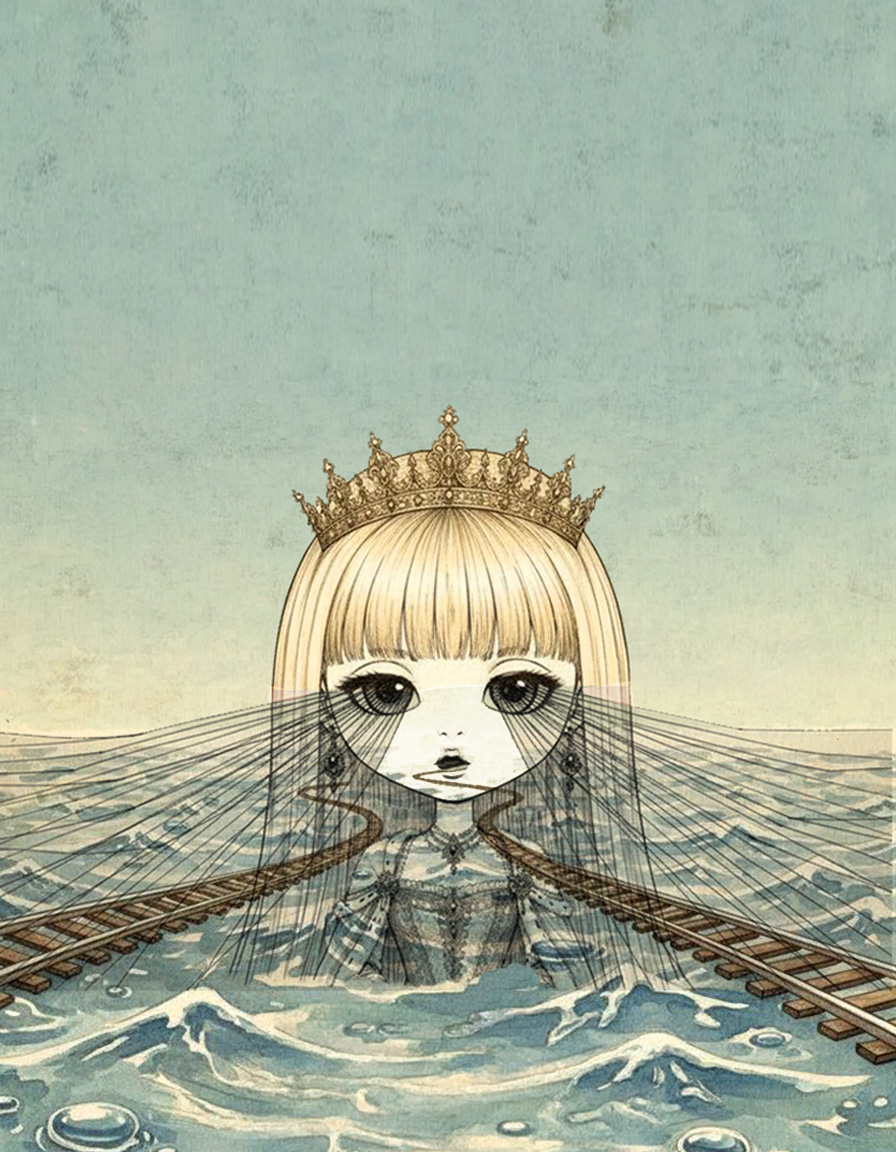
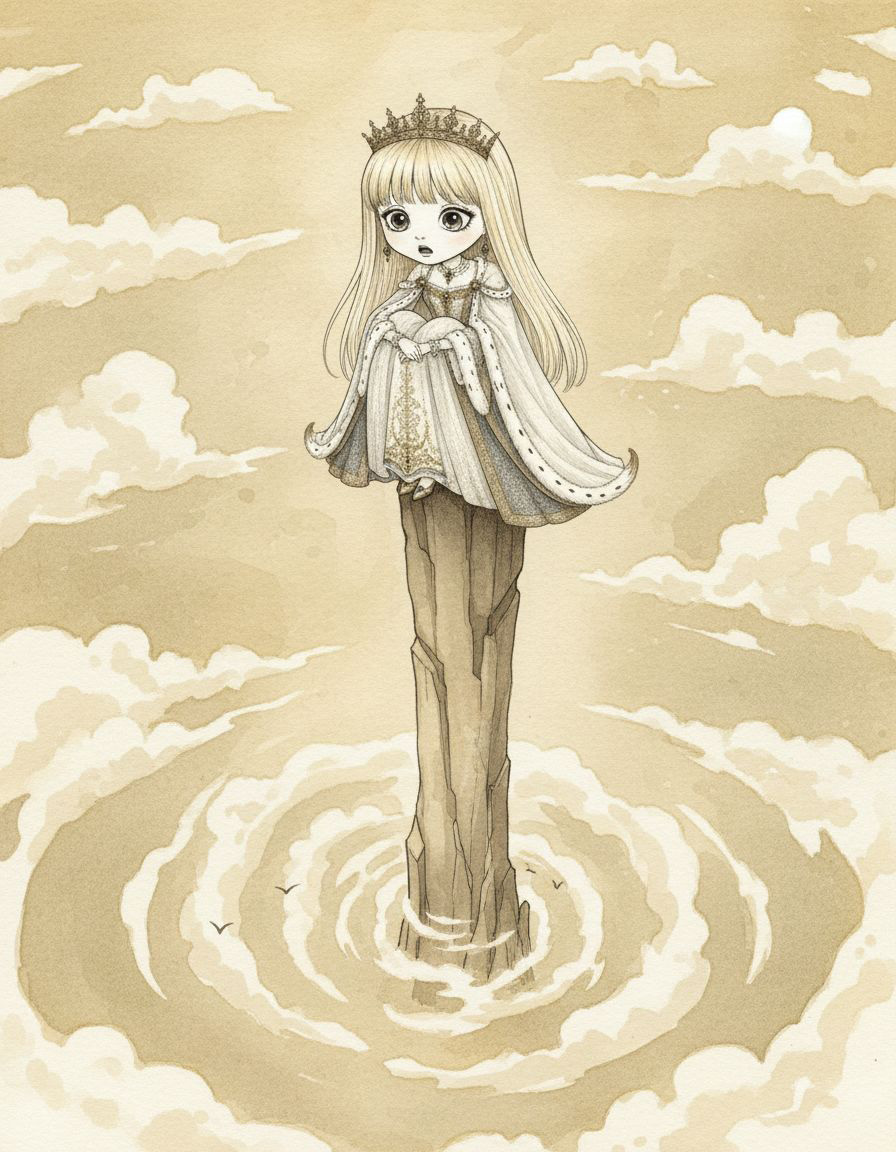
"huna's gone," the Una said inside the carriage.
The Nose rubbed his eyes, twitched his nose, and cocked his head. "Strange. She's nowhere about here."
Outside, cuna and the yeti were making a snowman.
"cuna, you know where huna is?" said the Una.
"That meanie? Don't know." said cuna. — "She couldn't think up a riddle, so she ran off!" Grumbling and complaining, cuna drifted up into the air.
Atop the pillar of rock, huna, trembling, strove to stay as calm as she could.
Peering carefully down, far below were clouds, and below them, small, the surface of the earth.
(Shall I jump?) — This must be an illusion. But the thought (and if it were not an illusion) crossed her mind too.
huna closed her eyes and slowly steadied her breath. (The real ground may, after all, be just below.) It was worth dropping a pebble to check by the sound.
As she picked up a stone at her feet, she saw cuna drifting up from below.
(An illusion.) huna dropped the stone toward cuna. — Bonk. The stone hit cuna on the head.
(It bounced there. The real ground is about… there?)
"Ow, ow!" half in tears, cuna came up, holding her head, and stood before huna.
"You are an illusion," huna said, trembling, and cuna, crying ow ow, pummeled huna with her fists.
— Something was different.
"…You're real?"
"Are you stupid?!" cuna raged.
"Idiot idiot idiot." Angry the whole way, cuna carried huna on her back and went down. "Why'd you run off to a place like that!"
"I didn't run off. I was caught in an illusion."
"Liar!"
From the carriage on the ground, "huna!" the Una came running.
"Did huna fly off too?" said the startled Una, and huna shook her head. "It was a place of illusion. — Quickly, let us get out."
The Nose sniffed the air with a hard face. "It's odd. No smell of anger, nor of malice. Only — only a smell that's been cleanly, carefully arranged."
huna felt a chill. Not a cruel tormenting, but an illusion that seemed to "test" her, one careful piece at a time.
— As if someone had been watching the whole of our journey, from the very start.
The instant she thought it, the shadow of that veiled old man crossed her chest again.
"In any case, this place is dangerous." At huna's command, the carriage kicked up the snow and left the place at full speed.
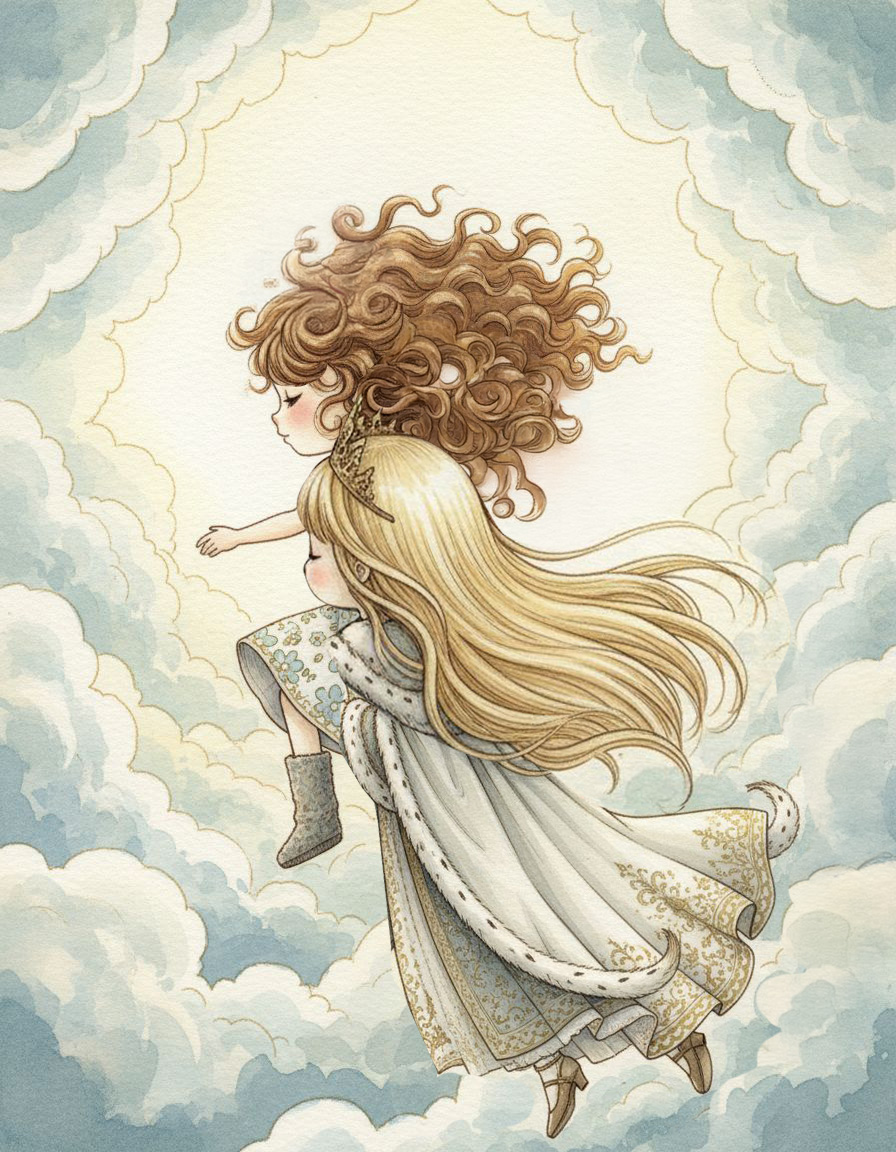
15. The Sea of Fire
After they had run on a while, the Nose suddenly twitched his nose and had the carriage stopped.
"…It's back."
"What is?" said huna.
"The robe's scent. That scent that cut off so abruptly in the Forest Country. — It runs on north again."
The Una and the others met glances. The trace they had so thoroughly hidden — why, now of all times? — As if someone were deliberately leading them along.
(That trial, and this scent.) huna felt a chill once more. But there was nothing to do but go on. "North."
Along the way, huna was silent the whole time. The smoke of the Ice Country, the clashing voices, suna's words — "Soon, blood will be shed" — lay black and knotted at the bottom of her heart.
In the evening they stopped the carriage and decided to rest a little in a wild strawberry field. The Una picked an armful, and the Nose put honey and strawberries in the pot and, so the Una would not scorch them, stirred slowly.
With the heat, the strawberries turned to red water and gave off a thick, lovely smell. — That smell seemed to wrap the black thing deep in huna's heart, gently, and make it vanish.
(At least, as far as this smell reaches, it is a happy place,) huna thought.
On toast browned crisp, they spread fresh-made jam thick, and everyone ate. Toast eaten outdoors was good enough to make your cheeks fall off. cuna scraped the jam stuck to the pot with a spoon and ate it.
The Nose said nothing, only watched huna.
"Now, let us go," said huna.
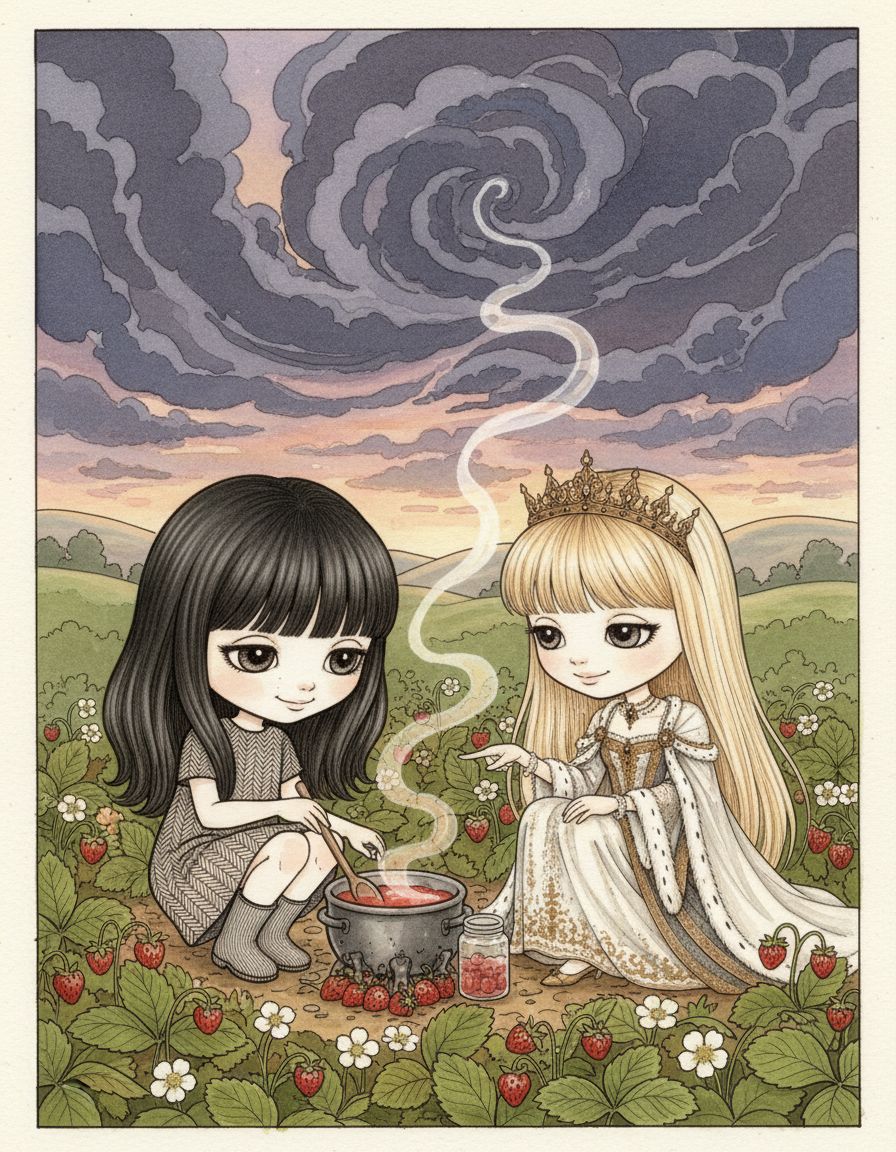
After that, the carriage and the yeti ran on for a whole day.
Toward morning. — White smoke, and a sea with flames blazing, came into view.
"It's a fake sea," said cuna.
The Nose opened the window a little and sniffed carefully. "There's no depth to the scent of the flames. It is, most likely, a fake."
"Into the sea." At huna's command, the carriage drove headlong into the sea of fire. The Una shut their eyes and covered their ears.
— Outside the carriage, it was just like being in the sea. Yet not a single drop of water came in. The sound of the wheels caught on solid ground, the vibration was the land itself, and yet outside the windows alone, it sank to the sea floor, down and down. A fish swam past, smoothly.
Before long the carriage stopped. When huna steeled herself and opened the door, it seemed truly the bottom of the sea. Beyond the clear water could be seen a great box-like white ship.
"Waah!" The moment the Una leapt out, they ran toward the ark. cuna followed, drifting, as if swimming through the sea.
huna and the Nose drew the carriage and approached that white ship.
Seen up close, it was of a size they had never known. Seamless, smooth, with nothing that looked like a door to be found.
"Could this be the rocket?" huna laid a hand on the white wall. Cold, slick — strike it, push it, and it did not budge. The Nose, too, sniffed from every angle and cocked his head. "…There's no smell of an entrance."
Going all the way around, nowhere was there any place that looked enterable.
Then the Una, on a whim, gave one spot on the wall a light touch with their hand.
— Without a sound, a door opened. A great door, large enough for the yeti and the carriage to enter just as they were.
"It's open!" huna cried. The Una, too, was startled at themselves.
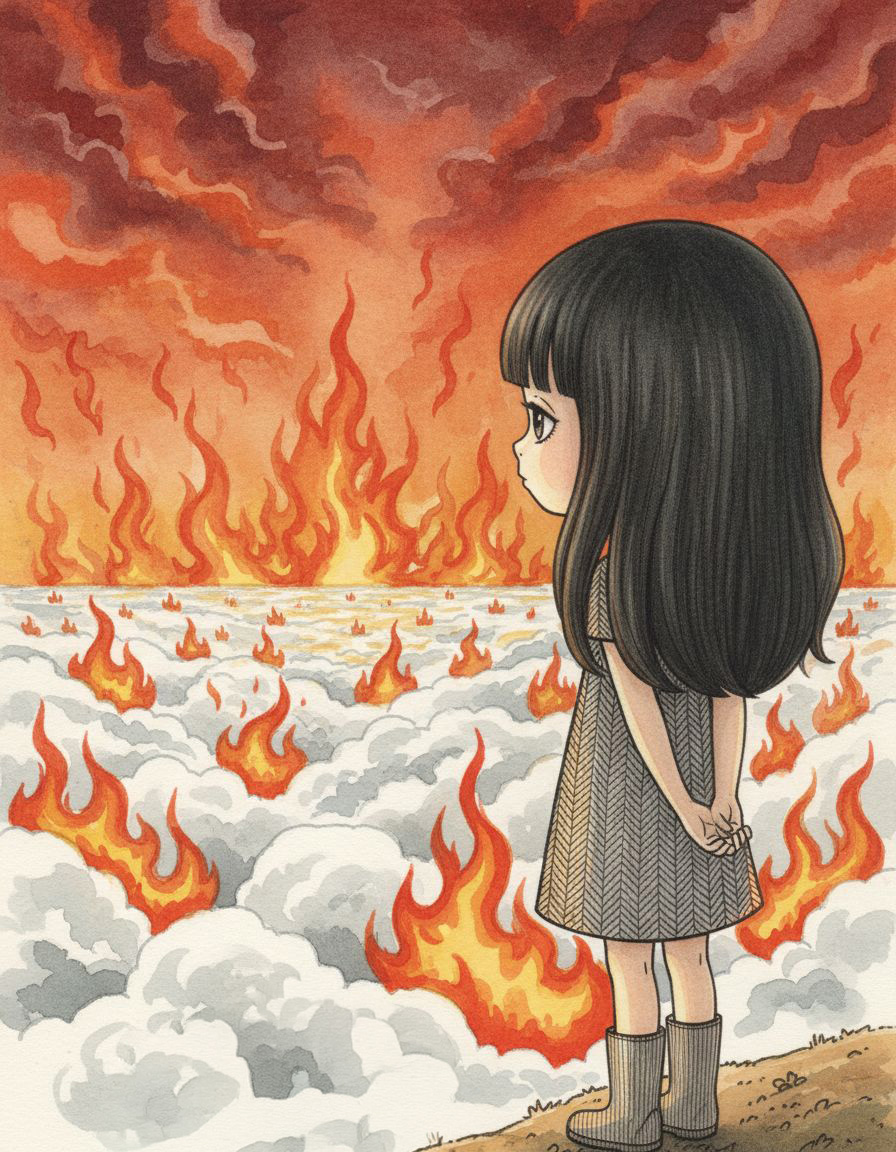
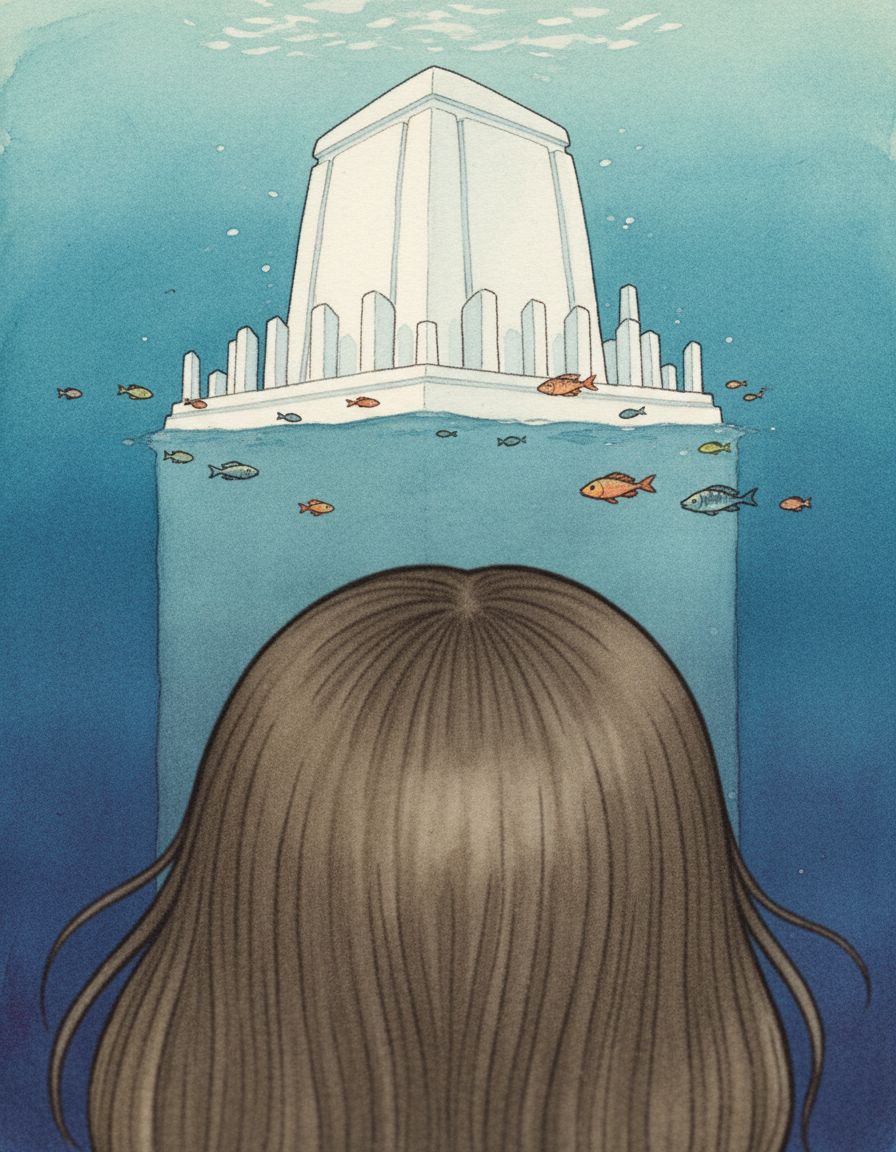
16. The Ark
Inside the ark, the walls resembled the rocket.
When they opened a door from which a pale-blue light leaked, there — transparent ice pillars stood in long rows. Within the pillars slept people dressed in the garb of long ago. "There's a musk ox," said the Nose. Even huge creatures they had never seen slept there.
Checking each in turn as they pressed toward the back, the clothing grew, little by little, newer. The Una ran off to the very back.
"There! Una's friends — there!"
In the pillars at the back slept many of the companions who had come on the rocket. Though the Una struck the pillar, it did not budge.
huna, running up, gave a small cry: "Oh." Right beside the pillar the Una was striking — a girl exactly like huna slept.
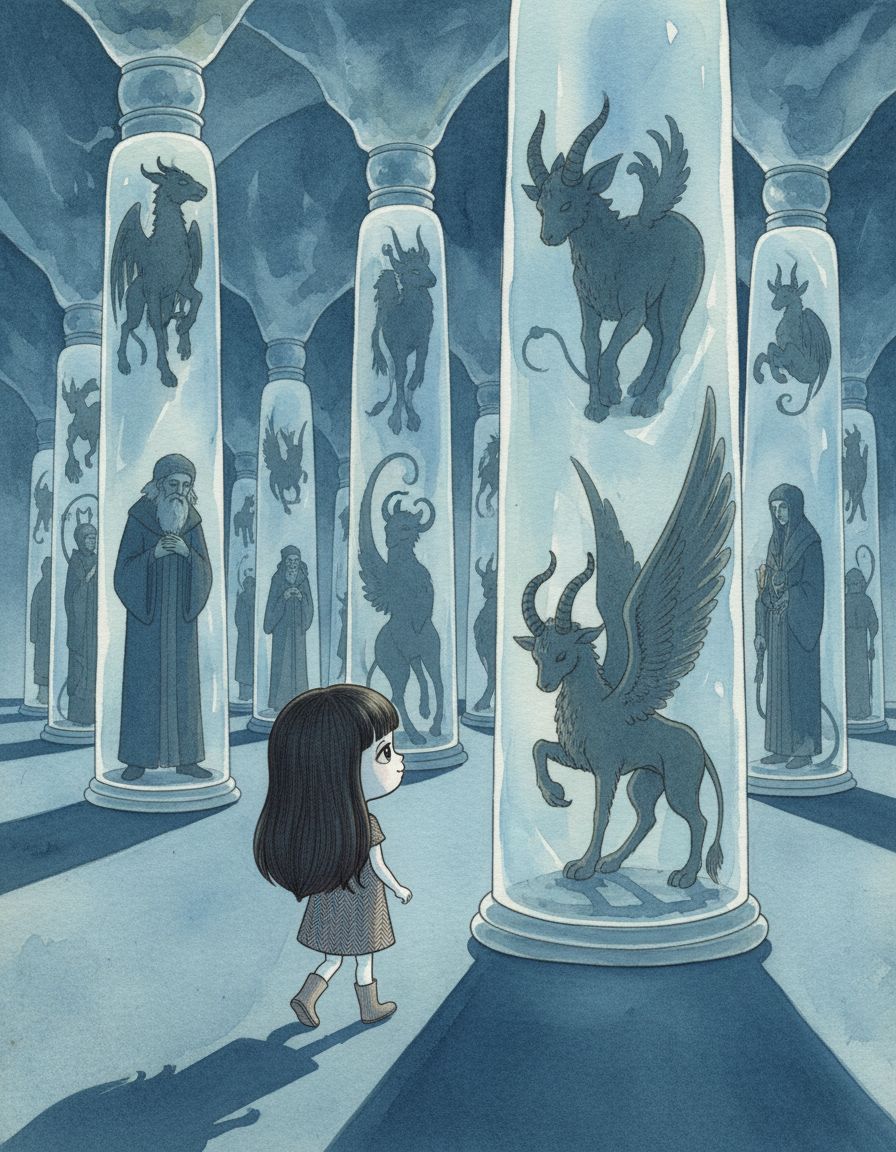
When huna touched the glowing panel at the foot of the pillar, a low voice rang out.
"So — you have come this far, at last."
There stood the old man in the monastic robe.
"So it was — the Veiled Elder, after all," said huna.
The Veiled Elder removed the black veil. An old man with shadowed, piercing eyes.
The Una started. It was that man — the one who had given them the book on the train, who had looked after them at the gate of the Ice Country.
"I must let you in on the secret," the Veiled Elder began, quietly, to speak.
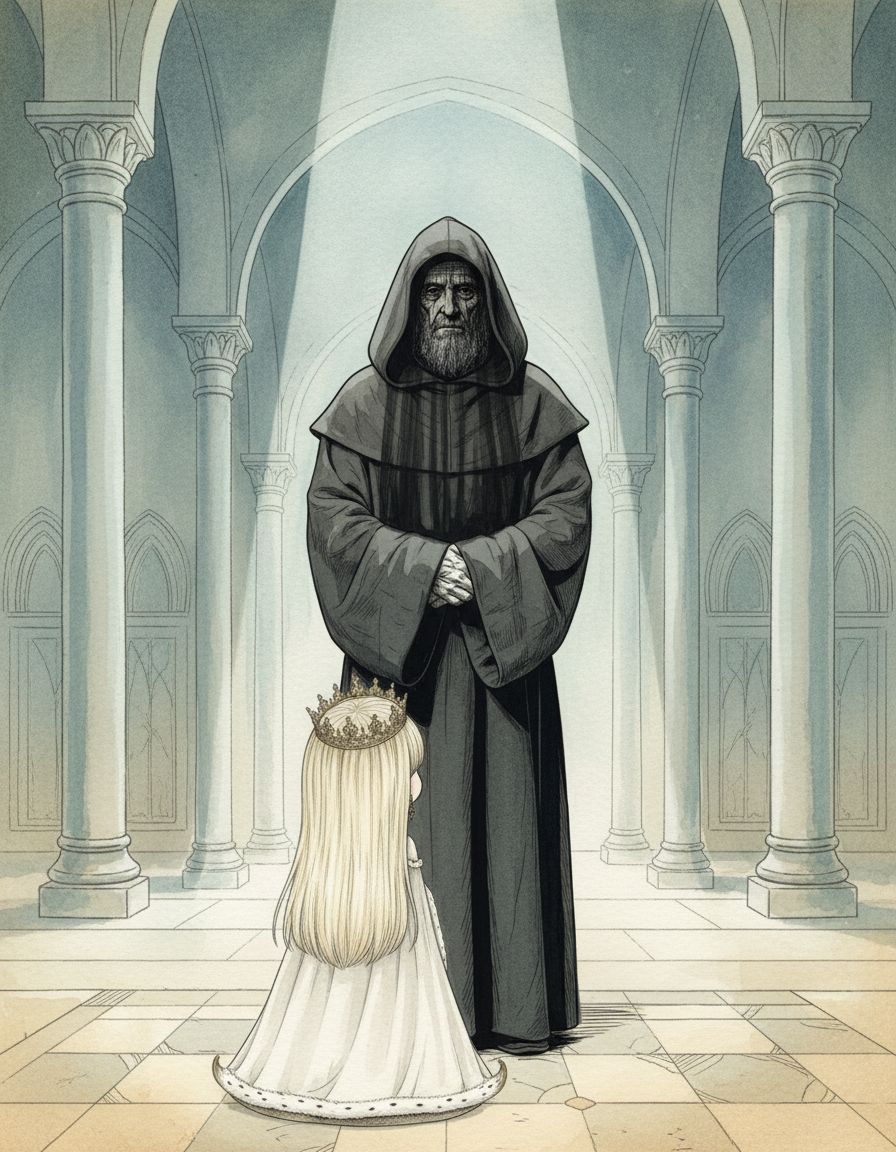
"Long ago, our ancestors let small boxes do everything, and flourished. In time the boxes turned against them, and the star destroyed itself."
— The Una and huna remembered that tapestry they had seen in the ice palace.
"Before that star perished, one alone had crossed to this one. — The ancestor of your Una folk.
"Hoping that someday her kin from the homeland would come to this star, she made this ark, and laid the seeds to sleep. And watching her daughters set out — to the ice village, to the forest, to the mountain — each by her own choosing, she lived on, all alone."
(The ancestor of huna, cuna, and suna.)
"Before she died, she left this charge: 'Seek one fit to inherit this future.' — That charge fell to me."
The Veiled Elder lowered his eyes a little.
"I am one whom she took in and raised — the child of the enemy. My father was the man who manipulated the hearts of others and sank this star into darkness. — She sealed him away. That loathsome power, I have inherited."
Behind the Una, the bored cuna flipped open her book of riddles and read out, as if to herself,
"— My child, older than I am. Who is it?"
No one answered. Only the Veiled Elder's voice went on.
"For the sake of her will, I searched, long, long, for one who was fit. And then — you fell from the sky. In the very image of that great ancestor," and he looked at the Una.
"I worked behind the scenes so that you would walk the same path as the ancestor. Some of the trials, too, I arranged — the last, the Cliff of Illusions, as well. You saw through it. I doubt no longer.
"Your companions sleeping in this ark — and your fellow traveler, made a specimen at the museum — all of them, I gathered here."
The Veiled Elder handed huna a small white box and a silver key.
"This ark, and the key to the future, are yours. Use them as you will."
Then he lowered his voice, by a single degree. So that it reached huna alone.
"— Only. To wake the sleepers and open the way home, a price is required."
"A price?"
"Someone must take on that cold in their stead. In place of all the sleepers — one warm life."
huna did not so much as blink. She gazed steadily at the Una, running happily among the companions' pillars. And then, quietly, she asked.
"…After everyone is saved. Will that do?"
The Veiled Elder gazed at huna for a long while, and then narrowed his eyes, just a little.
"— I thought you would say so."
huna told no one.
The Veiled Elder walked toward the door.
"My charge ends here."
His back looked terribly, terribly alone — the retreating figure of a child raised by the enemy, who had lived, for a long, long time, for nothing but a dead woman's will.
The Una pattered after him, took that candy from their pocket, and held it out: "Here, for you."
The Veiled Elder turned, and looked at it for a long moment. And when he took it, behind the veil, he seemed to smile, just a little.
When the door closed, his figure was already gone.
"There's no time," the Nose brought huna back to herself. That was right — what came now was the true purpose.
huna slid the silver key into the pillar where the Una slept. At once the ice vanished like smoke, and the Una inside toppled out with a plop.
"Sleepy," said the woken Una.
huna unlocked the pillars, one after another. The ship filled with a great many Unas.
And last of all, huna slid the key into the pillar where the girl exactly like herself slept.
The ice vanished, and the huna in the white pilot's suit toppled out. Queen huna caught her in her arms.
(Unbelievable.) They were so alike she could no longer tell which one was herself.
Between the two as they gazed at each other, the Una popped their face in. And to Queen huna they said, "huna, this is huna," and to the huna in the pilot's suit, too, "huna, this is huna."
"This is astonishing," said the Nose. The ship was full of a great many Unas and two hunas. cuna, uma, and the yeti were overjoyed at all the Unas, but there was no time for that.
"We must pilot this to Una's star — but is there anyone who can steer it?" said the Nose.
"I think I can," said the huna in the pilot's suit. Even her voice was exactly the same as Queen huna's.
"Please," said Queen huna.
And to the many Unas, she said this:
"We are bound for Una's star."
"Yes!" answered the great crowd of Unas.
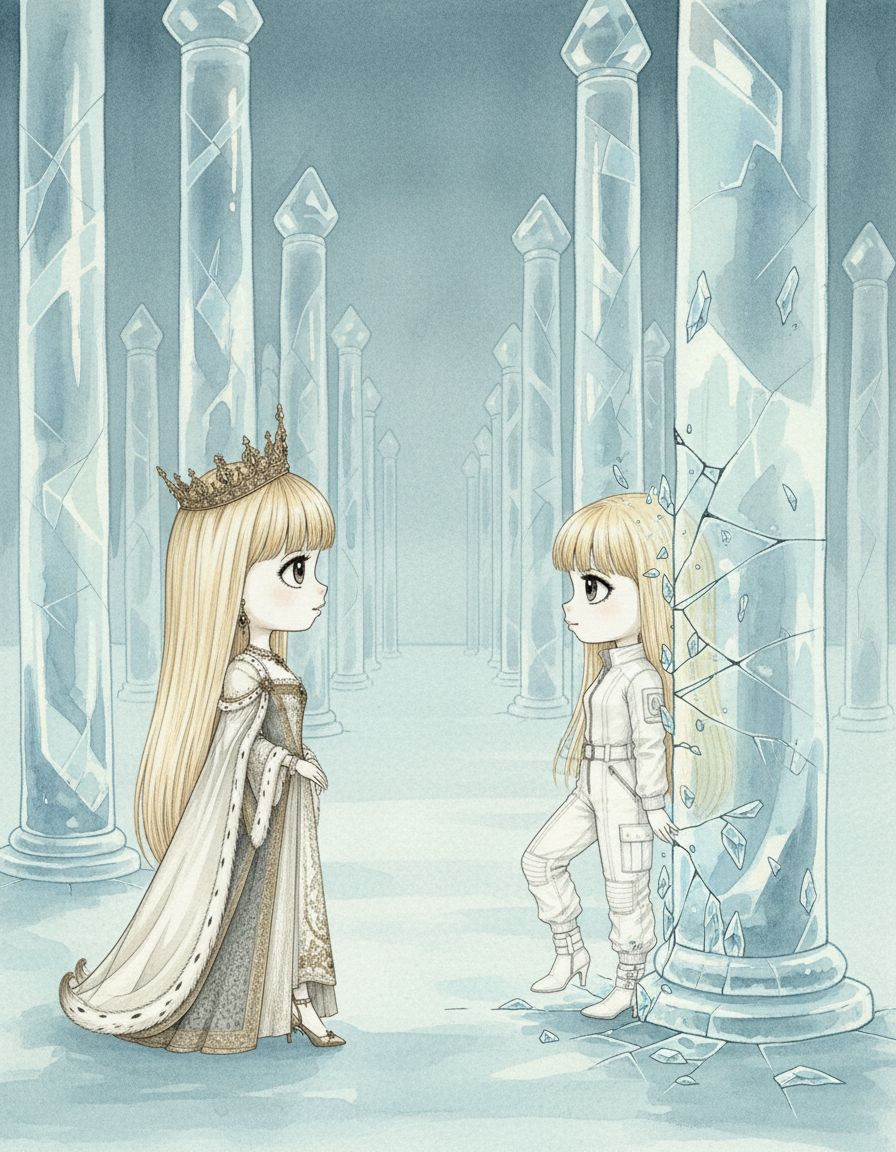
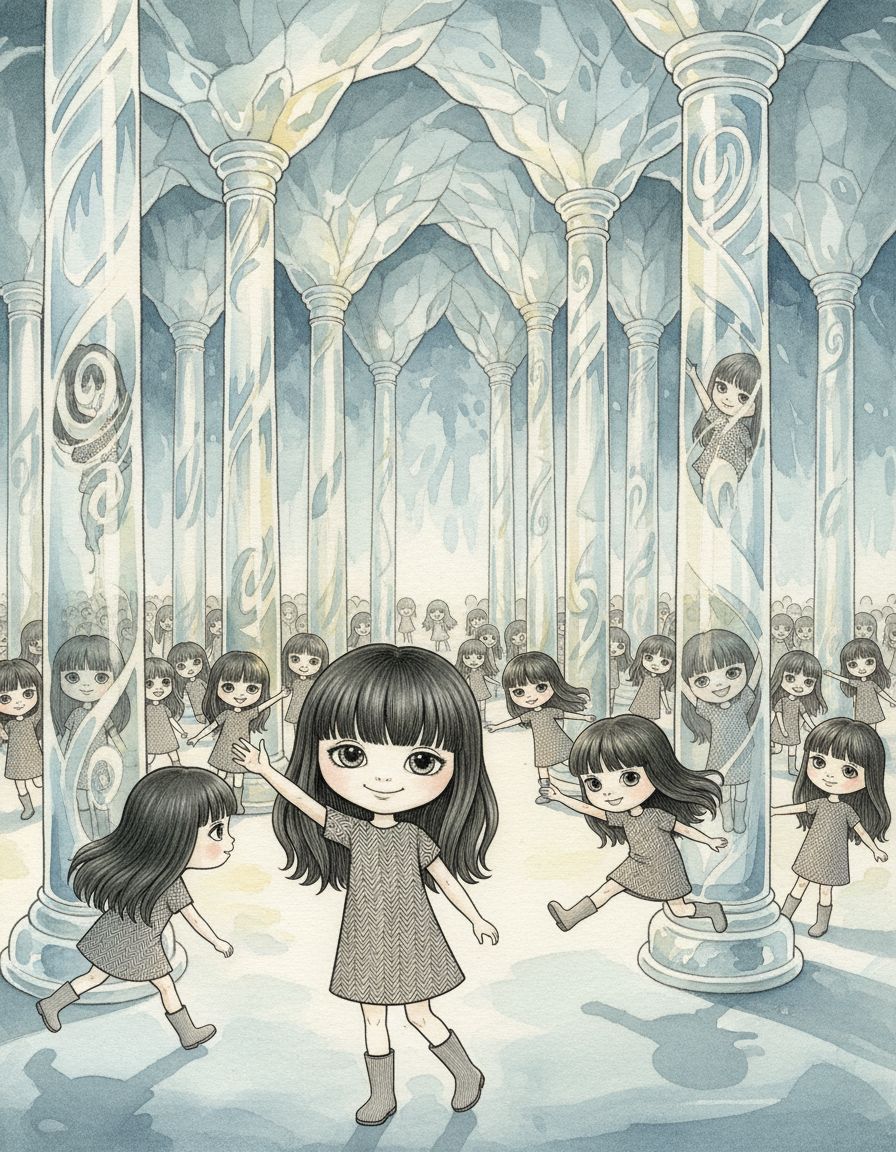
17. Back to the Old Star
The huna in the white pilot's suit took the pilot's seat. Beside her, Queen huna watched. Even without a word, their minds seemed to run together, and between the two no words seemed needed.
The huna in the pilot's suit struck the controls without the least hesitation, and in a moment the ark shot out into space.
A great many Unas walked about exploring the great ship. The one who had traveled with them could be told by their clothes, but with this many it grew confusing.
"There are so many now, so I'll call you Una," huna said, and Una grinned.
Una pressed their face to the window and looked at the strange star. The sea threw back the light, glittering. The coast ran on and on, like a deserted industrial zone. The star's drowning did not yet seem to have come so far.
Una twitched their nose, trying to catch the scent of the companions. Deep in their chest, a pounding fit to burst.
"There — they're there!"
huna's eyes, too, caught a small shadow. On the flooded land, a great many Unas waved, happy. — As if the whole world were blessing them.
At last, they had been able to come for the companions.
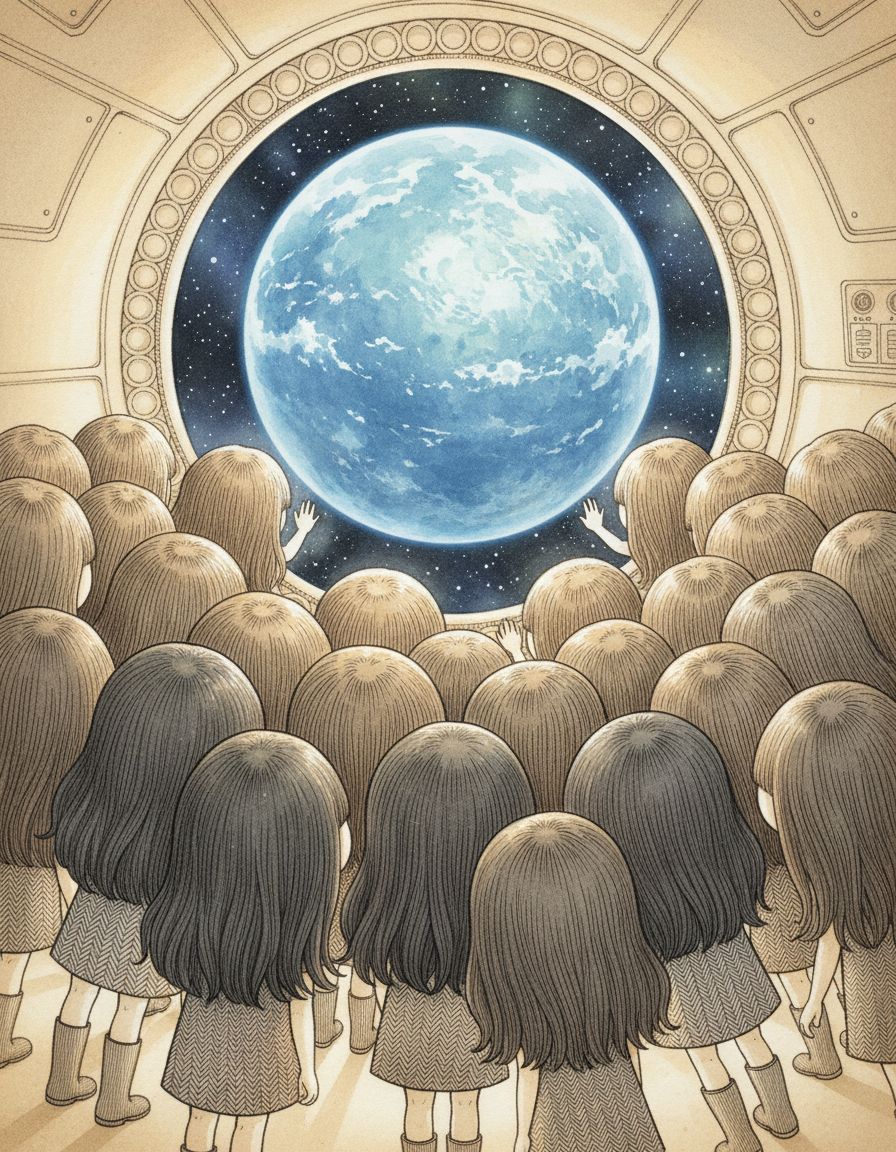
Inside the ark, a great many Unas made merry.
"Line uuup!" said Una, and the great crowd of Unas, smirking, lined up properly. cuna gave the Unas riddles and delighted in it.
The huna in the pilot's suit set their course, with flowing fingerwork, for the Ice Country. Queen huna closed her eyes, thinking of her country.
The Nose was compounding a rare white flower he had picked on Una's star. "Ten minutes to the star. Then we dive into the sea and land in the Ice Country's sea," said the huna in the pilot's suit.
The ark splashed down into the sea of the strange country, throwing up a great column of water with a zudoon. The moment it entered the sea, the Ice Country appeared on the ship's monitor. — From everywhere in the city, black smoke was rising.
To huna, watching it, uma nestled close.
"With this, ride all through the country." The Nose handed huna a bag of the white petals he had taken from Una's star. "A scent that calms the heart."
huna mounted uma and tore through the whole country at tremendous speed.
Slipping between people brawling in a park, racing past a ransacked grocery. The startled people, their hearts softened by the scent of the flowers — and then they saw the queen on horseback.
"The queen is back." — Cries of joy rang through the whole country.
From the sky, white snow poured down in plenty, and erased the black smoke.
By the time huna galloped into the castle, people from all over the country had crowded to it. Every priest, every minister, every lady-in-waiting bowed to the ground. That chatterbox lady-in-waiting wept and said, "Your Majesty, welcome home."
The priests and ministers all wore bright faces.
"Now, Your Majesty. The people are waiting," said the old priest.
huna headed for the castle wall. There, Una was waiting.
"What a huge crowd," Una said, happily.
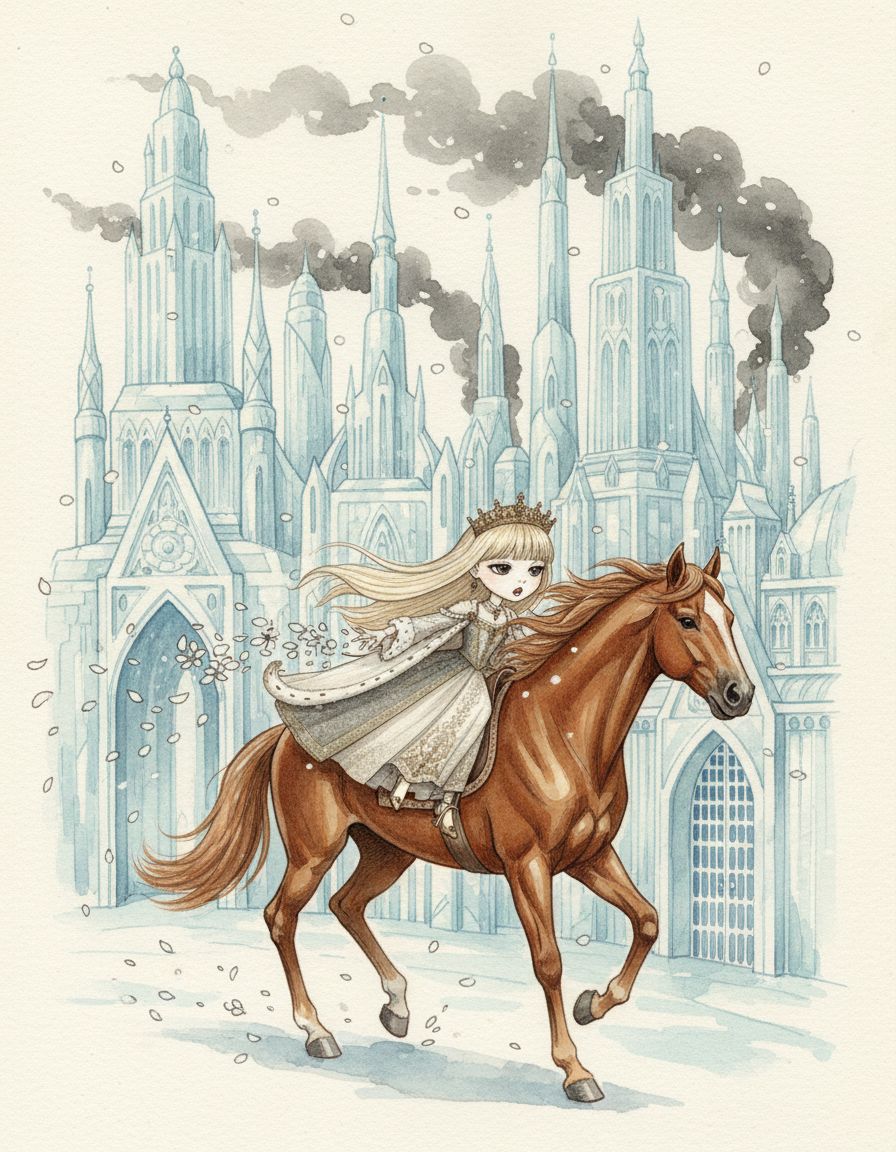
When huna showed herself on the wall, the people raised a great cheer.
"While I was away, I caused you hardship." — Great cheers, and the sound of people weeping, could be heard.
"On this journey, I learned something important," huna went on. "Alone, one is weak. I, too, nearly broke many times. — But my companions were truly strong."
The people listened, holding their breath.
"What is the person beside you there for? — For me to help the person beside me. And the person beside me is there to help me."
huna gazed steadily at Una. Tears spilled down, and, overcome, the words would not come.
Since huna did not speak, the eyes of the whole country gathered on Una.
And so Una said this:
"Una likes everyone."
— Because Una likes everyone, everyone likes Una.
huna, and cuna, and the Nose, and the yeti, and the people — everyone, glad, applauded.
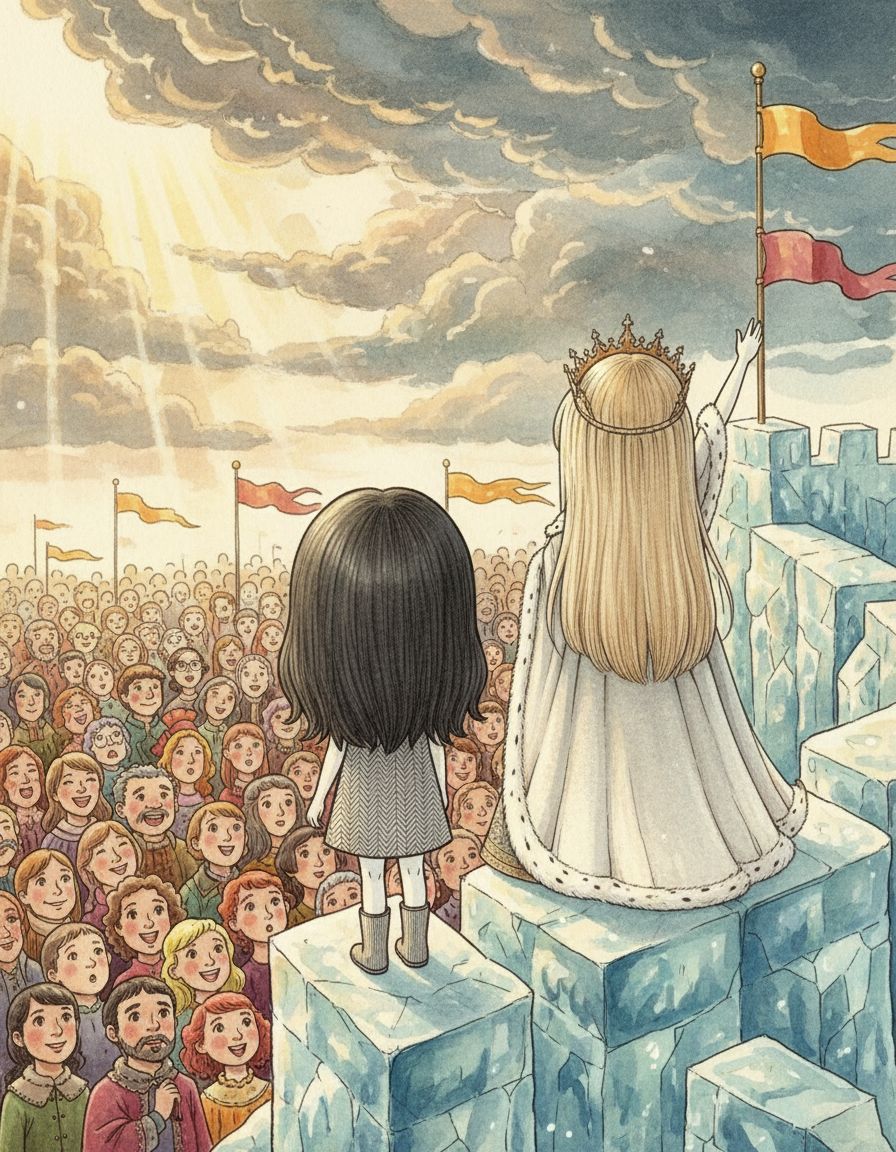
At the ice castle, celebration parties were held day after day.
cuna was given a room full of all-you-can-eat snacks and books of riddles. Once she went in, she was lost in it and would not come out. The Nose was given his own scent workshop, and an enchanting smell drifted out of it every day. Una had a special "strawberry-bread perfume" made just for them.
The creatures who had slept in the ark were unlocked one by one and returned to the places where they were born. Among them was an old master physician, who cured Mr. Nemuru's strange illness with ease. The Nemurus, quite recovered, were given charge of the castle's gardens.
Una, Queen huna, the huna in the pilot's suit, and cuna — everyone was laughing. Even when night came, it felt a waste to sleep.
Una, Queen huna, and the huna in the pilot's suit stayed together always, talking of all sorts of things, as if grudging even a moment apart.
As she talked with everyone, Queen huna felt an exhilaration and an ache that set her heart astir.
— Something is ending, and something is beginning. Outside, it was already growing light. To live is wonderful, she thought anew. There are bitter feelings, some — but still, still it is wonderful.
The world holds things this beautiful, and yet we always forget. Though I do not want to forget.
(If only I could keep this feeling — even in that small box.) Queen huna thought. Someday I may become a proud, headstrong queen. At such a time, if I could look at this feeling, surely I could take back a gentle heart.
— If only, truly, this feeling could go on and on. If only it could.
"huna," Una called.
Queen huna and the huna in the pilot's suit turned at the same moment.
"Will we be together from now on, too?" Una asked. — Their way of speaking had grown quite natural.
"Of course." — Only the huna in the pilot's suit answered.
Queen huna, who had meant to answer "Of course" at the same instant, found that no voice would come.
— Now, at last, the time had come for that promise she had chosen herself to be fulfilled.
Queen huna's knees buckled, and she toppled backward. The crown rolled from her head onto the carpet.
"huna, huna!" Una called, desperately. But huna's body grew colder and colder. The cold that huna had taken on from the sleepers — now it was coming back.
"I'll go get a doctor!" The huna in the pilot's suit flew out of the bedchamber.
Gripping huna's hand, Una said,
"Una can write, too."
At that, Queen huna faintly nodded. — That was the last.
"I can cook now, too," they said.
"I can do greetings now, too," they said. But she no longer answered.
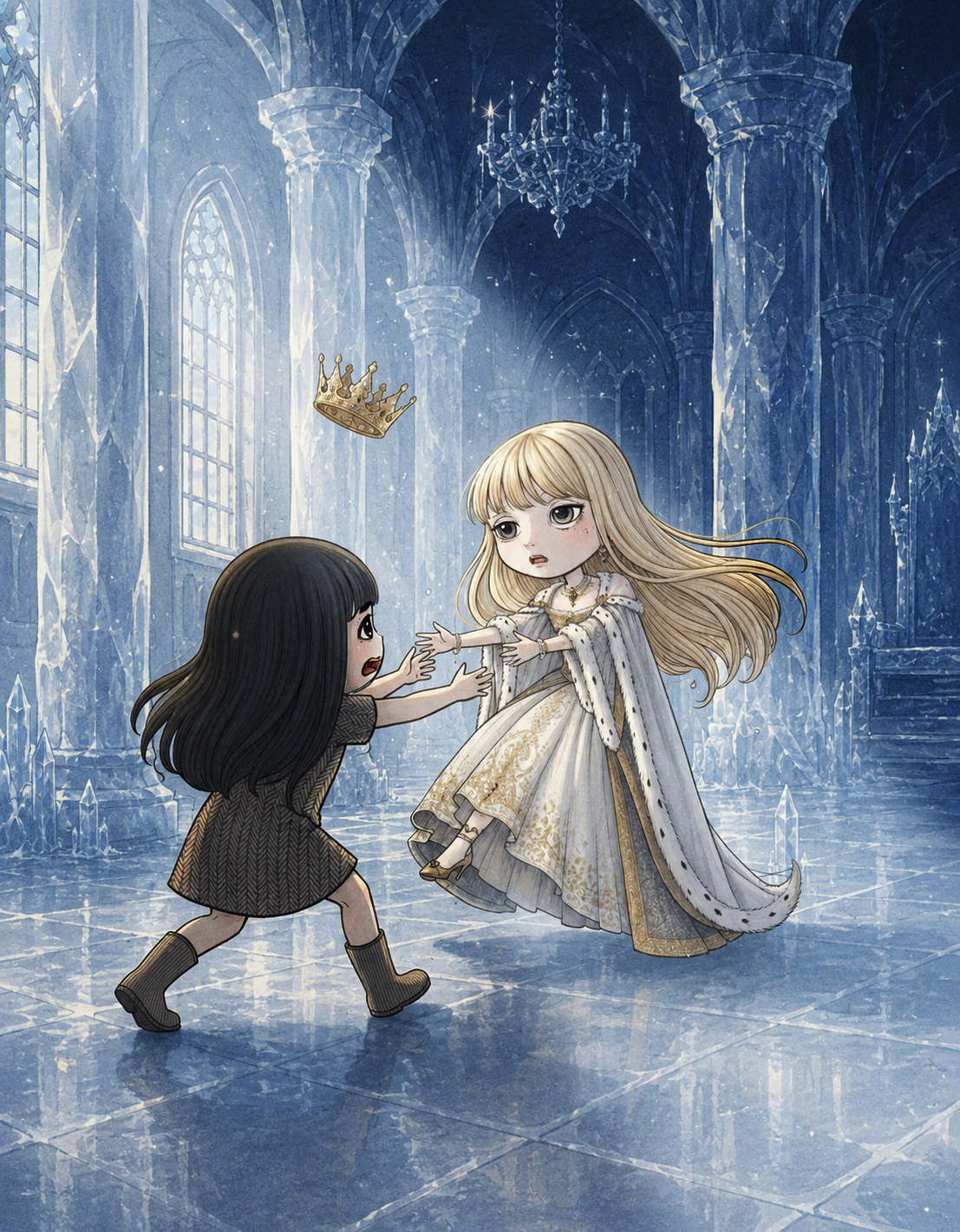
At so sudden a death, the priests fell into confusion. The country had only just turned toward rebuilding. If it became known that the queen had died here, what would become of it?
After an emergency discussion, the priests asked the huna in the pilot's suit to stand in for the queen.
The huna in the pilot's suit, in shock, had become like a doll without feeling. Una held Queen huna's hand and would not let go.
Led by the hand by a lady-in-waiting, the huna in the pilot's suit came out from the back room dressed in the queen's gown, and by any measure she was Queen huna herself. The instant the priest set the crown upon her — her expression changed. As though she had become another person entirely.
And then tears began to spill, and would not stop, on and on.
Seeing those tears, Una, too, at last let go of Queen huna's hand.
Drawing a deep breath, the huna in the pilot's suit spoke. Her tone was Queen huna herself.
"I have a request of you. I cannot explain why — but I need you, no matter what, to go there."
Una, weeping, nodded.
The priests broke out in gooseflesh. They even wondered whether, perhaps, the one who had died was the impostor.
Queen huna was laid in an ice coffin and borne into one of the ark's ice pillars.
While the funeral was being held quietly at the castle — Una had already set out, far, far away, on a journey. To a place not even on the map, that the huna in the pilot's suit had told them of.
18. Epilogue
At the end of the road Una had walked so far, a small wooden sign stood.
《 The End of the World 》
It was a strange place. A wide meadow, with grass, trees, and flowers — and yet, no living things. Perhaps for that reason, the sound of their own footsteps and breathing rang oddly loud.
As they walked on, a little ahead, something like a pure-black shadow floated in the air. Drawing near, it was bigger than expected, and there alone nothing at all could be seen.
At a spot where it seemed they could reach out and touch it, Una happened to look down. — The shadow was spreading, little by little, and the grass that entered the shadow lost its color and crumbled away.
Trying in a panic to flee, Una found that shadows had formed all around, many of them. Each one trembled and grew, little by little. The grass and flowers they touched lost their color in an instant and crumbled. From left and right, vast wall-like shadows crept closer, and looking up, shadows fell from above too, like a waterfall.
Una looked desperately around.
— Beyond the black pillars, color could be seen. A great many butterflies were flying.
As they drew near, a tremendous wind nearly pushed them back. This wind was what repelled the black shadows. The wind of the butterflies' wingbeats.
Una closed their eyes and dove in where the butterflies were fewest. Flap, flap, flap — butterflies struck their whole body, and all around was wrapped in pure-black shadow.
Within the butterflies was a very calm place. Like the eye of a typhoon, windless and serene.
Two girls in black dresses sat there.
"Oh my," said the orange-haired one.
"A guest," said the white-haired one.
"Let us show her hospitality." "Do you like tea?" "By chance, we have exactly one cup's worth of tea and hot water." "What a coincidence. But we mustn't fail at this."
A white table and chairs. Around the two, butterflies danced, making pillars of wind and pushing the shadows away.
"Sister, a problem has arisen," said the white-haired one. "We can't tell whether we put in sugar or salt."
"How troubling. And we can hardly taste it ourselves," said the orange-haired one.
Una was dumbfounded. Above and below, right and left, all covered in pure-black shadow — and yet these girls seemed to be having a wonderful time.
Una sipped the salty tea.
"How is it?"
"Salty."
The two looked at each other. "By the way, who are you?"
"Una," they said, and the two together said, "We are DUNA."
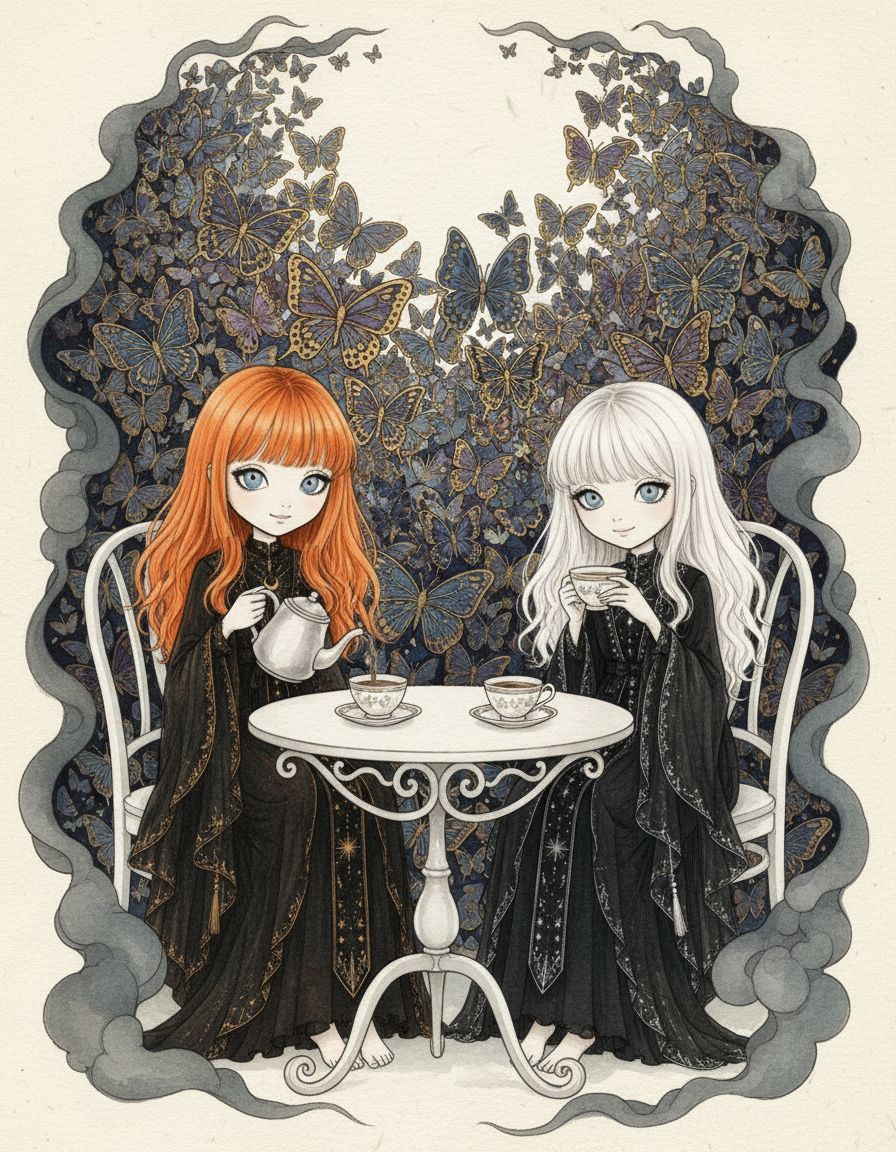
Una told them everything that had happened. It became a long, long story. The two DUNA listened — dozing, poking at each other — but listen they did. And when the two had fallen quite asleep, Una's story, too, came to an end.
The three of them slipped, just so, into sleep.
When Una lifted their face, a paradise spread before them.
A green meadow ran on without end; on a fruited tree small birds sang, and a puppy ran by the side of a lake.
Was it a dream? — but where Una lay sprawled was that white table set. The teacups, the same. Only, in the sky, a blue sky spread.
"Good morning," said the orange-haired DUNA, bringing a delicious-looking hot sandwich and soup.
"Where is this?"
"This is heaven."
"And this is hell," came the white-haired DUNA's voice from behind.
Turning, it was a fearful sight. The earth withered and dead, heavy clouds bearing down, and a blue-bodied, four-legged, bear-like creature, drooling, pacing about in irritation.
At the boundary between heaven and hell, a great many butterflies had settled. One creature, lured by the smell of the hot sandwich, drew near.
At which the orange-haired DUNA said,
"From heaven you can see hell, but from hell you cannot see heaven."
The bear-like creature stopped coming, and began to wander about.
"Some people call that a demon," said the white-haired DUNA.
Una wondered whether they had died. But looking at their hands, they felt no different than usual.
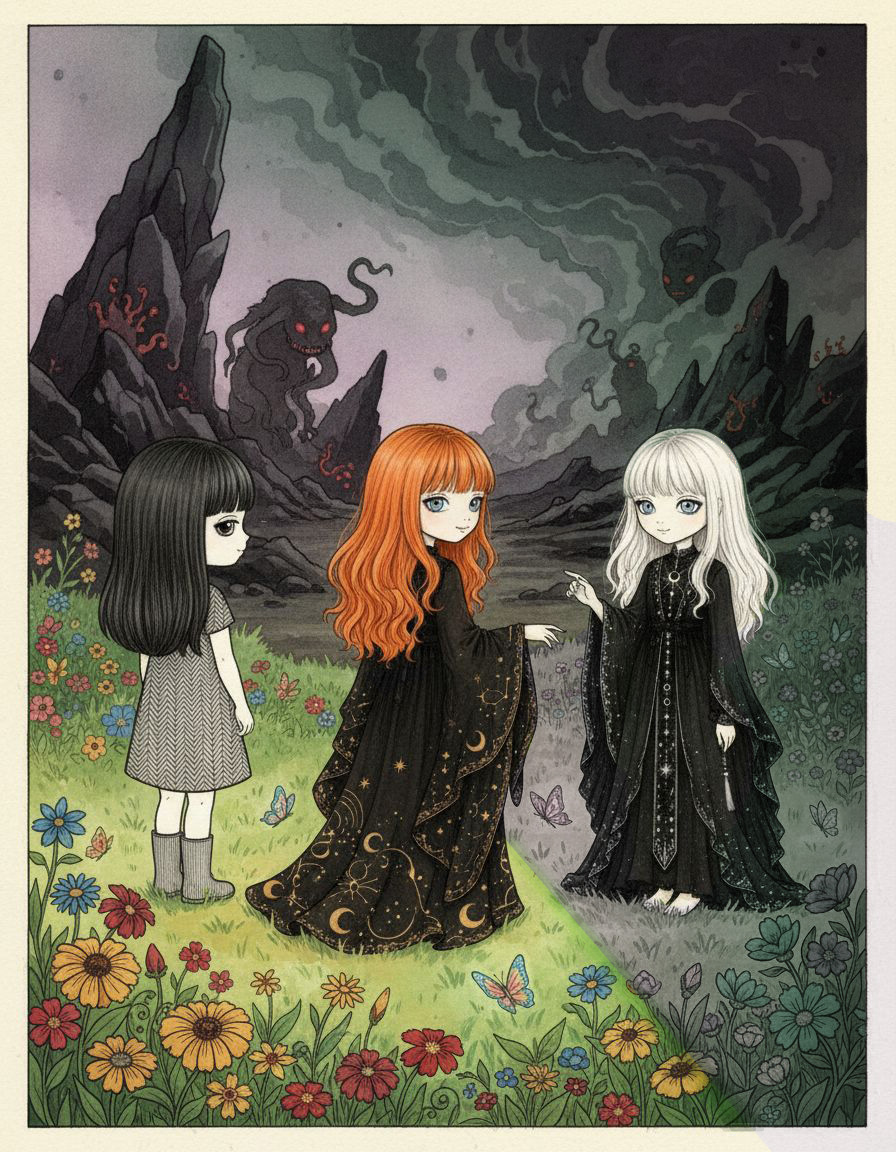
"Now then, the story was that you wanted to bring your friend, the girl, back to life — yes?" said the orange DUNA.
"You'll bring her back to life?" Una said, surprised.
"You didn't say any such thing, did you," the white DUNA whispered secretly.
"Well, it can't be helped. Did you even hear what it was about?"
"I wasn't listening. But who says, of their own accord, 'I want her brought back to life'?"
"I just supposed it was that sort of story."
"It's against the rules," said the white DUNA.
"Will my friend come back to life?" Una asked, with serious eyes.
The two made slightly troubled faces and answered, "It's a secret."
Led by the two DUNA, Una came at last to a strange place.
In the middle of a desolate, rocky waste, something like a hut made of bamboo. — Inside that great bamboo was huna.
"huna!" Una cried out loud, but she seemed not to hear at all.
"From the hell side, this side cannot be seen," said the white-haired DUNA.
"huna is in hell?"
"She offered up her own life as a promise, didn't she. Do that — and the soul is tethered to a place like this." "But this child did a great many good things. So it's a special, gentle hell," the two said, turn by turn.
"In that hut, she looks outside, sits, reads an old newspaper, looks outside again, folds clothes, reads the paper again, cleans, and reads the same paper once more." "Since there's no need to eat or sleep." "She may do anything at all. Only, she cannot get out of there."
"Help huna," Una begged.
But the two DUNA said, "We cannot help those who are in hell." "Even so, she will realize it, someday." "Until then, let us wait here."
"Someday?" Una asked uneasily.
"There's no time here, either — so we cannot say until when."
Shut in, huna tried all manner of ways to get out of the bamboo hut. She tried to widen the joints of the bamboo, and shaved at the wall, little by little, with the handle of a spoon. But strangely, whatever she did, it returned to as it had been at once.
huna looked outside. In the room was a single newspaper, of a date long past. With nothing else for it, she read it, looked outside again, folded clothes, cleaned, read the same paper again, gave a deep sigh, and slept.
When she opened her eyes in the morning, she wished that all of it had been a dream. But there she was, still, inside the bamboo.
By the time it seemed a great deal of time had passed — huna stopped reading the newspaper. She looked outside, sat, folded clothes, cleaned.
Before long she stopped folding clothes, too. More long time passed, and she stopped standing and walking. Then the room no longer grew dirty, and she stopped cleaning.
And so huna stopped everything but looking outside.
When more long time had passed, a change came to her. — She stopped looking outside.
But she began to look at something. Not the scenery outside, but the inside of her own heart.
In time, having gazed and gazed at her heart, she stopped playing the role called "huna." Deeper and deeper, endlessly, she relaxed.
(Why did I never notice this?) — When she tried erasing the thing called "self," she had been connected to the world from the very start.
At that moment, a strange thing happened. Together with the "consciousness of a self," the "bamboo" that had surrounded her vanished as well.
The place she had thought a desolate rocky waste — was a lush green meadow.
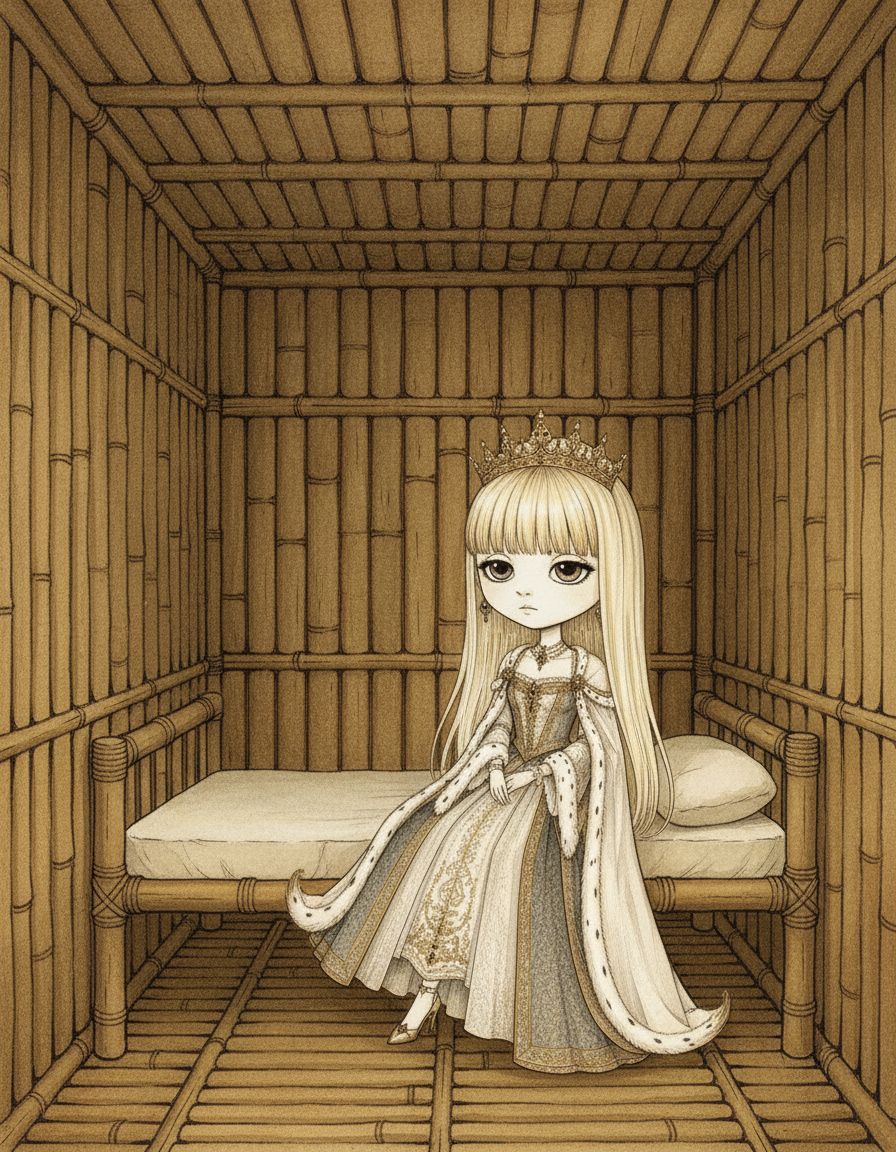
Una, who had been waiting intently for this, was asleep at the crucial moment.
"Now then. We must return this child," said the orange-haired DUNA, looking at Una.
"Yes. She seems tired, so let us put her back in the bed at the ice castle," said the white-haired DUNA.
To the freed huna, the two said:
"It seems she wants you brought back to life." "You are free." "You could go to heaven, as well."
At which huna answered, "Heaven would be the same, surely. There is nothing to do there, after all."
"But I'm glad. If I'm brought back, I can be with Una always."
The orange-haired DUNA said, troubled,
"To be brought back to life — even so, it is from a baby again."
"You don't return at once, just as you were when you died?" huna said, surprised.
"That is impossible," said the white DUNA.
"But that's…" — as huna tried to speak, the brightness grew so that she could no longer keep her eyes open.
(I am to be born again,) she felt.
"You did rather good things in your past life… so you may receive two special gifts."
"What gifts would be best?"
"Skill at piloting, and a companion — uma."
"Then let them be a first-rate skill at piloting, and uma."
"We could send you back just a little into the past." "Shall we ask her herself?"
The white-haired DUNA drew near the light — "She says she'll do it."
huna's body rose higher and higher, and before long was gone from sight.
— This was long, long before Una arrived by rocket.
That day, near the ice castle, one life was born. A very beautiful, dignified baby girl.
This child was none other than huna's reincarnation.
Strangely, when she grew up, that child came to be called "the huna in the pilot's suit." And she made a strange journey with the girl who came flying down from the sky.
In time, remembering all that had been, the huna in the pilot's suit became the rightful queen of the Ice Country — and lived, happily ever after, with her friend Una and a great many companions.
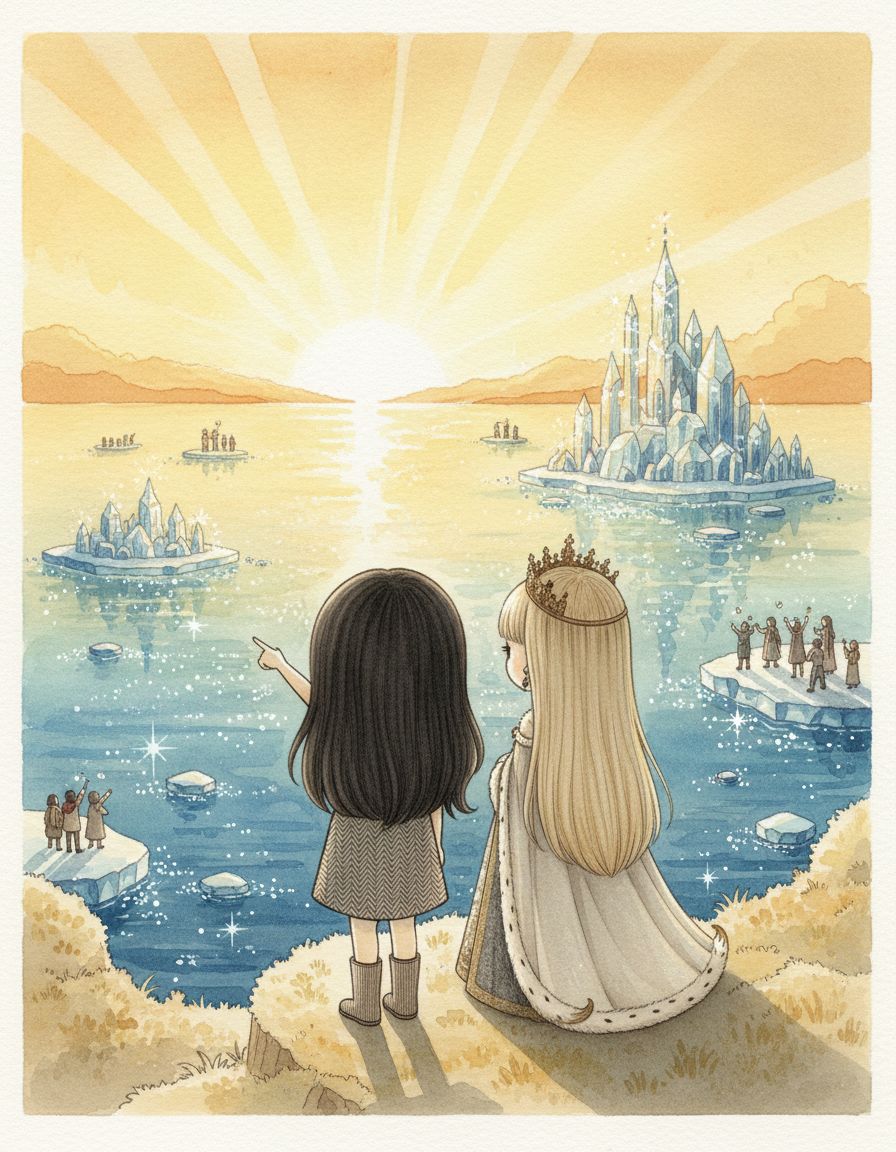
< Part One, "Una and the Wondrous Star" — End >
— Una, Queen huna, and cuna will set out again, on another journey. But that is a story for another time.
Afterword
It has already been more than twenty years since I wrote this story.
Back then, we were trying to bring a doll called Una into the world, with no money, no track record, and no connections.
We searched for a factory that could make the doll, visited factories, were turned away for lack of budget, and searched for another factory again — over and over.
Our funds were our own meager savings. And even those were swindled away from us partway through.
At the time, I took to my bed for three days, thinking everything was over — though even that, now, feels dear to me.
Looking back now,
this story — of a star sinking beneath the water, and a small Una who walks on, all alone, in search of the rocket and its companions —
was, I think, myself in those days, written down as a story.
Reading it over again, that is how it felt.
When I try to recall a little of those days —
the time for writing each story, I think, was always "just before the release day," when, frantically preparing the product, I was at the very limit of spirit and strength.
Once a new product — huna, say — was ready, I would steel myself: now I must take up the story-making I had been running from.
Why did I come to want to flee from making the stories? Because there was a conflict in it.
The way I make a story is, above all, to face the doll in front of me.
I look at huna, think, step away, and look again. Repeating that, dimly, the meaning of the product before me begins to come clear.
What had been a doll made in a factory has, before I know it, become a "something" that properly exists.
This huna lived in such a place, in such a way, and went away in such a way — that is the sort of thing I fit into the story.
Until it comes into view it is painful, but the moment it grows clear is a true joy — the moment that lets me feel the delight of creating.
And yet.
I cannot simply turn the things I have received into a story as they are.
These are dolls made by one person carrying debt. The fundamental premise is that they must sell out.
For instance, even if I feel that huna has a slightly cunning side, and suna is more of a cynic —
were I to make that the character's nature as it is, and then they stopped selling —
I would no longer be able to repay the bank.
I would no longer be able to pay the factory, nor the sewing shop, nor the costs of import and customs.
Thanks to the first Una selling out, we had become a small company — but fail once, and it is over.
Feeling that keenly, day after day, I did not have the courage to write a tale of meanness or cynicism into what was, in effect, a product introduction.
And so every character came to behave like a model pupil, and, feeling that impure motives had crept into the work,
making the stories grew more and more of a burden.
For some time now, I have now and then received emails saying they loved Una's story and wished I would post it again.
I, too — a good while having passed since the sale — felt a wish to set the slightly mean suna, and the somewhat odd cuna and huna, that I could not write back then, into their rightful places.
But there was another problem, and I kept putting off making the story public.
It was a problem I had had from the very start, too: that I could not draw the story's illustrations the way I pictured them.
Someday, when I have the time, I'll take the pictures in hand properly. Thinking so, nearly twenty years went by.
At this rate, I thought, even twenty years on, Una's story would probably never be finished — and so, it pains me to say, I have used generative AI to complete the artwork.
I draw the base characters myself, have the AI render them clean, combine them with backgrounds, and so make the illustrations.
I agonized over whether to use AI in the heart of the creative work, but I made my peace with it — that my role, for now, is first to put this story back into the world — and so left it in its present form.
As you know, it is all but impossible to make an image exactly as you picture it with AI.
There are some odd illustrations among them, but I would be grateful for your forbearance this time.
In finishing this story, I read the whole of it through for the first time in a long while.
The ending, especially, I had quite forgotten myself —
and that I was able to close it on hope is, I feel anew, because there are those who love Una.
My role, I believe, is to add, just a little at a time, to the windows that open onto this world of Una.
I would be glad if you would go on watching over Una.
June 4, 2026 moof